
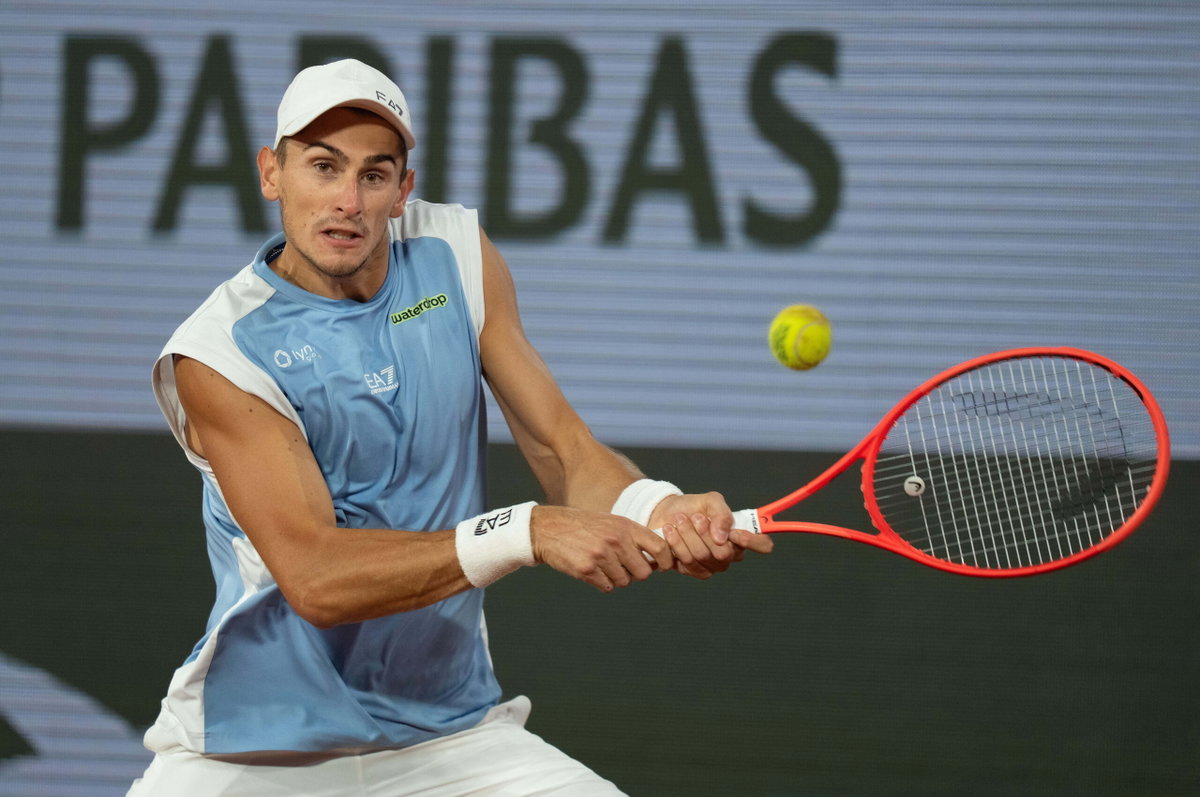
Upsets already defined the French Open 2026. Jannik Sinner is gone in the second round. Novak Djokovic was eliminated in the third. Carlos Alcaraz missed due to injury. The semi-final between two Italians was the perfect, fitting end to a fortnight that changed all expectations, especially for a match destined to be the first Grand Slam title for an Italian in the men’s draw. 20 minutes before the start, it was canceled altogether.
Watch What’s Trending Now!
The 25-year-old, who had one of the best career performances ever at Roland Garros, pulled out of his first Grand Slam semi-final due to a viral illness. Flavio Cobolli advanced to the final by walkover. Italian tennis was guaranteed a presence in Sunday’s championship, just not the way anyone had imagined.
Why Did Matteo Arnaldi Withdraw from the Roland Garros Semi-Final?
Unfortunately, the story of what happened was told with tears in Arnaldi’s eyes. After dinner the previous evening, his discomfort had progressed to vomiting, loss of sleep, fever, and returning to the bathroom every time he tried a bite or sip of anything. A doctor was called to his hotel room. The medication worked for a little while, but as the match was drawing near, Arnaldi was barely capable of standing.
“Last night I started to feel not very well,” he said in the press conference following his withdrawal. “Yesterday I was feeling OK. I came here to practise, I did everything I had to do. I was feeling fine. I had dinner. I started to feel so-so with my stomach. I woke up at 1 a.m. and I started vomiting. Then at 6, 7 a.m. I vomited again. This time it was pretty bad. We called the doctor in the room. Throughout the day, I couldn’t eat. Every time I ate something or would drink, I would go back to the bathroom.”
He held out until the last possible moment, attempting to get ready, checking whether his body might respond. It did not.
“Every time I get up I feel dizzy and I don’t feel the best. I’m pretty sure if I eat again I’m not going to feel good. To have to withdraw from my first Slam semifinal is not something you wish to anybody,” Arnaldi stated.
When pressed on whether it was food poisoning or illness, Arnaldi pointed to the chills and fever as evidence of a virus rather than something he had eaten.
“I had a fever too during the day. I can’t move, I can’t eat, I can’t drink. There was no way I would be able to play. I feel sorry for all the fans,” he added.
The cruelty of the timing was compounded by what Arnaldi had physically invested to get there. In the five rounds he had played at the tournament, he had accumulated 19 hours and 42 minutes on the court, the most since the ATP started tracking match times in 1991. He played through late nights, five-set marathons, and he was not beaten by a competitor, but by a virus that arrived 24 hours too early.
How Did Matteo Arnaldi and Flavio Cobolli Reach This Historic Roland Garros Moment?
Grit is the key component of Arnaldi’s run. The 25-year-old was ranked 104th in the world when he entered the tournament and had not made the quarter-finals of a Grand Slam tournament. He progressed slowly, and then it was dramatic. His route included wins over Stefanos Tsitsipas and Frances Tiafoe, the latter a five-set marathon that ran past 1 a.m. Paris time and lasted over five hours. In the quarter-final, he advanced when compatriot Matteo Berrettini was forced to retire with a hip injury, preserving what little energy remained in his legs for a semi-final that never came.
The all-Italian semi-final was only the third time two Italian men had reached the last four at a major, after Nicola Pietrangeli and Orlando Sirola at Roland Garros in 1960 and Jannik Sinner and Lorenzo Musetti in Paris in 2025. For Arnaldi and Cobolli, club teammates and compatriots who know each other well, it represented the pinnacle of Italian tennis’s new generation arriving simultaneously on the biggest stage.
In terms of the physical toll, Cobolli’s journey couldn’t have been any more different. The 24-year-old from Rome, seeded 10th, beat Andrea Pellegrino, Yibing Wu, and Learner Tien in the opening three rounds in straight sets, conserving energy methodically while the rest of the draw wore itself down. He then beat Zachary Svajda in four sets before producing arguably his best performance of the fortnight — defeating fourth seed Felix Auger-Aliassime 4-6, 6-4, 6-4, 6-4 in the quarter-final, denying eight of 11 break points in the process. It also earned his entry into the ATP top 10, an achievement that came before he had even played a single Grand Slam semi-final.
What Does Arnaldi’s Withdrawal Mean for Flavio Cobolli and the Roland Garros Final?
Cobolli found out about the withdrawal roughly an hour before the match was due to start. His reaction was a mix of emotions that he did not attempt to conceal.
“When it came to me almost one hour ago, I almost cried. It’s something that you don’t expect at all,” he said at the joint press conference with Arnaldi. “I was ready to play this match and when it came, I was completely sad for him. But at the same time, of course I’m really happy for the result I’ve received this week. My dad also came to me right before him and we had a big hug together with the whole team for achieving the top 10. I’m sad and happy at the same time.”
He was generous about Arnaldi in the same breath. “Matteo is a big inspiration for all of us. He’s an amazing player, and outside the court I think he’s one of the best for how he does things: the preparation, the focus, the cool-down. He’s the best person outside the court.”
Cobolli will now face second seed Alexander Zverev in Sunday’s final. The two have met four times previously, with Zverev leading 3-1, including a 6-2, 7-6, 6-1 victory over Cobolli at Roland Garros in the third round a year ago. Cobolli comes into the final round with his best season yet, having captured his first hard-court title, the Mexican Open, and the third ATP Tour title of his career this year. A win over Zverev on Sunday would vault him into the top five in the world and, more significantly, make him a first-time Grand Slam champion in a tournament that has been crying out for one all fortnight.
For Arnaldi, the question of whether an opportunity like this comes again hangs in the air. It was the most open men’s Grand Slam draw in years – without Sinner, Djokovic, and Alcaraz. He reached the semi-final ranked 104th in the world, playing through nearly 20 hours of tennis across five rounds. He will leave Paris ranked inside the top 35. No one knows if Matteo Arnaldi will ever walk into a draw this wide open again, and even if he doesn’t, can he still make it?