
Imago
251004 — BEIJING, Oct. 4, 2025 — Amanda Anisimova reacts during the women s singles semifinal match between Coco Gauff of the United States and Amanda Anisimova of the United States at 2025 China Open tennis tournament in Beijing, China, Oct. 4, 2025. SPCHINA-BEIJING-TENNIS-CHINA OPEN-WOMEN S SINGLES-SEMIFINAL CN NaxYuqi PUBLICATIONxNOTxINxCHN
Imago
251004 — BEIJING, Oct. 4, 2025 — Amanda Anisimova reacts during the women s singles semifinal match between Coco Gauff of the United States and Amanda Anisimova of the United States at 2025 China Open tennis tournament in Beijing, China, Oct. 4, 2025. SPCHINA-BEIJING-TENNIS-CHINA OPEN-WOMEN S SINGLES-SEMIFINAL CN NaxYuqi PUBLICATIONxNOTxINxCHN
On April 26, 2023, Amanda Anisimova’s Madrid Open loss to Arantxa Rus marked her fourth straight defeat, leaving her winless since February and at 3–8 for the season. Days later, the 2017 US Open girls’ singles champion stepped away to protect her mental well-being. She returned in early 2024, and by late 2025, the 24-year-old had surged to world No. 4, reached two Grand Slam finals. Now, with clear momentum and strong justification, 2026 appears set up as a genuine breakthrough year in her long-awaited pursuit of a Grand Slam title.


Mental resilience remains the cornerstone behind Anisimova’s continued success
Watch What’s Trending Now!
Amanda Anisimova returned to the tour in 2024 after her break from tennis. The comeback was not instant. It took several months for her game and confidence to settle again at the highest level.
By May, she worked her way back into the top 200. Progress followed steadily. In August, she reached the final of the Canadian Open, a result that lifted her into the top 100 and pushed her ranking to world No. 49.
That run marked a turning point. She began entering bigger tournaments again and started collecting wins consistently. By the end of the 2024 season, she had climbed to No. 36, quietly re-establishing herself on the tour.
Imago
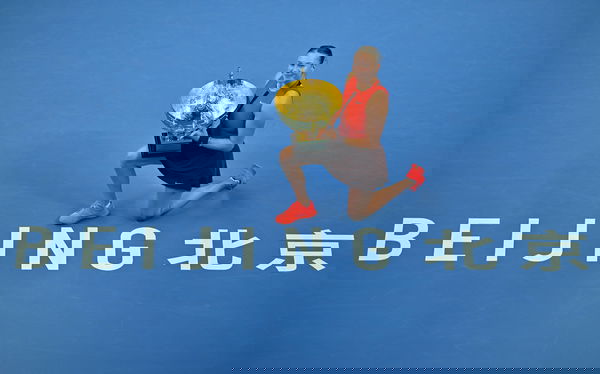
251005 — BEIJING, Oct. 5, 2025 — Amanda Anisimova reacts during the awarding ceremony after the women s singles final match between Amanda Anisimova of the United States and Linda Noskova of the Czech Republic at 2025 China Open tennis tournament in Beijing, China, Oct. 5, 2025. SPCHINA-BEIJING-TENNIS-CHINA OPEN-WOMEN S SINGLES-FINAL CN HuxJingwen PUBLICATIONxNOTxINxCHN
Few, however, predicted what would come next. Early in 2025, Anisimova made a dramatic leap forward. “I already won my first 1000 in February… bringing a really high level. That’s the biggest thing that I’ve done to grow as a player.”
Throughout the season, she delivered elite results. She won two WTA 1000 titles in Doha and Beijing. She also reached the finals of Wimbledon and the US Open, proving her ability across different surfaces.
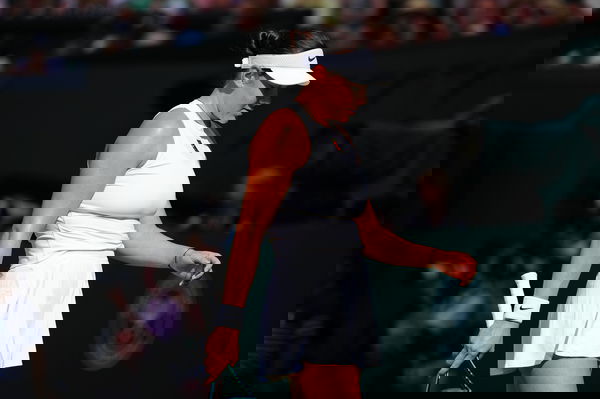
Wimbledon marked her first Grand Slam final. Along the way, she defeated world No. 1 Aryna Sabalenka. In the final, though, she ran into Iga Swiatek and suffered a brutal 0-6, 0-6 defeat.
Redemption came quickly. At the US Open, Anisimova eliminated Swiatek, flipping the narrative. “I told myself it’s a new day and a new match… I kept telling myself to focus on that,” the world No. 4 said.
She recalled an unexpected moment before that match. “And then I had gotten to the gym to warm up for my match, and they were just like, playing the replay [of the Wimbledon final], but I didn’t look.” She added, “I think that actually fueled me a little bit. I was like, O.K., we got this.”
That mindset carried her through the season. She handled pressure with composure at the WTA Finals, beating Madison Keys and earning another win over Swiatek. “What if I never came back and just called it quits? I didn’t like the thought of that… I still had so many things I wanted to achieve in my career.”
Anisimova said retirement was never truly an option. “I knew I was going to have to work my ass off, but I was ready to do it. I just needed that time to reset,” she said. Reflecting on her break, she added, “Yeah, I think it was the best decision ever.”
With that mental resilience, her rise speaks loudly. From re-entering the top 200 to reaching back-to-back Grand Slam finals on different surfaces, a major title now feels firmly within reach.
Explosive power off her racket
One shot has clearly stood out in Amanda Anisimova’s rise. Her backhand has become her defining weapon. It is not just powerful within the women’s field. It has matched and even surpassed numbers seen in the men’s game.
Anisimova averaged 124 km/h on her backhand. That figure was higher than Jannik Sinner’s 122 km/h and Carlos Alcaraz’s 119 km/h. Those numbers immediately caught attention across the sport.
In men’s tennis, raw pace is often absorbed. Players cover the court at extreme speeds. Long rallies and elite defense can neutralize even the fastest shots.
The women’s game works differently. Flat hitting and taking time away can shift matches quickly. Speed through the court matters more than sustained exchanges.
Imago
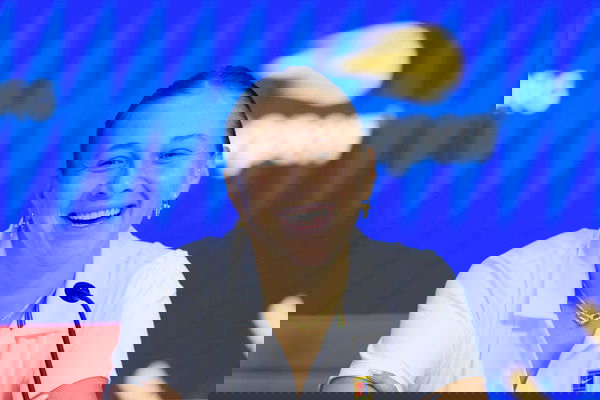
September 5, 2025, Flushing Meadows, New York, USA: Amanda Anisimova attends a press conference, PK, Pressekonferenz after winning her semifinal match against Naomi Osaka on Day 12 of the 2025 US Open at USTA Billie Jean King National Tennis Center on Friday September 5, 2025 in the Flushing neighborhood of the Queens borough of New York City. JAVIER ROJAS/PI Flushing Meadows USA – ZUMAp124 20250905_zaa_p124_028 Copyright: xJavierxRojasx
That difference explains the value of Anisimova’s backhand. It is a shot designed to steal time. It forces opponents into rushed decisions and defensive positions.
Patrick Mouratoglou highlighted this strength. Comparing her backhand to Sinner and Alcaraz, he said, “I’m not surprised when it comes to her backhand. It’s a shot she trusts a million percent. She goes full, and she doesn’t apply spin. The ball is very low over the net, travels faster because there is no spin. So there is less security, more risk, more pace.”
The risk is obvious, but so is the reward. In the men’s game, movement and consistency often reduce the impact of speed. In the women’s game, early aggression can open the court immediately.
Mouratoglou believes this style suits the WTA. “Yes, there are women that hit shots faster than Alcaraz and Sinner, even though it’s difficult to believe, but with a much higher percentage of risk,” he said.
He also explained why it works. “And it’s not a bad idea when it comes to women’s tennis because men move incredibly fast. So to open the court fast in the women’s game early in the rally is often a very good tactic.”
Anisimova’s US Open run reflected this approach. She attacked relentlessly and trusted her shot-making. Opponents struggled to keep up with the pace she generated.
Her progress over one year makes it more impressive. In 2024, she failed to qualify for Wimbledon. Twelve months later, she reached the final. With that backhand, a Grand Slam title now feels close.
Consistency will be the defining factor in Amanda Anisimova’s pursuit of a Grand Slam title
Amanda Anisimova’s breakthrough season truly began in February. She captured her first WTA 1000 title in Doha and immediately signaled a shift in her career. From that moment, her level rose sharply and forced the tennis world to pay close attention.
Her Wimbledon run became a defining chapter. Anisimova stunned world No. 1 Aryna Sabalenka in the semifinals. She had beaten Sabalenka before, but never on Centre Court and not while Sabalenka stood as the sport’s dominant Grand Slam force.
That victory carried added weight. Six years after reaching her first Grand Slam semifinal, Anisimova finally pushed beyond that barrier. That momentum continued in New York as she took revenge over world No. 2 Iga Swiatek at the US Open. Soon after, she dominated world No. 3 Coco Gauff with a 6-1, 6-2 victory on her way to the Beijing title.
Imago
Amanda Anisimova dejected during the Ladies Singles Final Wimbledon Tennis Championships, Day 13, The All England Lawn Tennis and Croquet Club, London, UK – 12 Jul 2025London The All England Lawn Tennis and United Kingdom PUBLICATIONxINxGERxSUIxAUTxHUNxGRExMLTxCYPxROUxBULxUAExKSAxCHNxDENxINDxITAxPORxESPxSWExTURxMEXxCOLxVENxPERxECUxBRAxARGxCHIxURUxPARxPANxONLY Copyright: xJavierxGarcia/Shutterstockx 15392293bh
By season’s end, her résumé stood alone. At the WTA Finals, she defeated Australian Open champion Madison Keys. That result made her the only player in 2025 to beat all four Grand Slam champions of the year.
The numbers backed it up. Anisimova finished with 47 match wins, the highest total of her career. She also posted a strong 10-5 record against top-10 opponents, proving her consistency at the elite level.
Those results built confidence heading into 2026. Melbourne now looms large as she targets a third straight Grand Slam final. “It’s been a surreal year for me,” Anisimova said in a late-season interview with New York Post Sports.
She reflected on the journey. “I think a lot of highs, a lot of achievements that I wasn’t sure I’d be able to achieve, at least not this year,” she said. “I’m just really looking forward to next year.”
Her rise did not happen overnight. In 2017, at just 16, she made her Grand Slam main-draw debut at Roland Garros with a wildcard. Two years later, she reached the Australian Open fourth round and the French Open semifinals.
At Roland Garros, she pushed through to the final four before losing to eventual champion Ashleigh Barty. By 18, she had already played two finals, won her first title in Colombia, and finished inside the top 25.
Still, challenges followed. Injuries and uneven results marked early 2023. At only 22, she chose to step away from the tour for nine months to reset both physically and mentally. That pause reshaped her career. In 2025, consistency became her defining strength. She highlighted this in a recent interview with Jon Wertheim of Sports Illustrated.
“I think my consistency,” Anisimova said. “That was so huge for me, because in the past, that’s something I really struggled with—backing those results and showing up week after week.”
Now she looks ahead. Anisimova is confirmed for the Brisbane International, beginning January 4. With Sabalenka, Rybakina, and Keys also entered, the test will be fierce.
But with her current form, many believe a Grand Slam title may finally arrive in 2026.
Written by

Edited by

Janainah Fazlin Anam