
Reuters
Paris 2024 Olympics – Tennis – Mixed Doubles Quarterfinals – Roland-Garros Stadium, Paris, France – July 31, 2024. Coco Gauff of United States and Taylor Fritz of United States during their match against Gabriela Dabrowski of Canada and Felix Auger-Aliassime of Canada. REUTERS/Violeta Santos Moura
Reuters
Paris 2024 Olympics – Tennis – Mixed Doubles Quarterfinals – Roland-Garros Stadium, Paris, France – July 31, 2024. Coco Gauff of United States and Taylor Fritz of United States during their match against Gabriela Dabrowski of Canada and Felix Auger-Aliassime of Canada. REUTERS/Violeta Santos Moura
Team USA has kept their United Cup title defense alive, topping their group with a win over Spain. Coco Gauff suffered a shock three-set loss to Jessica Bouzas Maneiro, but Taylor Fritz steadied the ship, defeating Jaume Munar in a marathon clash. Gauff redeemed herself in mixed doubles with Christian Harrison, winning 7-6(5), 6-0. Yet concerns have emerged over the tournament balls, which sparked controversy and disrupted play for the Americans.
Watch What’s Trending Now!
American ace Taylor Fritz has once again brought attention to a growing concern within professional tennis. This time, his focus is firmly on the quality of tennis balls and the way they are influencing modern match play. His remarks came during the United Cup and quickly resonated across the tennis community.
Speaking during his post-match press conference yesterday, Fritz explained his perspective clearly. “To me, honestly, and most players that I’ve talked to agree with me on this, I don’t think they’ve slowed down the courts that much over the years. I just think the balls are so much slower,” he said.
Top Stories





He expanded on that point by highlighting how ball construction has changed. Fritz said the balls feel softer than before. As a result, they lose speed more quickly when they strike the court.

Imago
Netto ATP, Tennis Herren finals 2025 Turino – Tennis – Atp – Netto Atp finals 2025 Turino – 11/11/2025 – Taylor Fritz -Usa Torino PUBLICATIONxNOTxINxFRAxBEL Copyright: xChryslenexCaillaudx/Pznewsx
“There’s so much just softer, so they just lose so much speed when they hit the court. Especially I feel like the quality has gone down. They get so big so much quicker, I feel. Yeah, I don’t think there should be situations like, I guess, today. Even today, it’s not a fast court, but the balls get big,” he said.
For Fritz, the issue directly impacts his aggressive style of play. He described situations where he feels powerless despite executing his shots well.
“I’m serving as hard as I can, hitting my spot, and then hitting the next five balls as hard as I possibly can corner to corner, and my opponent is just chipping and giving me nothing to work with, and you can’t put the ball away,” he added.
His frustration reflects a broader concern among players who rely on pace and precision. Slower, heavier balls allow defenders to neutralize attacks more easily. This often leads to longer rallies and fewer outright winners.
Fritz was not alone in raising these concerns. Coco Gauff, another United Cup teammate, also lent her support. When asked about Fritz’s comments, her response was brief but telling. “Yeah,” she said, signaling agreement with his assessment.
Christian Harrison reinforced the point further. “I agree with Taylor. I think it’s the balls other than the court speeds. Everyone always talks about it.” His words reflected a sentiment shared quietly among many professionals.
This is not the first time Fritz has spoken publicly about equipment concerns. The World No. 6 has developed a reputation for addressing uncomfortable topics. At the 2025 Canadian Open, he openly criticized the tennis balls used at the event.
During that tournament, Fritz said players struggled to control the ball. He explained that this forced many to play more conservatively than they would prefer. The criticism sparked debate but did not lead to immediate changes.
At the United Cup and throughout the Australian Open warm-up swing, Dunlop serves as the official ball partner. The company holds the contract through 2028. Dunlop supplies balls for the Australian Open and all lead-in events.
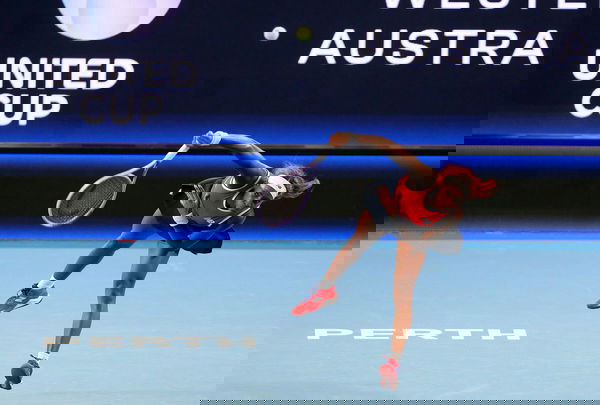
Imago
260104 — PERTH, Jan. 4, 2026 — Coco Gauff of the United States serves during the women s singles match against Solana Sierra of Argentina in the Group A round robin match between the United States and Argentina at the 2026 United Cup tennis tournament in Perth, Australia, Jan. 3, 2026. Photo by /Xinhua SPAUSTRALIA-PERTH-TENNIS-UNITED CUP-USA VS ARG ZhouxDan PUBLICATIONxNOTxINxCHN
These include the United Cup, Adelaide International, and Hobart International. Each of these tournaments uses the same brand, yet players continue to report concerns about performance and durability.
Different Grand Slam tournaments rely on different manufacturers. The French Open and US Open use balls produced by Wilson. Wimbledon maintains its long-standing relationship with Slazenger.
Each brand produces balls with distinct characteristics. Differences in bounce, speed, and durability are noticeable to professionals. Adjusting to these variations has become one of the sport’s toughest challenges.
One of the biggest demands of elite tennis is constant adaptation. Players must adjust not only to surfaces and weather but also to equipment. Ball changes can dramatically alter match dynamics from one week to the next.
Each tournament’s contract with ball manufacturers creates unique playing conditions. While variety has always existed in tennis, many players feel the differences are now more extreme.
Injuries are often linked to these rapid adjustments. New tennis balls begin with a tight layer of felt. As play continues, contact with racket strings and court surfaces causes the felt to fluff up.
Once the felt loosens, balls become less aerodynamic. They travel more slowly through the air and are harder to strike cleanly. This reduces the effectiveness of aggressive shot-making.
Fluffier balls also lead to longer rallies. Many players believe modern balls fluff up faster than they once did. This belief has gained traction across the tour.
Some of these issues can be traced back to the COVID-19 pandemic. Disruptions to production lines affected the consistency and quality of materials. Suppliers struggled to maintain uniform felt standards.
As players attempt to adjust, the sport itself is evolving. Less powerful players feel the impact most acutely. Their ability to control points diminishes when balls lose speed quickly.
Cameron Norrie has spoken openly about this challenge. He believes certain balls make it harder to impose his game style. “I think that the ball’s getting messed up easier in some tournaments,” he says.
“For players like me, it’s not easy to generate as much power as other players, and that’s cost me, or it’s easier for other players. But, to be honest, I’m never complaining about the balls,” Norrie added.
Emma Raducanu has also raised concerns. She believes ball deterioration presents both tactical and physical challenges. For her, the issue extends beyond match outcomes.
“I do think the balls are a big challenge for all of us,” says Raducanu. “The way that they deteriorate is really challenging. I think it gets very fluffy.”
She also linked the issue to injuries. “You see a lot of wrist, elbow, and shoulder injuries happening now. And it is hard because the dynamic of the points can be different from when they’re new to when they’re old,” she added.
Players who rely heavily on topspin have also noticed changes. A livelier ball once rewarded heavy spin with higher bounce. That advantage now appears reduced.
Casper Ruud, known for his spin-heavy forehand, believes opponents handle his shots better than before. “I feel like the players are handling my heavy shots like way better now than when I came on tour, which was pre-COVID,” he said.
“They’re able to just step in and rip the damn thing back, and I’m kind of surprised how well people do it,” Ruud added.
To compensate, many players have adjusted their equipment. Some incorporate natural gut strings alongside polyester strings. This combination helps generate additional power.
Others opt for looser string tension when struggling to hit through slower balls. These changes reflect how deeply ball performance influences playing styles.
On hard courts, excessive fluff does more than slow rallies. It affects timing, physical load, and injury risk. Players must work harder to produce the same results.
No player has been more outspoken on the subject than Daniil Medvedev. During last year’s French Open, he made a rare and dramatic adjustment mid-match.
Against Cameron Norrie, Medvedev requested completely different strings. He switched from a hybrid setup to full polyester. Such a change is unusual at the professional level.
“Until 2023, I had never done it,” Medvedev says. “Something started to change on tour; I had to adapt. Now I’m never sure.”
Novak Djokovic has also weighed in on the debate. He believes ball quality represents the biggest difference compared to earlier eras. “That’s probably the biggest difference I can notice, compared to maybe 10, 15 years ago,” he says. “It’s the balls.”
Before the Australian Open this year, Alexander Bublik added a visual element to the discussion. During off-season training, he shared a striking image on his Telegram account.
The image showed two Dunlop Australian Open balls. One was untouched and pristine. The other was heavily fluffed after just five minutes of slice practice.
The contrast was impossible to ignore. While the post carried Bublik’s trademark humor, the message was serious. Ball durability remains a pressing concern.
Alexander Zverev has also criticized modern balls. Last year, he said it was normal for balls to fluff up before being changed. Now, he believes the problem goes deeper.
“The air and the pressure leave the tennis ball because of the material. The material doesn’t keep it inside,” he said. He added that matches sometimes feel unnatural.
“They’re a little bit like a shuttlecock. They fly very fast through the air the first two, three metres, then they just slow down. There’s nothing that keeps the ball alive, which was very different about five, six years ago,” he said.
Zverev also linked the issue to injuries. “That’s why a lot of players now have elbow issues. A lot of players have wrist issues,” he said. “That was not the case about 10, 15 years ago.”
Casper Ruud, however, offered a different perspective. He believes switching ball brands is part of tennis’s identity. For him, variation adds intrigue.
Switching ball brands between tournaments is “the beauty of the game,” Ruud said. “It’s nice because you’ll have different winners.’”
“If you just stick to one ball, it would be in a way a bit unfair for whoever likes the Tecnifibre ball,” he added. “It will give less chances to a guy who prefers a Wilson over a Dunlop ball.”
As the season now begins, ball-related issues have once again moved into the spotlight. With Taylor Fritz and Coco Gauff raising concerns at the United Cup, the debate feels renewed.
Players across generations and playing styles are voicing similar frustrations. From veterans to rising stars, the issue cuts across the tour.
The question now lingers over professional tennis. With so many voices speaking out, what steps will the tour take to manage the problem?
