Imago
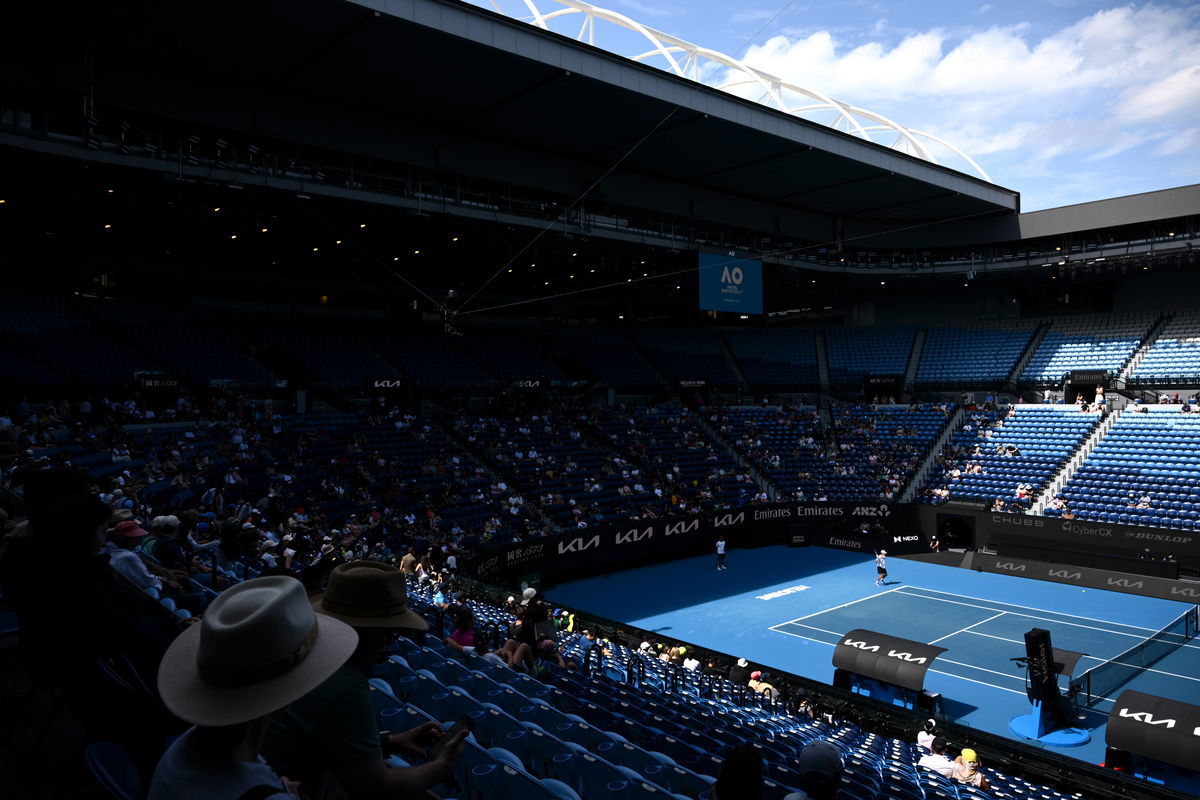
TENNIS AUSTRALIAN OPEN PRACTICE, Alex de Minaur of Australia during a practice session ahead of the Australian Open tennis tournament at Melbourne Park in Melbourne, Wednesday, January 14, 2026. NO ARCHIVING, EDITORIAL USE ONLY MELBOURNE VICTORIA AUSTRALIA PUBLICATIONxNOTxINxAUSxNZLxPNGxFIJxVANxSOLxTGA Copyright: xJOELxCARRETTx 20260114194795946210
Imago
TENNIS AUSTRALIAN OPEN PRACTICE, Alex de Minaur of Australia during a practice session ahead of the Australian Open tennis tournament at Melbourne Park in Melbourne, Wednesday, January 14, 2026. NO ARCHIVING, EDITORIAL USE ONLY MELBOURNE VICTORIA AUSTRALIA PUBLICATIONxNOTxINxAUSxNZLxPNGxFIJxVANxSOLxTGA Copyright: xJOELxCARRETTx 20260114194795946210
The Australian Open is often billed as a haven for power tennis, where big serves and first-strike aggression should reign. Yet, every year, Melbourne’s opening week tells a different story. More than any Slam, those first seven days ruthlessly expose serve-reliant players with fragile baseline plans, as heat, surface traits, match formats, and fearless opponents combine to systematically dismantle one-dimensional power.
Watch What’s Trending Now!
Extreme heat: raw power crumbles without proper recovery
Melbourne’s early rounds are often played in brutal heat. Temperatures regularly climb above 35°C and sometimes push past 40°C. In January, the heat emerges right to the forefront, becoming an opponent that players must fight as hard as the one across the net.
The Australian Open, held in the heart of summer, often turns into a severe endurance test. Players struggle to cool down between points. Fainting spells, retirements, and visible distress are not uncommon as bodies are pushed to their limits.
In January 2009, Melbourne endured three straight days above 43°C. It was a historic stretch of extreme heat. Just days after the tournament ended, on February 7, temperatures soared even higher, reaching a staggering 46.4°C.
Imago
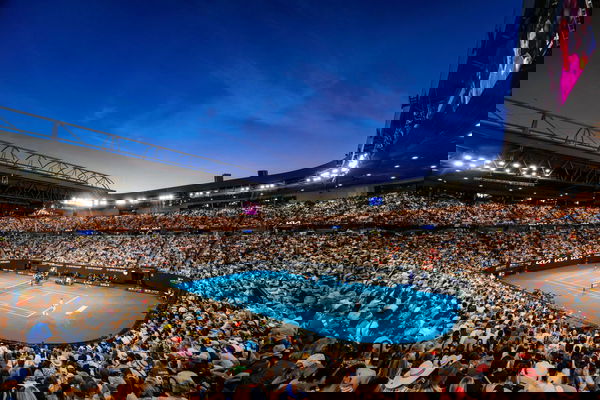
January 19, 2025: MELBOURNE, AUSTRALIA – JANUARY 19: Rod Laver Arena stadium atmosphere as Novak Djokovic of Serbia plays Jiri Lehecka of Czech Republic on day eight of the 2025 Australian Open at Melbourne Park on January 19, 2025 in Melbourne, Australia. – ZUMAp121 20250119_zsp_p121_112 Copyright: xChrisxPutnamx

A similar scenario unfolded in 2014. The conditions were so oppressive that they drew gallows humor from players. Frenchman Jo-Wilfried Tsonga summed it up memorably, saying, “With two eggs, I could make you a little omelet nice and easy for breakfast!”.
While heat affects everyone, big servers suffer the most. Their games rely on maximum effort. Explosive service motions, aggressive forehands, and short points define their success. Sustaining that intensity becomes far harder under extreme temperatures.
Heat slows neuromuscular recovery between points, not just between games. As matches stretch on, serve speeds drop. Hawk-Eye data from ATP hard-court events shows declines of 5–10 km/h. For players like Ben Shelton, Reilly Opelka, Elena Rybakina, and Madison Keys, this is decisive.
Their tennis is built to finish points quickly. When rallies extend, power turns into a burden. Big servers either win sets fast or lose them slowly. Long, grinding sets drain energy without delivering scoreboard rewards, and Melbourne exposes that weakness ruthlessly.
Fresh courts reduce pace advantage, not raw power
The Australian Open now uses a new acrylic hardcourt surface from Spanish-based manufacturer GreenSet Worldwide. It replaced the distinctive blue Plexicushion surface that had been in use since 2008. The change has subtly reshaped how the courts play, especially in the opening rounds of the tournament.
Early in the event, the bounce is high and extremely consistent. Balls sit up cleanly after the return and there’s noticeably less skid compared to later rounds, when the surface begins to wear and break down under heavy use.
These conditions favor elite returners rather than big servers. The predictable bounce makes timing easier and reduces the reward of sheer pace. According to ATP data, return points won in the first week of the Australian Open are 3–5% higher than in later rounds.
The explanation is simple. Clean bounces allow players to block back even the biggest serves. Novak Djokovic, Daniil Medvedev, and Iga Świątek excel here. They absorb pace, reset rallies, and drag big servers into exchanges they would rather avoid.
One-dimensional power is exposed from the start
Big servers with incomplete baseline structures are especially vulnerable in Melbourne. Players such as Taylor Fritz, Alexander Zverev, and Holger Rune fall into this category. They possess heavy serves and attacking intent, but their games are often built around limited rally tolerance.
These players usually depend on short exchanges. Early forehand control and measured aggression shape their success. Sustained defense is not their primary strength. In the first week, opponents stay patient. They block returns, stretch rallies, and wait for errors. When serve percentages drop, pressure builds quickly.
Imago
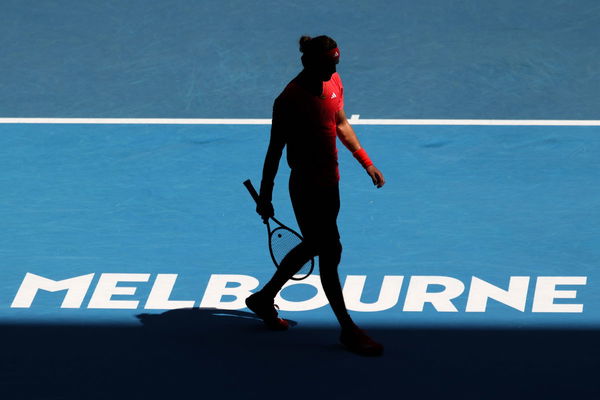
Alexander Zverev Silhouette, steht auf dem Melbourne Logo, von oben, Australian Open 2025, Melbourne Park, Melbourne, Victoria, Australia. *** Alexander Zverev silhouette, standing on the Melbourne logo, from above, Australian Open 2025, Melbourne Park, Melbourne, Victoria, Australia Copyright: xJuergenxHasenkopfx
Alexander Zverev’s Australian Open struggles reflect this pattern. His quarterfinal loss in 2021 and second-round defeat to Michael Mmoh in 2023 followed the same script. He hit many aces, but his effectiveness faded in rallies lasting longer than nine shots.
Night sessions offer relief, but not a cure
Night sessions offer some relief, but they are not a complete solution. Cooler air and slightly slower conditions help servers only marginally. Extreme heat has become common in Melbourne. The hard courts absorb and radiate heat, intensifying the furnace-like conditions players feel during the day.
Despite the introduction of night sessions starting at 7 PM, most matches are still played during the hottest hours. Day sessions remain the norm, forcing players to endure severe conditions.
What was once seen as a test of mental toughness is now under scrutiny. Night sessions bring different difficulties. Crowds are larger and louder. The atmosphere is more intense. Cooler temperatures slow the court slightly, which naturally extends rallies and increases physical demand.
For emotionally driven power players like Ben Shelton or Madison Keys, this can be risky. The energy of the night crowd lifts adrenaline levels. At the same time, volatility rises. Momentum swings faster, and emotional control becomes harder to maintain.
Statistically, tie-breaks occur more often at night. Slower conditions make breaking serve harder, pushing sets toward 6-6. The ball feels heavier and less lively, reducing easy winners. This dynamic hurts players who rely on serving through sets to protect their margins.
Best-of-five matches: when the serve falters
In best-of-five matches, it is not a question of ‘if’ a big server’s serve will dip, but ‘when’.
When that moment comes, elite opponents immediately test two things: Can you win from the baseline? Can you defend without panicking? For many big servers, the answers are inconsistent. Serve speeds drop, second serves become conservative, return games lengthen, and pressure compounds.
Some big servers do survive the early rounds, but often at a cost. Examples include Coco Gauff and Karolína Plíšková. They can win early matches in three sets, but these victories often come with high game counts, multiple tie-breaks, and long baseline exchanges.
Imago
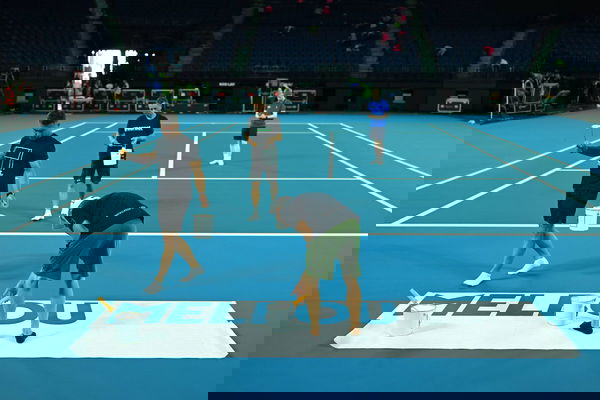
AUSTRALIAN OPEN 2026 PREVIEW, Crews complete line-marking and painting of the Melbourne sign and court at Rod Laver Arena during preparations for Australian Open 2026 at Melbourne Park in Melbourne, Victoria, Monday, December 29, 2025. NO ARCHIVING Melbourne Victoria Australia PUBLICATIONxNOTxINxAUSxNZLxPNGxFIJxVANxSOLxTGA Copyright: xJamesxRossx 20251229197753082464
By the second week, the physical toll shows. Gauff’s Australian Open runs often feature early marathons, leaving her vulnerable in later rounds despite her athleticism. Every year, at least one major server exits early.
Recent examples highlight the pattern. John Isner has fallen in the early rounds despite ace totals exceeding 25 per match. Reilly Opelka lost five-set grinders to elite returners, such as last year, when Tomáš Macháč beat him in the second round. Madison Keys has suffered shock early exits despite dominant service stats, including an 11 Australian Open appearance record of 34–10 and only last year beating Aryna Sabalenka in the final.
Karolína Plíšková, known for her powerful, flat-hitting game and strong serve, often relies on fast striking to control rallies. Yet she has been outlasted by counterpunchers despite winning more first-serve points. Serving numbers look impressive on paper, but matches are frequently lost elsewhere.
On the other hand, some big servers survive week one by evolving. Elena Rybakina has improved rally tolerance and defensive positioning. Aryna Sabalenka reduced double faults and learned to reset emotionally. Their Australian Open success reflects strategy and adaptation, not just raw power.
The Australian Open does not reject big servers. It rejects incomplete ones. In Melbourne, power is just an entry ticket. Survival demands endurance, patience, and a solid Plan B.
For big servers, the first week is not about how hard they serve. It’s about adapting when serving alone is not enough. As the first week unfolds, the game evolves, and those who cannot adapt will be eliminated.
Related Newsletters