
Imago
Image credits: imago
Imago
Image credits: imago
Aryna Sabalenka, facing Nick Kyrgios, headlines tennis as a modern “Battle of the Sexes” set for December 28, blending spectacle and star power. Yet beyond the buzz, questions linger. While many see harmless entertainment, others warn that it risks diminishing the women’s game if Sabalenka loses. Framed as a litmus test, the matchup raises a deeper issue: does this exhibition truly resonate with today’s generation, or does it echo a bygone narrative?
Watch What’s Trending Now!
The original ‘Battle of the Sexes’ in tennis took place more than 50 years ago. It happened on Sept. 20, 1973. Billie Jean King stepped onto the court against Bobby Riggs. The match came at a defining moment in tennis and society.
That same year, King founded the Women’s Tennis Association. When Riggs first challenged her, she said no. Margaret Court accepted instead. Court was 30 years old and returning after giving birth to her first child.
Riggs defeated Court 6-2, 6-1. The match became known as the “Mother’s Day Massacre.” Riggs was far past his playing prime, but he knew how to command attention. He reinvented himself as a media personality built on controversy.
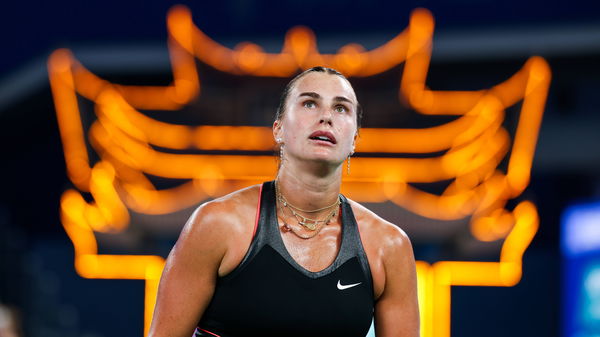
Imago
WUHAN, CHINA – OCTOBER 11: Aryna Sabalenka of Belarus reacts in the Women s Singles Semifinal match against Jessica Pegula of the United States on day 8 of 2025 Wuhan Open at Optics Valley International Tennis Center on October 11, 2025 in Wuhan, Hubei Province of China. PUBLICATIONxNOTxINxCHN Copyright: xVCGx 111596587805
King later agreed to face him. The match was played at the Houston Astrodome. It drew the largest crowd ever to watch a tennis match at that time. Ticket sales broke the venue’s record, even surpassing a Muhammad Ali fight held there four years earlier.
Newspapers labeled King as “the sport’s most militant women’s libber.” Riggs embraced his role as the villain. He proudly called himself the world’s “No. 1 male chauvinist pig.” The stage was perfectly set.
King won decisively, 6-4, 6-3, 6-3. An estimated 90 million viewers watched worldwide. The victory carried weight far beyond the scoreline.
There was a deeper narrative behind King’s win. She was nearly half Riggs’ age. She was also fighting for equality in a sport where women earned a fraction of men’s prize money.
“Because we don’t have equality yet. It’s a no-brainer. See, every generation has to fight these fights. Every generation,” King later said. Her words reflected the moment and the mission.
Money also played a role. One reason Court agreed to play Riggs was financial. She was guaranteed $20,000. That amount exceeded what she earned for winning a Grand Slam.
King’s fight extended beyond that match. It followed her push for gender equality and her journey toward accepting her sexuality. These issues still resonate today.
The movement began earlier, in September 1970. Nine women, later known as the Original 9, signed symbolic $1 contracts with World Tennis magazine. They did so at the Houston Racquet Club.
At the time, a man earned $12,000 for winning a tournament. A woman earned just $1,500 for winning the same event. The Original 9 broke away to form their own circuit. That decision helped change the sport forever.
For many, the 1973 match fueled the rise of equal pay in tennis. It stood for social change. It matched the cultural climate of the era.
However, the proposed Sabalenka versus Kyrgios match is very different. Bobby Riggs was older and retired, but his resume mattered. He was a former world No. 1 and a Hall of Famer.
Nick Kyrgios does not fit that profile. He is often injured and plays part-time. He has a history of making sexist remarks about female players. His behavior often overshadows his tennis.
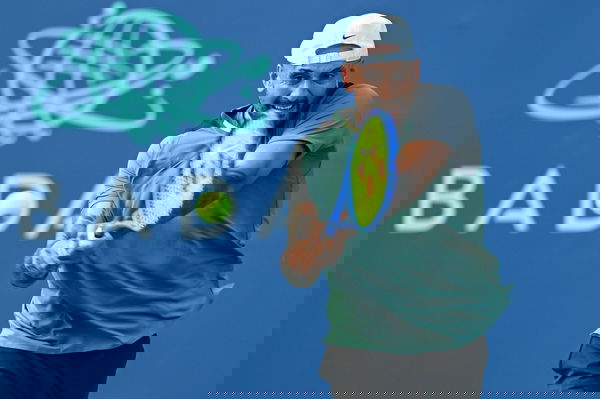
Imago
July 21, 2025, Washington, D.C, U.S: NICK KYRGIOS hits a backhand during his doubles match at the Rock Creek Tennis Center. Washington U.S – ZUMAg196 20250721_zap_g196_008 Copyright: xKylexGustafsonx
Aryna Sabalenka has also faced criticism. She has apologized for poor sportsmanship in the past. Playing Kyrgios in a so-called battle of the sexes does her few favors.
Kyrgios is undeniably talented. He reached a Wimbledon final. Yet he has become more of a caricature than a competitor.
His controversies are well documented. They include joining OnlyFans and promising that tennis balls would be involved. He has been accused of tanking matches. In 2023, he pleaded guilty to one count of assault involving pushing his ex-girlfriend. A magistrate later dismissed the charges.
Perhaps this exhibition distracts from real issues as well. Women’s tennis has progressed since the 1970s, but inequalities remain. Prize money is still uneven.
Many 1,000-level events pay women less than half of what men earn. This happens even when they share venues and play best-of-three sets.
The numbers are telling. Carlos Alcaraz and Jannik Sinner have already earned more career prize money than Venus Williams. Novak Djokovic has earned more than Venus and Serena combined, even including doubles.
The WTA has committed to equal prize money. In 2023, it pledged to match the ATP by 2033. That goal remains nearly a decade away.
Why focus on a gimmick now? Especially at a time when players complain about long seasons. Even King dismissed the comparison. “The only similarity is that one is a boy, and one is a girl. That’s it. Everything else, no. Ours was about social change; culturally, where we were in 1973. This one is not.”
And as the match draws closer, opinions continue to pour in. Players across the sport are sharing their views. The conversation is loud. But the meaning feels very different.
What have players said about the match itself?
As the match moves into the spotlight, both players have spoken openly about the contest. Aryna Sabalenka rejected the idea that the exhibition could harm women’s tennis. Asked if it could be damaging, she said, “I don’t agree. I am not putting myself at any risk. We’re there to have fun and bring great tennis. Whoever wins, wins.”
Sabalenka expanded on her view and addressed the physical debate directly. She said, “It’s so obvious that the man is biologically stronger than the woman, but it’s not about that. This event is only going to help bring women’s tennis to a higher level. We are helping tennis to grow. It’s fun, it’s challenging and I think that’s what people want to see.”
Nick Kyrgios also shared his thoughts, though his comments stirred controversy. The former world No. 13 said in September that women cannot return men’s serves. He also claimed he could beat Sabalenka without needing to try at full intensity.
Despite those remarks, Kyrgios insisted the match could still have value. He framed it as a moment of unity between the tours rather than competition alone. “So I can’t do anything other than hope me and Aryna play our best tennis and, at the end of the day, whoever wins, that our handshake afterwards solidifies the union between males and females in the tennis world,” he said.
However, not everyone agrees with that outlook. Several players and coaches have questioned the purpose of the event. Former British No. 1 Laura Robson expressed doubt during an interview with Sky Sports Tennis.
“I’m interested to hear what the appeal is for Aryna. I’m not sure this is what the game is missing,” Robson said. Her comments reflected uncertainty about how the match benefits women’s tennis.
Former WTA player and commentator Rennae Stubbs was far more blunt. Speaking on The Rennae Stubbs Tennis Podcast, she dismissed the event entirely. “No one gives a f— about what’s happening with Aryna Sabalenka and Nick Kyrgios,” Stubbs said.
Stubbs also questioned the motives behind the exhibition. “I mean, the only reason they’re putting this on is because it is literally their company, Evolve, who’s a sponsor, who’s their management company. . . But what is in this for women’s tennis?” she added.
Another perspective came from Eva Lys, the current top-ranked German player on the WTA Tour. She described the match as more spectacle than substance. “I have an ambivalent opinion, but in general, I think that Aryna Sabalenka is very good for women’s tennis. She pushes the limits and sometimes has moments that you don’t know from sports,” Lys said in German.
Lys also highlighted the promotional angle of the event. “It’s no secret that it’s a very big PR campaign to draw more attention to tennis. With whom can you do something like that? With Nick Kyrgios, of course. I think the two have found each other. You have to see it with humor. Tennis is still a sport that is taken a tad too seriously,” she added.
Former world No. 1 Garbiñe Muguruza offered one of the strongest warnings. Speaking on El Partidazo de COPE, she drew from personal experience. “I’ve had so many [male] hitting partners, and every time I had to play a practice set against them, I’d end up super frustrated. How can it be that I can’t win a set against someone who isn’t even a professional player, someone who’s just a sparring partner?” she said.
Muguruza went further in her assessment of the physical gap. “The difference is huge. It’s not just power – physically… the muscles, the stamina a man has to play a match… There are so many things. I have two brothers and I’ve never beaten them. A guy who is ranked 1,000 in the world or doesn’t even have a ranking could be far superior to a top-10 player on the WTA circuit. When I was at my best level, being world No 1, I wouldn’t have even beaten a junior.”
Criticism also came from outside the player ranks. Roger Rasheed, former coach of Lleyton Hewitt, shared his disappointment on ABC Sport’s Summer Grandstand. He said he was “disappointed” that the match was happening.
Rasheed made his stance clear. “I’m not a fan of it, to be honest,” he said. He questioned the upside for women. “I think it’s a lose-lose for the women’s side … I actually think it’s quite insulting, to be perfectly honest.”
He added that Sabalenka gains nothing from the exhibition. “I don’t see where there’s one minute, one second of win for the number one player in the world. If you are looking after Sabalenka commercially, is this a place where you want to be?”
The broader argument remains unresolved. The WTA and ATP are separate but complementary organizations. Women’s tennis should be judged on its quality, not on cross-gender comparisons. Men are bigger and stronger. John Isner could ace Steffi Graf all day, but that does not make him the better tennis player.
If Sabalenka wins, critics will claim the rules favored her. If she loses, women’s tennis absorbs the damage. This is not truly a battle of the sexes. Aside from financial gain, there are no real winners here.
Written by

Edited by

Sowmya Anantharaman