

Serena Williams’ back-to-back win in 2015 and 2016 remains the last time the Wimbledon title was defended by a woman. She came closest to doing it a third time in 2019, before falling to Simona Halep in straight sets in the final. In hindsight, that defeat marked the last real brush anyone had with repeating as the Wimbledon champion.
Watch What’s Trending Now!
That trend continued this year, as defending champion Iga Swiatek was ousted in the third round by Alexandra Eala, extending a decade-long streak without a successful women’s singles title defense at Wimbledon. Eight different women have lifted the trophy after Serena, and with Swiatek and Barbora Krejčíková out of this edition, there is set to be another new winner.
No other major has such a turnover. In the same period, the Australian Open has produced repeat winners in Naomi Osaka and Aryna Sabalenka. The French Open has been relying on Swiatek’s four titles, and even at the US Open, Sabalenka has managed to defend her title. Only Wimbledon has refused to let anyone win it twice.
It is what grass does to the sport’s hierarchy. The surface has the shortest season on tour, with just about three weeks of warm-up events packed in after the clay swing, and no events higher than the 500 level to prepare players for the pressure of a Grand Slam. The change itself is unsettling, from a high, slow, bouncing rhythm on clay to a low, skidding bounce, which punishes baseline rhythm and favors instincts.
This is the only surface where serve-and-volley and net aggression are heavily rewarded, elements that much of the modern game has abandoned. That abandonment is no coincidence, nor is the role of grass today. In 2001, the All England Club tore out its courts and replaced a mix of 70% ryegrass and 30% creeping red fescue with 100% perennial ryegrass, to make a sturdier surface that let groundsmen keep the soil firmer and drier.
The outcome was a slightly higher, slower, and more predictable bounce, and it worked right away. The 2001 final between Goran Ivanisevic and Pat Rafter was a serve-and-volley duel, while a year later, baseliners Lleyton Hewitt and David Nalbandian played in a final that signaled the end of the traditional serve-and-volley points. Grass had also been moved closer to the rest of the tour, rewarding the same baseline games flourish as on hard courts, but it always retained that skiddy character that requires a bit of adjustment. Grass has always required a certain type of versatility, and the players who embody this have been changing over the years.
That versatility is made harder still by how alive the surface is. Grass is the most expensive and difficult court to maintain, and it does not stay the same from one day to the next. It dries and hardens in hot weather, softens and slows in wet weather, and two weeks of foot traffic roughs up the baseline, so the court that a player faces in the second week is very different from the one that they started on. Reading those shifts in real time is a skill in itself, and it is one that only comes with repeated exposure that most players simply do not get.
1. The Post-Serena Vacuum
Aryna Sabalenka, who has mostly been the world’s top-ranked player over the last two years, has only won one of the last seven Grand Slams she participated in, from the 2025 Australian Open to the 2026 French Open. Madison Keys, Coco Gauff, Swiatek, Elena Rybakina, and Mirra Andreeva have each taken one of the others, and Wimbledon is now guaranteed to add a seventh different name to that list. The dominance at the top of the rankings and the dominance at the majors just don’t go together anymore.

Imago
Iga Swiatek celebrates with the Venus Rosewater Dish after victory in the Ladies Singles Final Wimbledon Tennis Championships, Day 13, The All England Lawn Tennis and Croquet Club, London, UK – 12 Jul 2025London The All England Lawn Tennis and United Kingdom PUBLICATIONxINxGERxSUIxAUTxHUNxGRExMLTxCYPxROUxBULxUAExKSAxCHNxDENxINDxITAxPORxESPxSWExTURxMEXxCOLxVENxPERxECUxBRAxARGxCHIxURUxPARxPANxONLY Copyright: xJavierxGarcia/Shutterstockx 15392293dd
Iga Swiatek, another player who dominated the world No.1 position for a staggering 125 weeks. But as her own case demonstrates, her strength lies in a particular surface. Swiatek’s clay titles at Roland Garros helped establish her as the top player of her generation on clay, and her title at Wimbledon in 2025 provided a promising indication that she could do the same on grass. Instead, she has started to lose form with no titles this year yet and has been undone by a third-round exit that leaves her Wimbledon reign as a single, isolated year rather than a streak.
Sabalenka for hard courts and Swiatek for clay were the story for the past few years, but no one could quite dominate grass. Additionally, holding the No.1 spot in the world has not guaranteed Slams.
2. A Deeper Pool, No Grass-Court Specialists
Unlike the era Serena and Venus Williams defined, today’s WTA does not have a cluster of players built specifically for grass. The number of women who can win at majors has increased significantly, but this depth has not been matched with an identity with grass-court like Petra Kvitova or the Williams sisters.
Part of the reason is developmental. Nearly all players are raised on hard courts or clay, the turfs that dominate the junior circuit and the bulk of the professional tour. Grass, for this generation, is a place they encounter in a few weeks each summer and not in years of practice like it was for previous generations. The grass specialists of the past, the Williams sisters, Kvitova, and further back, the serve-and-volley greats like Martina Navratilova, either grew up with the surface or built their entire games around its demands. The players of today are visitors, not natives, as they arrive at Wimbledon.
It shows how recent champions have arrived: Marketa Vondrousova won as an unseeded player in 2023, Rybakina came in seeded 23rd in 2022, and Barbora Krejčíková was seeded 32nd in 2024. The other three majors have never generated such a string of underdogs in the same span.
3. The Scheduling Problem
Structurally, the grass swing works against continuity, too. Six WTA events in three weeks pave the way to Wimbledon, while ten weeks of build-up to Roland Garros during the clay season. Moreover, there’s no WTA 1000 tournament on grass at any point to provide players with significant reps leading up to the biggest prize.
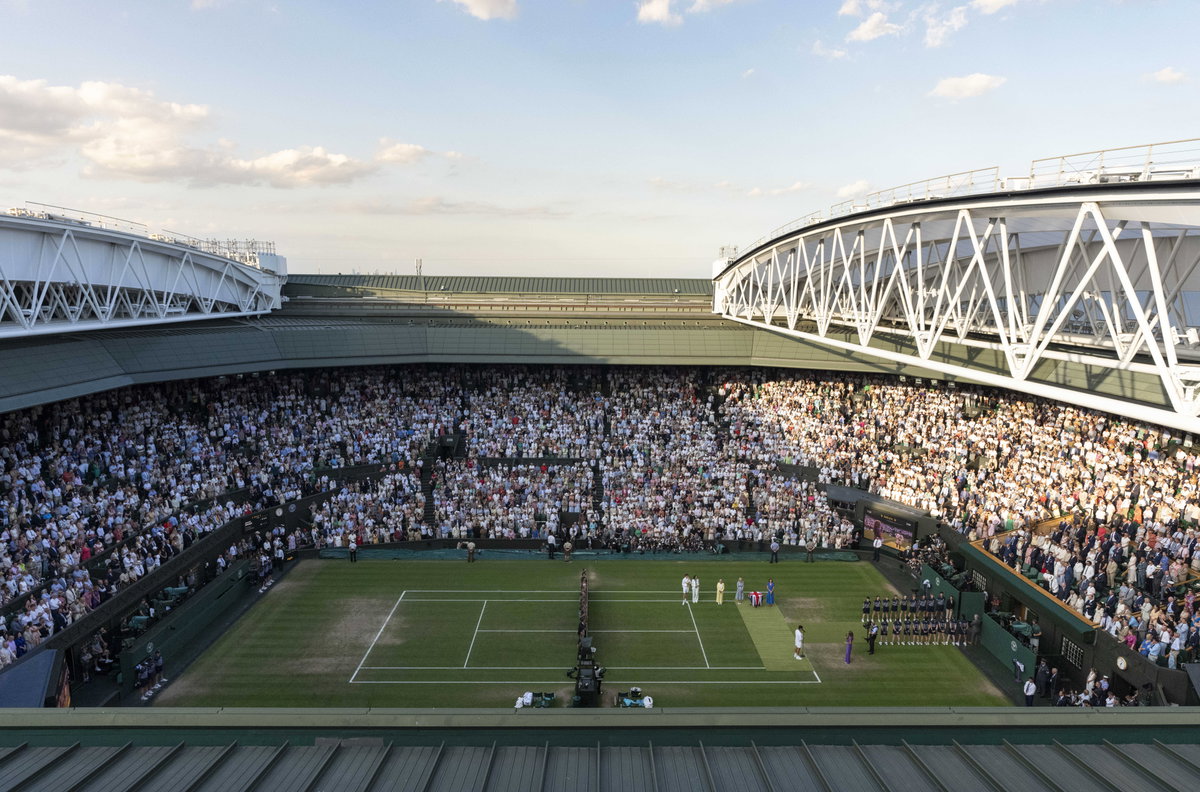
Imago
The Prince and Princess of Wales Attend Wimbledon 2025 View from the roof of Centre Court during the prize giving ceremony with HRH The Princess of Wales, Patron of the All England Lawn Tennis Club, after Jannik Sinner ITA defeated Carlos Alcaraz ESP in the final of the Gentlemen s Singles at The Championships 2025. Held at The All England Lawn Tennis Club, Wimbledon. Day 14 Sunday 13/07/2025., Credit:AELTC/Joe Toth / Avalon United Kingdom, Wimbledon PUBLICATIONxNOTxINxUKxFRAxUSA Copyright: xAELTC/JoexTothx/xAvalonx 1021811916
Most professionals only get two or three weeks of true grass-court match time in a year, and make the surface into an improvisation rather than something they can develop real rhythm on throughout the season.
There is little sign of a dominant grass-court player at the moment, and none of those structural problems is likely to change in the near future, so the trend is far more likely to extend than end. Wimbledon’s champion could be different each year for the foreseeable future, not because the sport needs great players but because grass, the most unpredictable surface on the tour, will not let anyone win twice.
A new Grand Slam champion will be crowned at Center Court on Saturday, as either Karolina Muchova or Linda Noskova emerges victorious in an all-Czech final.