Imago
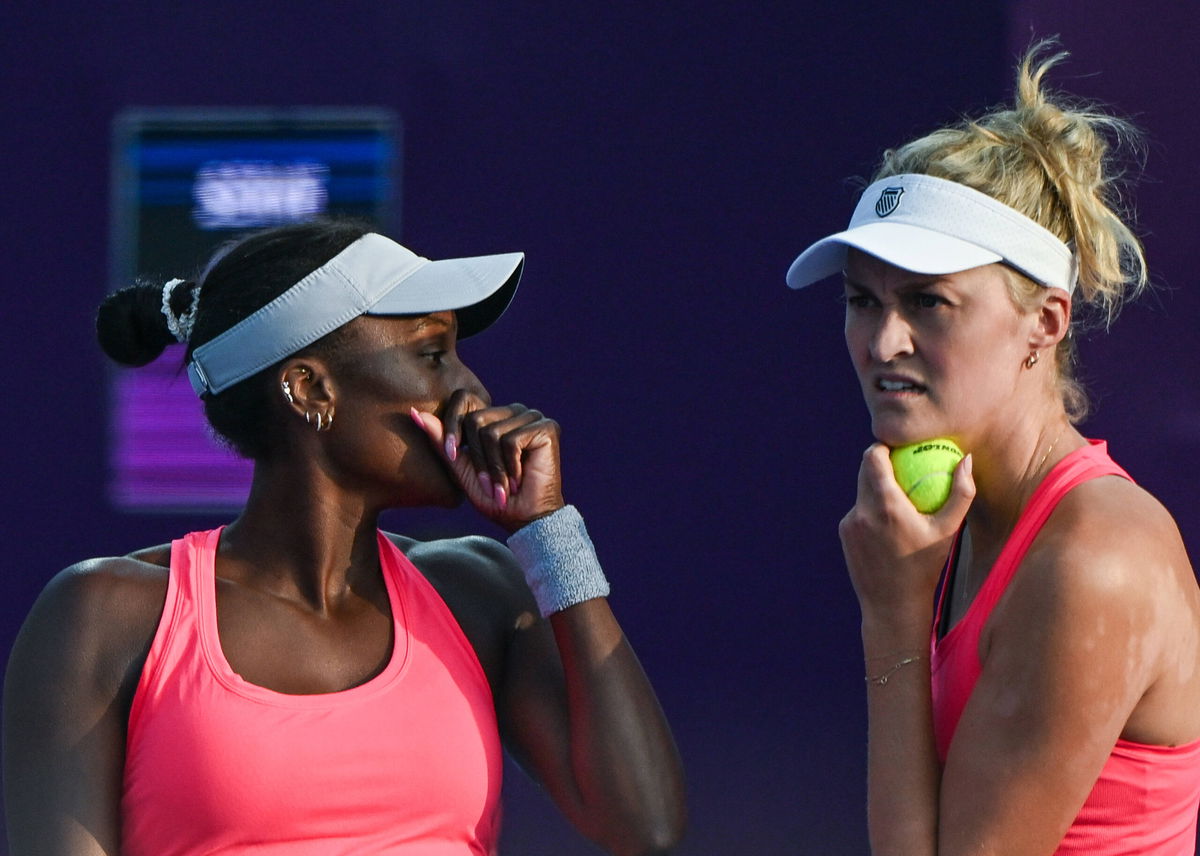
Qatar TotalEnergies Open 2026 – Day One DOHA, QATAR FEBRUARY 8: Asia Muhammad L of the United States and Erin Routliffe R of New Zealand are seen during the First Round of the doubles match against Barbora Krejcikova and Katerina Siniakova of the Czech Republic, at the Qatar TotalEnergies Open, part of the Hologic WTA, Tennis Damen Tour, at the Khalifa International Tennis and Squash Complex, in Doha, Qatar, February 8, 2026. Doha Qatar PUBLICATIONxNOTxINxFRA Copyright: xArturxWidakx originalFilename:widak-qatartot260208_npdVa.jpg
Imago
Qatar TotalEnergies Open 2026 – Day One DOHA, QATAR FEBRUARY 8: Asia Muhammad L of the United States and Erin Routliffe R of New Zealand are seen during the First Round of the doubles match against Barbora Krejcikova and Katerina Siniakova of the Czech Republic, at the Qatar TotalEnergies Open, part of the Hologic WTA, Tennis Damen Tour, at the Khalifa International Tennis and Squash Complex, in Doha, Qatar, February 8, 2026. Doha Qatar PUBLICATIONxNOTxINxFRA Copyright: xArturxWidakx originalFilename:widak-qatartot260208_npdVa.jpg
After parting ways with Gabriela Dabrowski in late 2025, Erin Routliffe teamed up with close friend Asia Muhammad, but the partnership failed to deliver beyond a Miami quarterfinal. The struggles forced a split, sending both in different directions at the Charleston Open. In a cruel twist, their on-court reunion turned painful as Routliffe accidentally struck Muhammad, leaving behind a moment of shock and tension.
Watch What’s Trending Now!
Erin Routliffe partnered with Jennifer Brady at the Charleston Open. They faced Jessica Pegula and Asia Muhammad in the Round of 16. The match turned dramatic in the second set. At 6-6 in the tiebreak, Muhammad played a backhand, which Routliffe returned.
The rally continued with both players moving closer to the net. As the ball came back toward Muhammad, she attempted another return. In that moment, Routliffe stepped forward and struck the ball.
The shot went straight into Muhammad’s face. The impact forced her to immediately sit down on the court, holding her face in pain. Routliffe reacted instantly to the situation. She rushed toward her former partner, repeatedly saying “Sorry” in distress as the crowd fell silent.
First match after the breakup and Routliffe hits Muhammad directly in the face 😭😭😭 pic.twitter.com/koCqN9KAkQ
— Owen (@kostekcanu) March 31, 2026
Despite the incident, the match itself had started strongly for Routliffe and Brady. As a new pairing, they quickly built momentum. They raced to a 4-0 lead by breaking serve in the first and third games. Pegula and Muhammad managed to recover one break in the sixth game.
The set then progressed on serve. Routliffe and Brady closed it out 6-4, 7-6.
After the match, Routliffe reflected on the partnership. “We had a lot of fun out there today. We knew it was going to be a tough first round given that all four on court are good players. It was a high quality match,” she says.
However, their run did not last long. They were eliminated in the quarterfinals at the Althea Gibson Club Court by Miyu Kato and Giuliana Olmos with a 6-3, 6-1 loss.
Such incidents are not new in tennis. Similar situations have occurred in other tournaments as well. At the 2023 Korea Open, Alycia Parks played doubles with Sofia Kenin. They faced Luksika Kumkhum and Peangtarn Plipuech in the semifinal.
Kumkhum and Plipuech won the first set 7-5. The second set was equally competitive. At 5-5 in the second set, Parks had a chance to hit a smash at the net. She struck the ball, but it went directly into Plipuech’s body.
Plipuech, positioned at the net, was unable to react in time. She had to sit down on the court to recover from the pain. The chair umpire came down to check on her. Players from both sides gathered around during the pause.
Parks immediately raised her racket in apology. Despite the incident, Kumkhum and Plipuech went on to win the match 7-5, 7-6(3).
These moments highlight the risks of close net play. In some extreme cases, such incidents have even led to player disqualifications.
ATP duo disqualified after hitting opponent’s head with ball
The first known disqualification in the Open Era for hitting someone with a ball involved Tim Henman. The incident took place at Wimbledon in 1995. Henman was playing doubles alongside Jeremy Bates. During the match, he hit a ball in anger.
Unfortunately, the ball struck a ball girl. As a result, the umpire immediately disqualified the British pair. Their opponents, Henrik Holm and Jeff Tarango, were awarded a walkover into the second round.
A similar but more recent incident occurred last year. Alexander Donski and his partner Siddhant Banthia were competing in an ATP Challenger event in Barletta, Italy. They were facing the duo of Simone Agostini and Gianluca Cadenasso. During the match, a serious incident took place.
Donski hit a ball that struck Agostini in the head. Agostini immediately held his face in pain after the impact. The situation escalated because Donski had smashed the ball in frustration. This came after he missed a break point earlier in the match.
Agostini tried to move out of the way, but the ball still hit him directly. After the incident, both teams came to the net. Donski appeared to apologize during the exchange. The players then spoke with the umpire about what had happened.
Soon after, a tournament official from the Open Citta della Disfida entered the court. A physio also came to treat Agostini’s injury. The umpire then made the decision to default Donski. At that point, Agostini and Cadenasso were leading 6-2, 4-4.
Despite being ahead, they had been under pressure and close to breaking before the incident occurred. The default ended the match in their favor.
The decision was likely based on unsportsmanlike conduct. According to the International Tennis Federation rulebook, “Players shall at all times conduct themselves in a sportsmanlike manner and give due regard to the authority of officials and the rights of opponents, spectators, and others.”
Such incidents continue to occur in tennis. They show how quickly frustration can lead to serious consequences, including disqualification.
