
If you had zero Mid-Majors reaching the Sweet 16 in the 2026 NCAA men’s basketball tournament, then your bracket is likely in very good shape.
Watch What’s Trending Now!
From here on out, this year’s March Madness will feature only Power Conference schools, leaving the entire field of Mid-Majors on the outside looking in.
It’s a phenomenon that has now happened two years in a row after not happening a single time before that, since the tourney field expanded to 64 teams in 1985.
And the reality is, it’s likely to happen most every year now in this new reality for college athletics.
Just look at this graphic. It details where every starter on each of the Sweet 16 teams began their college career.

Where every Sweet 16 Team's Starting-5 began playing college basketball. (Try to figure out which teams are which)

Do the math. Six Big Ten teams. Four SEC. Three Big 12. Two Big East and an ACC thrown in for a dash of spice. In lieu of this year’s Cinderellas sit No. 9 Iowa and No. 11 Texas, both Power Conference schools. You can’t call a Power school a Cinderella.
But it might not be all that it appears, as the Mid-Majors are technically, as the numbers suggest, getting stronger.
ROLL CALL
We’ll always remember the great Cinderellas that inspired a nation. George Mason in the 2006 Final Four. Butler in back-to-back finals (2010 & 2011). And who could forget dear old Sister Jean and the 2018 Loyola Chicago Ramblers?
The literal definition of March Madness.
First came the money. Then the portal. And March hasn’t been the same since.
THE WIDENING MONEY GAP
The numbers tell a tale of two sports that are almost completely different. The average SEC roster has an average cost of $9.7 million per year, with Mid-to-High Majors cashing in around $2.3 million per program.
Kentucky alone spent $22 million on this year’s roster – and lost during the opening weekend.
With Low-to-Mid Major schools averaging $525,000 annually, the SEC is spending roughly 18 times as much to build their roster.
Consider this: The Top-10 highest-paid college basketball players in 2026 all make in excess of $1.5 million. Less than 10% of players earning at least $100,000 in NIL competed outside the five power conferences.
Impossible to recruit against.
The portal was meant to level the field, but instead, the money flowed upward, bringing the talent with it. The Mid-Majors can’t compete when it comes to the pocketbooks. Their one advantage, their secret path to the Sweet 16, was time — multiple years to develop talent, taking the chance on a crop of 17- or 18-year-old and developing unbreakable chemistry over multiple years.
Now, that’s gone. The portal stole time. So they’re finding a new way to thrive.
THE NEW ORDER
The opening of the portal closed the door on how Power Conference programs recruit players out of high school.
There’s no longer an incentive to develop a high school player for three years when a John Calipari or Bill Self can reload with a seasoned player the day after the championship game when the portal opens.
This narrows their high school recruiting process to a battle for the nation’s top five-star talent. And thus, the four-star recruits are now becoming more accessible to the Mid-Majors. Mid-Major recruiting is on the rise as these programs become masters at efficiently developing strong pipelines.
The cruel irony, however, is that no matter how deep a team’s development gets them, the greater the success, the greater the chances of watching it travel out the door to the spoils of the Power Conferences.
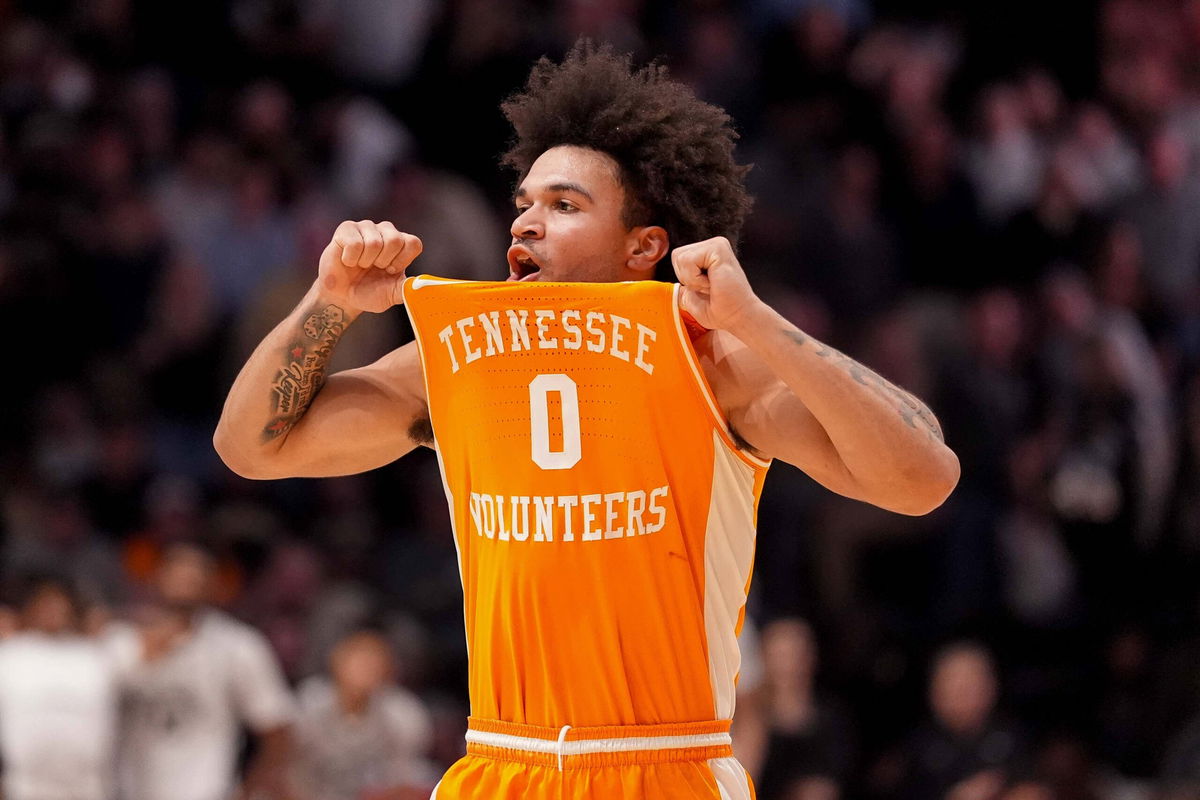
Former Belmont guard Ja’Kobi Gillespie is now a first-team All-SEC player on a Sweet 16-bound Tennessee Volunteer team.
Charleston went 75-27 and won two outright Coastal Athletic Association titles in three straight years. Then, after two tourney appearances, the Cougars hemorrhaged 86 percent of their scoring in one fell swoop, along with head coach Pat Kelsey, who bolted for the greener pastures of Louisville.
In this year’s Sweet 16 alone, you’ll find Michigan’s Yaxel Lendeborg (started at UAB) and Iowa State’s Nate Heise (Northern Iowa), as well as Nebraska’s Jamarques Lawrence (Rhode Island) and St. John’s Bryce Hopkins (Providence). Of course, we can’t forget Drake 2.0, aka Iowa, which welcomed starters Bennett Stirtz, Tavion Banks, Cam Manyawu, and Kael Combs, all of whom followed head coach Ben McCollum to Iowa City from the Bulldogs.
In essence, build it, and they will leave.
THE LANDING
No one is at fault, necessary here. The portal and NIL are all working as intended, leaving the programs with bottomless pockets to duke it out.
The competition is stronger than ever on all levels, yet the version of March Madness is perhaps changed forever. The path for that unknown kid from some far-off nook to ruin your bracket is now a much tougher one.
But hey, that’s what Cinderellas are all about, right?