
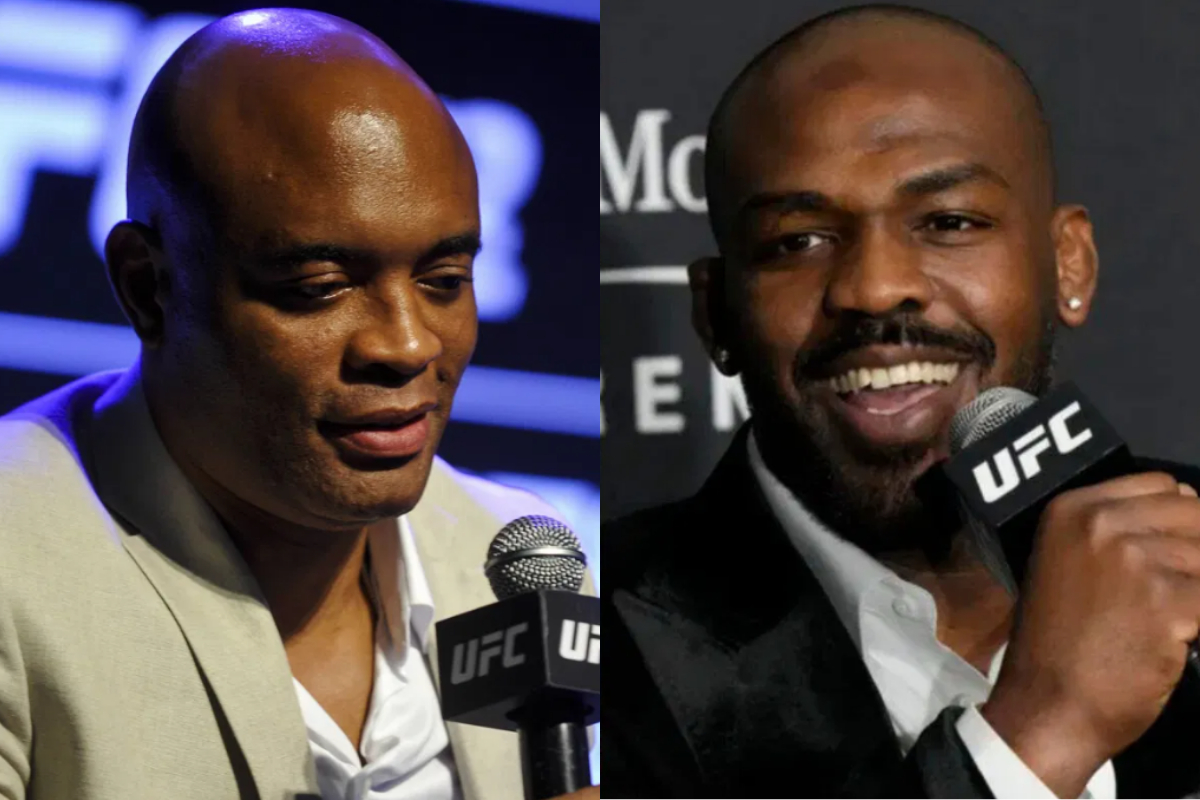
Anderson Silva may have pocketed a reported $10 million from the UFC’s antitrust lawsuit, but the MMA legend was surprisingly in the dark about the case’s gravity—until a training session with Jon Jones set him straight. Following a lengthy legal battle, the promotion agreed to pay $375 million to more than 1,100 fighters who competed in UFC events in the US between December 16, 2010, and June 30, 2017. Out of them, Anderson Silva reportedly received the largest individual compensation at $10.3 million.
Watch What’s Trending Now!
As a result, many assumed ‘The Spider’ must have been deeply involved in the suit from its inception. However, Silva recently revealed that he had no idea about it and that the first time he learned about it was during a training session with Jon Jones, not in a meeting with lawyers or managers.
“You know, it’s so interesting because when people talking about that, really I (didn’t) know. Jon Jones talked to me,” Anderson Silva told Ariel Helwani. “One time I trained with Jon Jones, and I’m with Devin, training, shooting techniques. And I am with Jon Jones, and Jon Jones tell me about that. I say, ‘Bro, I don’t know. I think I (should) go talk to Dana about that.’ And Jon Jones talked to me and say, ‘That’s the truth.'”
The former UFC middleweight champion went on to claim that he never felt compelled to sue the UFC and that he initially believed that speaking directly with Dana White would provide the best understanding of the problem.
“I try to call Dana to check it out,” he continued. “So what’s going on? I don’t know. I don’t sue the UFC and this and that.
“And when I started talking with my lawyer, my lawyer explained to me the whole thing. And that’s all. I say, Okay, all right, it’s done.”
The lawsuit covered fighters who competed between 2010 and 2017, with claims that the promotion limited athletes’ opportunity to negotiate elsewhere and maintained pay below what it should have been. The final settlement resulted in hundreds of millions of dollars being given to over a thousand fighters, with compensation ranging from a few thousand dollars to more than $10 million, depending on their activity during that time.
When Helwani joked that the settlement sounded like free money, Anderson Silva immediately disagreed.

Anderson Silva is asked about the class action lawsuit settlement. #HelwaniShow
“It’s not free money. I pay tax, but remember, it’s not free money,” Silva said. “I think this is the money that UFC needs to pay for everybody.
“And for me, it’s nothing free because I suffered a lot to… get this money to come to my account.”
The debate over fighter pay has resurfaced again, with numerous fighters asking how much the promotion should be paying compared to the revenue it generates. Silva, however, made it clear that he never looked at the lawsuit as something personal against the UFC.
For him, it was a legal scenario that evolved over time, something Jon Jones warned him about before he understood it himself. However, the same cannot be said about Ronda Rousey, who brought back the issue to the spotlight after she slammed the UFC for making its fighters resort to OnlyF-ns.
Ronda Rousey slams the Dana White-led promotion’s low pay
Ronda Rousey stirred the fighter pay pot at a press conference last week, long before Anderson Silva revealed his side of the settlement, and her comments were far more direct about the sport’s current status. Instead of discussing the past, ‘Rowdy’ questioned how fighters are paid now, despite the promotion’s growing revenue.
Speaking ahead of her fight against Gina Carano, Rousey stated that the UFC is no longer the greatest place for fighters to earn a livelihood, claiming that many athletes are forced to look for money outside the cage.
“It used to be that the UFC was the best place that you could come in combat sports to make a living and be paid fairly. Now, it’s one of the worst places to go,” Rousey said. “It’s why so many of their top athletes are going to find pay elsewhere.
“It’s why their champions, like Valentina Shevchenko, are selling pictures of their ti—– on OnlyF—.”
She said that the problem extends beyond a few big names and impacts fighters across the roster, particularly those lower on the card.
“They are bleeding talent because of their short-term greed,” she added. “They are thinking about the next quarter. They are thinking about the shareholders.
“They are not thinking about their responsibility to be stewards of the sport.”
Take the White House card for example. Jon Jones is not fighting on the card because they could not offer him the same $30M they offered him last year to fight Tom Aspinall. Michael Chandler is fighting Mauricio Ruffy instead of Conor McGregor because they want to use the Irishman on a card where they can sell tickets and make money off his name. So, it is not just fighter pay, but good fights that are also becoming casualties under the new regime.
According to Ronda Rousey, the issue is not simply one case or one payout, but how the business of the sport is being run today. And honestly, comments like hers are precisely why the discussion over fighter pay hasn’t faded yet and why every new payout or contract ends up reopening the same argument again.