Imago
Credits: IMAGO
Imago
Credits: IMAGO
Imago
Credits: IMAGO
Imago
Credits: IMAGO
“I will tell someone about it so that it does not happen a million times,” Rinat Fakhretdinov shared after abruptly being cut from the UFC roster despite a perfect record. Apparently, some contract nuances led to the unfortunate shuffle. However, only a day later, an antitrust lawsuit against the UFC made it an eerie moment for the MMA world.
Watch What’s Trending Now!
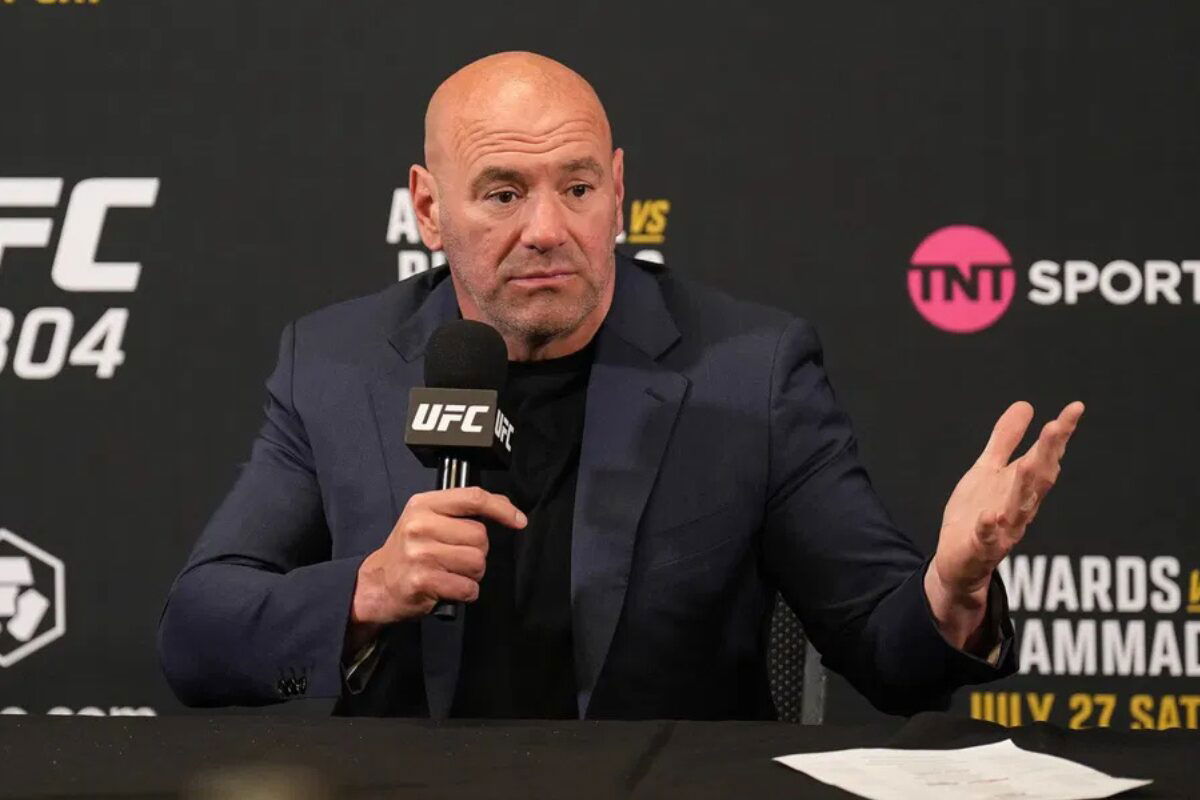
On Tuesday afternoon, UFC boss Dana White and senior UFC legal executive Tracy Long were ordered by the Federal court to testify under oath in an antitrust lawsuit spoliation hearing on Feb 4-5.
UFC is alleged to have suppressed fighter pay
The Cirkunov v. Zuffa is a class-action lawsuit filed by a group of fighters accusing the UFC of exercising monopolistic control over the fighting scene while suppressing pay into ridiculously restrictive contracts. Moreover, both Dana White and Tracy Long are alleged to have destroyed or hidden essential evidence, including phone logs and chats, as the lawsuit claimed “gaps in production.”
The spoliation hearing ordered by Judge Richard Boulware would examine those alleged gaps in information and whether any form of evidence destruction had been performed on the data provided by White. The case demands the promotion to turn over fighter pay and contract discussion data, and White’s cell phone data, including chats and phone recordings with the concerned fighters.
The case was originally filed on May 23 this year in the U.S. District Court in Nevada by former UFC fighter Mikhail “Misha” Cirkunov. The lead plaintiff represented a class of fighters who fought from July 1, 2017, and were bound by arbitration clauses or class-action waivers.


Imago
Credits: IMAGO
The case alleged that UFC established a monopoly with exclusionary practices and restricted fighter opportunities with rival promotions. It also allegedly controlled fight contracts with an iron hand, with little room for negotiation. Judge Richard F. Boulware is presiding over the case, having previously presided over the Le v. Zuffa lawsuit, which resulted in $350 million being awarded to former fighters in that particular suit.
However, White isn’t quite approving of Boulware. White shared that the two had attended high school together, and the bad blood began somewhere along the way. “I don’t think I did anything to this guy. I don’t know what the hell happened. But there’s no doubt in my mind this feels absolutely personal, and whatever it is with this guy, we’ll let the lawyers deal with it, and it is what it is,” he told Yahoo! Sports.
Despite the distaste, White and the UFC promotion will have to testify for the alleged claims, with some reports claiming that if the organization is found to have held back evidence, it could potentially cost them billions. While this lawsuit hangs in the balance, UFC’s legal history suggests that this is not the first time it has found itself at odds on similar grounds.
UFC antitrust lawsuits surface amid Cirkunov v Zuffa fiasco
The matters date back to December 2014, when Jon Fitch, Nate Quarry, Brandon Vera, Javier Vazquez, Kyle Kingsbury, and Cung Le filed the Le v. Zuffa antitrust lawsuit, alleging the promotion for monopolistic control that kept the fighter contracts below a competitive level. They demanded $800 million to $1.6 billion in damages for the fighters who fought between Dec. 16, 2010, and June 30, 2017.
The lawsuit finally came to a close in 2025, after Richard Boulware gave his verdict against the UFC, with $375 million in damages, $250 million of which will settle the payments for the fighters. A similar Johnson v. Zuffa lawsuit was filed in 2021, concerning the group of fighters beyond the 2017 period, which is still in progress.
Moreover, alongside the Cirkunov lawsuit this year, which targets a subset of Johnson v. Zuffa’s concern, focusing on fighters bound by arbitration clauses, another lawsuit bloomed on May 29. UFC Fighter Phil Davis filed an antitrust case in the Nevada federal court, drawing heavily from the findings on the Le v. Zuffa files.
He argues that UFC’s dominance restricts the motion of elite fighters into other promotions. Instead of seeking damages, he asks for injunctive relief that would allow fighters to exit UFC contracts after one year. Clearly, UFC is in a volatile legal environment, with the details still in the shadows. The spoilation hearing next year will decide which direction the promotion is headed next.