

Alejandra Lara, a former Bellator title challenger, has broken her silence after being suspended by the Nevada Athletic Commission after testing positive for the coc-ine metabolite benzoylecgonine.
Watch What’s Trending Now!
The commission stated on Wednesday that it had reached a settlement agreement with ‘Azul,’ handing the Colombian fighter a nine-month suspension, a $412.50 fine, and $250.60 in legal fees. As a result, she will now be eligible for return to competition only after January 24, 2027. The fighter, however, claims that the positive test came out of something completely unintentional.
“I had been appealing the suspension because consuming coca leaf is a cultural practice in South America, and it’s something I’ve done for many years,” Lara wrote on X, clarifying the details behind her suspension. “Mambe originates from the Amazon rainforest, and it is sent to me by Indigenous elders from the region.
“Because I’ve always consumed Mambe, I got too confident and chew it in the fight week. My mistake. The suspension ends in January. In the meantime I’m training and looking for opportunities to fight in other countries that aren’t under the jurisdiction of the Nevada Commission.”
This marks the first time Alejandra Lara has tested positive for a banned substance in her almost 15-year professional mixed martial arts career.
For the unaware, Mambe is a powder prepared from toasted coca leaves that is widely used in Indigenous tribes throughout South America. Coca leaves and coc-ine are different substances. However, coca leaf products may contain chemicals that cause a positive test for coc-ine metabolites.
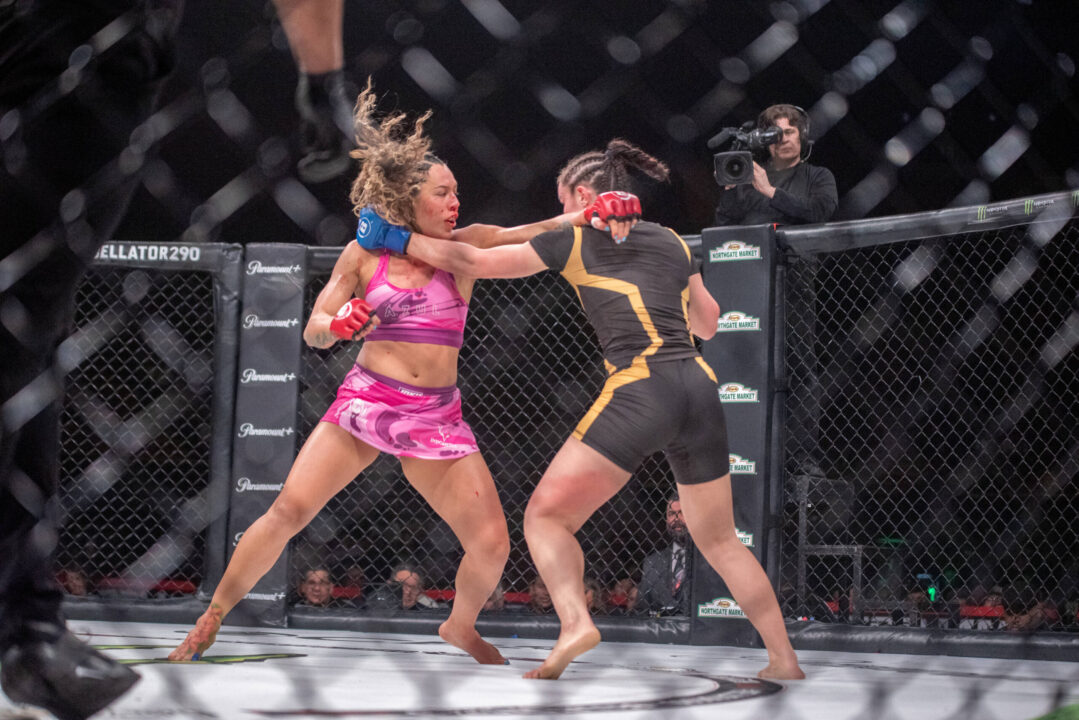
Imago
February 4, 2023, Los Angeles, CA, California, United States: Los Angeles, California – February 4th: Diana Asaragova defeats Alejandra Lara via Split Decision 29-28 x 2, 28-29 x 1 at Bellator 290 Bader vs Fedor 2 at The Forum on February 4th, 2023 in Los Angeles, California, United States. Los Angeles, CA United States – ZUMAp175 20230204_zsa_p175_114 Copyright: xMattxDaviesx
So, it was no surprise that Alejandra Lara tested positive for tests conducted shortly before her April 24 fight at Tuff-N-Uff 153, where she lost to Jaleen Robledo via third-round guillotine choke. Since the positive test was from April, her suspension was backdated and will only extend till January. Regardless, her defeat in April dropped her record to 3-3 since leaving Bellator in 2023.
Prior to that, ‘Azul’ was a regular in Bellator’s women’s flyweight division. She finished 3-6 in the promotion and earned a title chance against Ilima-Lei Macfarlane at Bellator 201 in June 2018. However, in the third round, Macfarlane submitted her with an armbar.
It is worth noting that for many fight fans, cocaine metabolite benzoylecgonine sounds too similar, and that’s because a former UFC champion and legend also tested positive for the same substance just 30 days before a historic fight.
Jon Jones was also flagged for the same coc-ine metabolite over a decade ago
Former UFC two-division champion Jon Jones also tested positive for benzoylecgonine just one day after being featured on Forbes magazine’s “30 Under 30” list of the “brightest young stars” in sports, though the circumstances of his cocaine case were very different.
‘Bones’ tested positive for the coc-ine metabolite in December 2014, following a random out-of-competition sample collected by the Nevada Athletic Commission ahead of his UFC 182 fight against Daniel Cormier.
But the timing resulted in an unusual situation. Jon Jones was not stopped from fighting ‘DC’ because the test was done outside of competition, and coc-ine was not yet banned under the anti-doping rules that were in effect at the time. So, he eventually went on with the fight and defeated Cormier by unanimous decision.
‘Bones’ did, however, briefly enter a treatment facility in Albuquerque following the revelation.
“I’m not a coc-ine addict by any means or even a frequent user,” Jones said at the time. “I just made a really dumb decision and got caught.”
That episode remains separate from the two other instances in which Jon Jones was formally sanctioned for illegal substances. In 2016, he tested positive for clomiphene and letrozole ahead of UFC 200, forcing him to withdraw from his scheduled rematch with Daniel Cormier. But this time, USADA did punish him for a year after Jones blamed the positive test on a contaminated se-ual-enhancement product.
Then came the far more significant 2017 case. ‘Bones’ tested positive for turinabol after defeating ‘DC’ by knockout at UFC 214 to reclaim the light heavyweight title. However, the decision was eventually overturned to a no-contest, and Jones was stripped of his title.
Even though Alejandra Lara’s situation is different, the shared presence of benzoylecgonine has inevitably prompted parallels. For now, the former Bellator title challenger must wait until January before she can return under the Nevada commission’s jurisdiction.