

Dan Hooker has never been shy about embracing chaos. The New Zealand fighter earned his nickname, “The Hangman,” through violence. Over time, his tattoos began matching that fearless personality. For Hooker, tattoos also became personal pieces of artwork. Each design added another chapter to his evolving identity. Some carry cultural meaning, while others simply complete his vision. Let’s piece together the story behind every inked decision — from the traditional Ta Moko to the skulls, axes, and the bold “death drive” ink across his abdomen.
Watch What’s Trending Now!
What is the meaning of Dan Hooker’s chest tattoo?
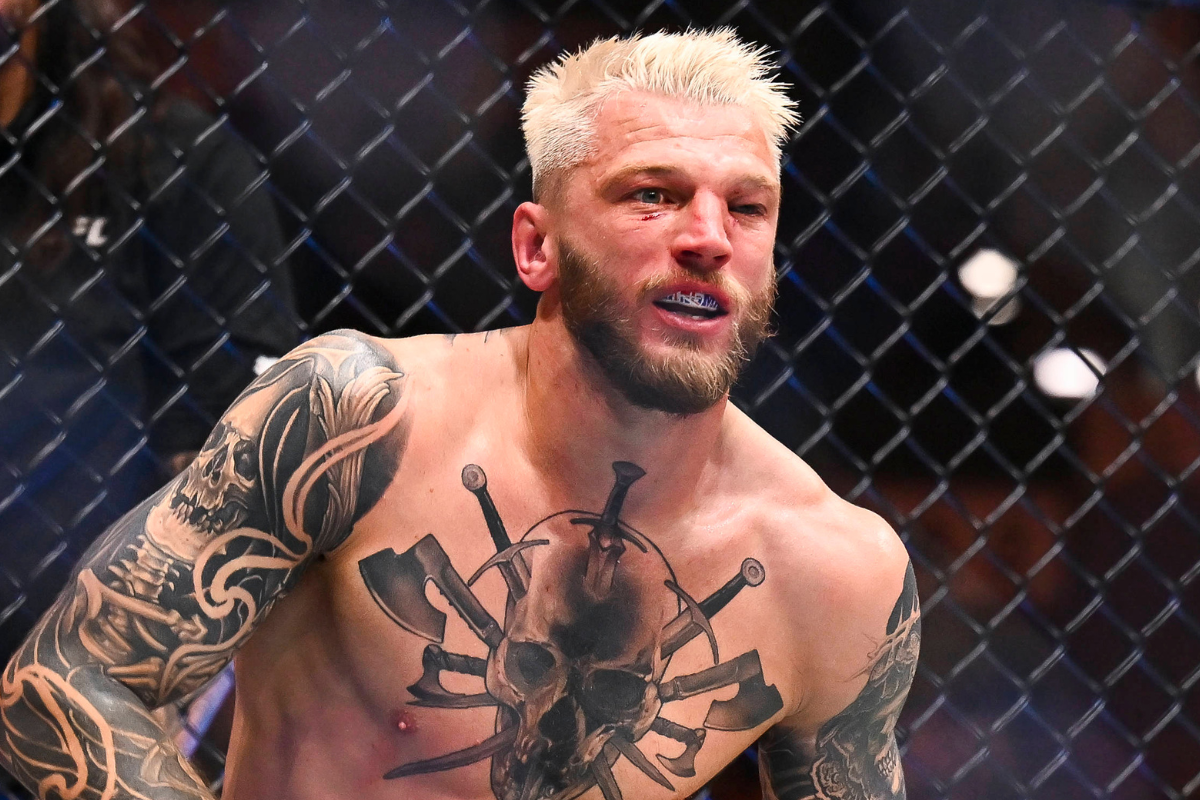
Thinking that just one tattoo on his back didn’t look good, Hooker went on to balance it out with a couple of more inks on his chest and abdomen. The one on his chest is a human skull that has been impaled by 3 daggers and 4 axes. Surprisingly, the New Zealand star received considerable backlash for it.
Talking to ‘The Mac Life’, Hooker once said, “I just had to get it to a point where it looks like how I wanted it to look. I was never just gonna get one tattoo and then [dip]. It’s art, man. It’s a piece of art. So, you gotta have a look like the picture. Everyone can see the picture, I can see where it’s going.” But if the chest tattoo is raw aggression, the next one is tradition, identity, and history.
Imago
Credits: IMAGO
Are there other tattoos on Dan Hooker’s body?
One of the most prominent tattoos on ‘The Hangman’s limbs is the one on his legs. Extending from his feet and going to his knees, Hooker gained a boatload of attention for the traditional Maori tribal Ta Moko tattoo. The Ta Moko serves as a reminder to the people about the responsibilities they have shouldered in their lives. For the Maori people, getting a Ta Moko tattooed is a pretty huge moment of pride and honor.
If you think that’s the only tattoo on Hooker’s limbs, be ready to be surprised. As he said in January 2024, “It pi—es you off when you get like, ‘I got 1 leg done’ and I was like, ‘that looks stupid’— I have to obviously do the next one. Then, do my arm and I was like, well, obviously I have to do my other arm.”
That’s exactly what he did when he put on a tattoo on each of his arms. On the left side, there is a skeletal figure, drawn on his forearm, posing with its hands raised high. His left arm is inked with a veiled skeleton wearing a crown of thorns. And the tattoo on his right arm? It’s probably a reminder of his injury and recovery. He did say that it was “just a scratch”, didn’t he?
The one on his abdomen received even more dislikes. The tattoo on Dan Hooker’s abdomen reads ‘death drive’. Needless to say, the text shows how strong a fighter he is. But many of the fight fans didn’t like the alphabet crowded with designs.
Yet, this piece is a reflection of Hooker’s fighting spirit, the willingness to walk toward risk rather than away from it. Whether fans love it or hate it, it represents exactly who he is as a competitor. But before all these tattoos, Dan Hooker had one design that started it all, a symbol of discipline, warfare, and pride.
The tattoo of a samurai helmet, or kabuto, with a lion in the crest, was the very first tattoo that Hooker inked on his body. The design indeed looks inspired by Alexander Volkov’s samurai helmet tattoo. But what is the significance of a kabuto? Well, samurai are considered among the fiercest warriors in history. Known for their ruthlessness and immense pride, these Japanese warriors command the respect of every martial artist.
A tattoo of the samurai’s helmet might represent a strong defense and a tactical approach to fights. On the other hand, the lion in the helmet’s crest might stand for the fierce warrior’s spirit and represent Hooker’s strength and courage in the arena. Hooker was never shy of showing off the artwork on his body.
Taking to Instagram and sharing his first tattoo, the ‘Hangman’ wrote, “If I’ve ever punched or pi–ed you off before I’m sure you will enjoy watching me get tattooed for this long.”
Together, the tattoos tell a complicated story about Hooker. Some designs represent heritage, while others simply reflect artistic instinct. None needs to explain his entire fighting career. They only need to belong to him. For “The Hangman,” that seems to be the point.