

For a fighter like Stephen Thompson, who has spent over a decade inside the Octagon, saying goodbye to the sport wasn’t an easy decision. Many fighters in ‘Wonderboy’s’ position have spent their retirement weighed down by depressive thoughts. Though the 43-year-old left Madison Square Garden with a spectacular third-round spinning wheel kick finish over Charles Radtke on the UFC 334 prelims, curiosity lingers over what is going through his mind now that he has left the fight game. Would he face emptiness and struggle with post-retirement depression, too? Thompson has finally answered that burning question.
Watch What’s Trending Now!
“Not at all,” Thompson told Fullmount MMA. “The thing is: Me and the UFC is not my identity. There’s a lot of people that fought for the UFC. That’s kind of all they know is the fight game. It’s been a part of them. It’s been their identity since day one.
“For me, my identity is the Karate Kid school, the Karate instructor at Upstate Karate that teaches the kid. That’s what I love to do. The fight game, you know, kept me in shape. It kept me striving to be a better martial artist.”
Post-retirement depression strikes when a fighter faces a mental health struggle marked by low mood, anxiety, aimlessness, and identity loss after stepping away from MMA. This could stem from their minds not adjusting after years of competition inside the Octagon.
Thompson’s words suggest that he’s confident he won’t find himself dealing with anxiety without competing inside the Octagon. He firmly believes his broader identity as a martial arts instructor has proven valuable in this case.
‘Wonderboy’ has been teaching karate at Upstate Karate in Simpsonville, South Carolina, a family school founded in 1983. For years, he has been mentoring kids in his establishment and shaping himself into a devoted martial arts teacher to the next generation. That calling alone gives him a powerful reason to stay fulfilled, even with him not fighting inside the cage anymore.
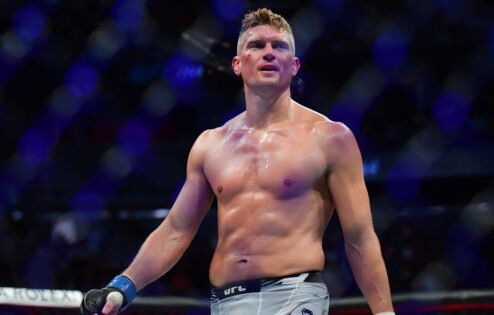
USA Today via Reuters
MMA: UFC 264-Burns vs Thompson, Jul 10, 2021 Las Vegas, Nevada, USA Stephen Thompson reacts following his match against Gilbert Burns during UFC 264 at T-Mobile Arena. Mandatory Credit: Gary A. Vasquez-USA TODAY Sports, 10.07.2021 20:59:11, 16393880, NPStrans, T-Mobile Arena, Stephen Thompson, Gilbert Burns, MMA PUBLICATIONxINxGERxSUIxAUTxONLY Copyright: xGaryxA.xVasquezx 16393880
Even before his retirement fight on November 14, the South Carolina native told Ariel Helwani that he’s going to dedicate his life to up-and-coming martial artists, and that he has “zero regrets” about his retirement. In the recent interview, however, Thompson revealed that he would have fought for free, adding that his identity lies with his character as a martial arts trainer.
“I would have done it for free,” Thompson added. “I tell people that I’m serious when I say this. I have fought so many times for free…the money was just a bonus. But who I truly am is the karate instructor, a karate teacher, passing my knowledge on to the next generation and developing these young kids.
“Boys, girls, and teenagers. Even adults. The martial arts and just being a good human being through it all. That’s my identity.”
It’s reassuring that Wonderboy has such clarity about life after retirement, so he doesn’t find himself facing a void of emptiness. But unfortunately, some fighters have openly shared facing post-fight depression after ending their careers.
UFC fighters who dealt with depression after retirement
When it comes to fighters getting depressed after retiring from the sport, the name of Uriah Hall comes to mind. Like Thompson, Hall fought in the UFC for over a decade and faced names like Anderson Silva. However, after losing to André Muniz at UFC 276 in July 2022, he retired from the sport.
Hall eventually made the transition to boxing, making his debut against Le’Veon Bell in October 2022 on the Jake Paul vs. Anderson Silva card. But even though he got the chance to fight in the same year he retired, Hall explained that the few months without actively participating in MMA sent him into a deep depression, to the point of him contemplating very dark thoughts.
“I spent the last 20 years of my life committing myself, my soul, to one attribute, and then all of a sudden, it’s gone, it’s taken away,” Hall told MMA Fighting. “It was some really dark, deep places, and luckily, I had the right people around me to support me.”
Another admission came from Amanda Nunes before she conceded submission loss against Kayla Harrison at UFC 334. She told Demetrious Johnson on his podcast that after hanging up her gloves at UFC 289, she felt severe anxiety and feared becoming depressed.
“After you retire, you realize you don’t really know yourself,” Nunes said. “I always had something to chase, and then one day, you suddenly stop. I started getting anxiety, and I was scared of being depressed. I needed something to focus on in my life and prepare for my life.”
Thompson, by contrast, appears to have the right mentality to avoid such thoughts after retirement, as he plans to coach young kids following his exit from the UFC.