
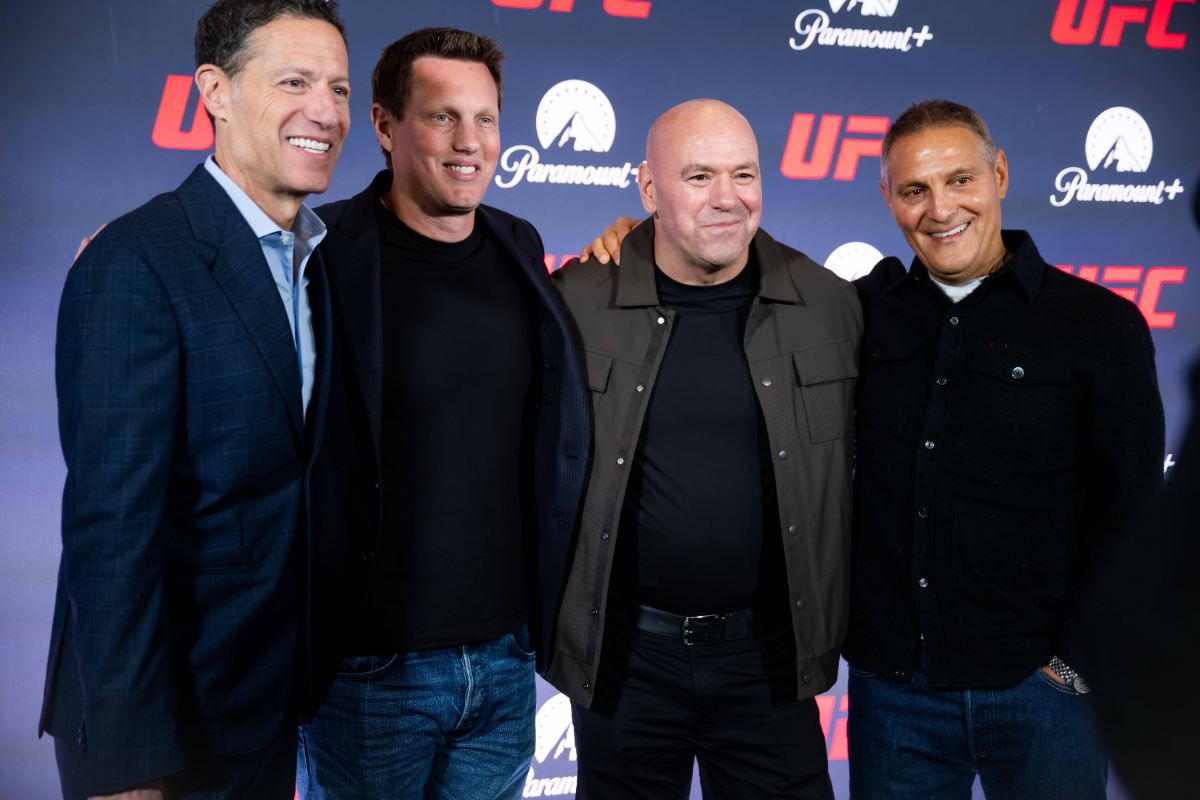
Double the annual value of the previous ESPN deal, a historic breakup with the PPV model, and a one-stop shop for all things UFC on a modern-era streaming platform – these were the pillars of the UFC’s new streaming rights deal with Paramount+. Expectations were high. Increase in fighter pay, bonuses, and fewer watered-down cards hosted back-to-back at the Apex were some of the earlier predictions. But was that all there was to this historic partnership?
Watch What’s Trending Now!
Analyst Luke Thomas believes there may be deeper strategic motives behind Paramount’s $7.7 billion deal with the UFC. The promotion inked the broadcast agreement in August last year and began operations at the start of this year. While the transition to a new broadcast partner wasn’t entirely seamless, particularly due to early streaming issues, the situation has since stabilized. Even so, Thomas remains skeptical, suggesting it’s difficult to see how Paramount will fully recoup such a massive investment through the deal.
“There is no way Paramount is going to make their money back on UFC,” Thomas said during an interview withPablo Torre on PABLO TORRE FINDS OUT. “Not only are they not going to make their money back, [but] they’re going to take a bath.”
The UFC agreed to a seven-year deal with Paramount Global worth $1.1 billion annually. Under the agreement, Paramount secured rights to all of the UFC’s major content, including numbered events, Fight Nights, The Ultimate Fighter, and Dana White‘s Contender Series.
Unlike the promotion’s previous arrangement with ESPN—which relied heavily on a pay-per-view model—the new deal shifts entirely to a subscription-based structure on Paramount’s platform. However, according to Luke Thomas, there’s reason to believe the UFC wanted to retain at least a partial presence on ESPN as part of a broader strategy.
CEO Dana White had confirmed as much when they were negotiating with different platforms. He claimed the different UFC shows could end up on different platforms. At least, that was the case before Paramount came out of left field.
Thomas said, “They [UFC] wanted Netflix to buy what they could, and then they were going to maybe sell back the rest to ESPN. But Netflix was like, ‘We only want the numbered events. We don’t really want the rank-and-file ones,’ which makes sense for Netflix’s business model.
“And so they were trying to see if they could make that work. Some of the industry projections around that time were around $800 million per year if they could split it up, maybe a little bit higher even than that on the really high end. Then, as you indicated, the Skydance merger happens with Paramount.”
Just before the UFC–Paramount agreement, Skydance Media merged with Paramount Global in an $8 billion deal that officially closed in August. Paramount had already been struggling to adapt to the streaming era, burdened by significant debt and in need of a lifeline through a buyout.
The newly combined company is now led by David Ellison, who serves as Chairman and CEO. According to Luke Thomas, Ellison’s involvement was a key factor in pushing the UFC deal across the finish line, suggesting the agreement may be part of a broader strategic vision rather than a straightforward media rights play.

"There is no way Paramount is going to make their money back on UFC." —@LThomasNews on the possible ulterior motives that might make up the UFC's $7.7 billion streaming-rights price tag
“And all of a sudden, here come the Ellisons, who are regime-allied, regime-friendly. Of course, Dana White is regime-allied and regime-friendly. And they give them $1.1 billion a year for seven years. I just don’t understand, even with how many subs they can pull or what the ads are, they can show how they can possibly make their money back…
“You’re going to get to go and have an event at the White House, and you’re going to get potentially laws passed in your benefit to make that boxing even more lucrative. Like, there are a lot of reasons, certainly, where I could understand you would want to be aligned with people at this particular moment in time who are going to have, let’s put it euphemistically, the regulatory wind at their back.”
Pablo Torre responded, “Which is all to say that what Dana White wants, seemingly, out of all of his business dealings with Donald Trump is not just the widest possible berth for the UFC to operate with impunity; he wants the ability to remake combat sports in his image.”
Zuffa Boxing has thrown its support behind the Muhammad Ali Boxing Revival Act, a move that could pave the way for the creation of Unified Boxing Organizations (UBOs) and introduce the UFC-style business model to professional boxing. The bipartisan bill recently cleared the U.S. House of Representatives via a voice vote, marking a significant step toward potential reform in the sport.
Alongside the UFC, Paramount has also signed a deal to broadcast Zuffa Boxing events on the platform. And Thomas pointed out how Zuffa could scale up production and match the number of yearly events as the UFC. Regardless of what Luke Thomas believes were the underlying motives, the deal has already proven highly beneficial for Paramount.
UFC 324 delivered record-breaking viewership numbers on Paramount+
As the first event under the UFC’s seven-year, $7.7 billion deal with Paramount, the card drew an impressive 4.96 million average viewers, with more than 7 million households tuning in for the main card. At its peak, the event reached 5.93 million concurrent streams, making it the largest exclusive live event in Paramount+ history.
Held at the T-Mobile Arena, UFC 324 was headlined by Justin Gaethje defeating Paddy Pimblett to claim the interim lightweight title. According to data from Nielsen Media and Adobe Analytics, the event reached more homes than any UFC show in nearly a decade across linear, broadcast, and streaming platforms, signaling a major success for the UFC’s move away from pay-per-view.
Paramount may not fully recoup its investment, as Luke Thomas suggests, but bringing the UFC onto the platform functions as a powerful long-term marketing engine. It doesn’t just raise awareness of Paramount+—it actively drives consumers to subscribe and engage with the product.
By replacing pay-per-view with a subscription model, the UFC effectively turns each major event into a funnel for new users while reinforcing retention among existing ones. Where fans had to pay $79.99 per PPV event on ESPN, they can now pay as little as $8.99 per month on the subscription model, or even a slightly higher price for ad-free options. The highest-priced ad-free yearly subscription costs around $140, and fans get to see all UFC shows on one platform.
That dynamic is likely to persist throughout the duration of the seven-year deal, making the partnership as much about sustained audience growth as it is about immediate financial return.