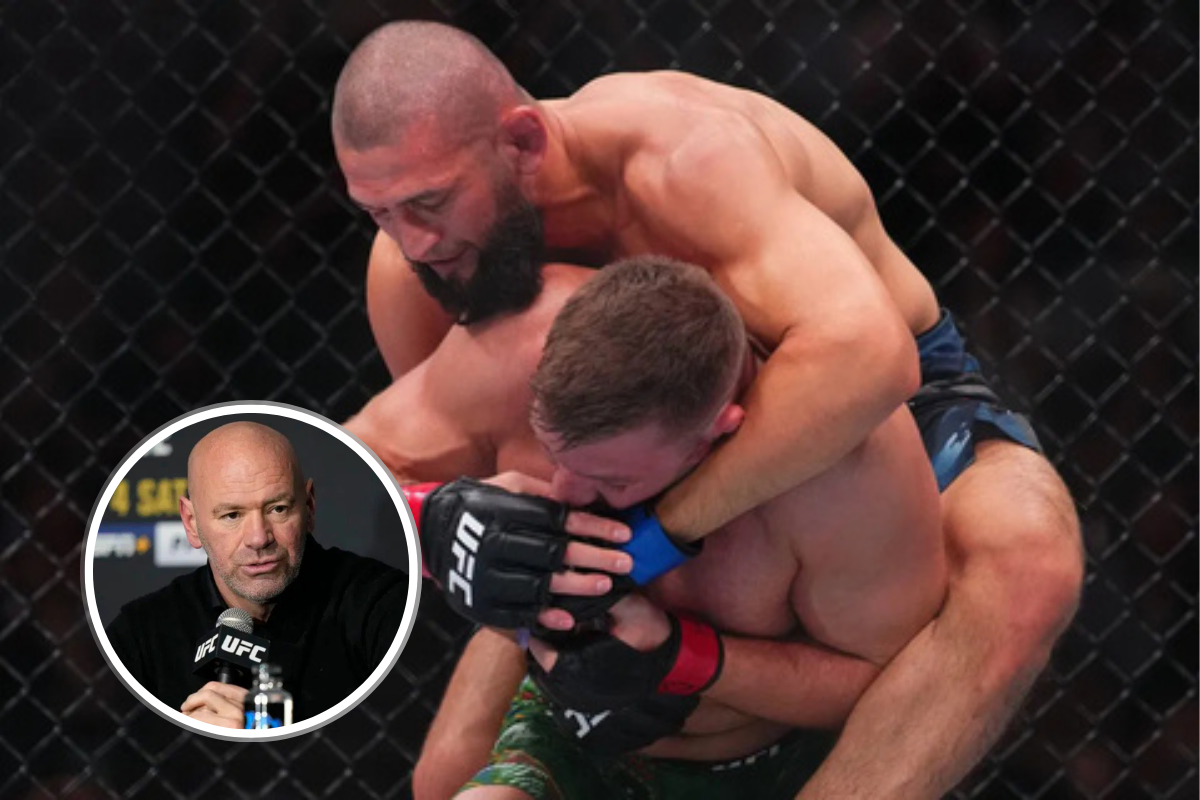
The aftermath of UFC 319 wasn’t loud because of controversy. Fans witnessed Khamzat Chimaev deliver one of the most crushing title-winning performances in the middleweight division’s history, but the scorecards failed to capture the atmosphere in the arena. Dominance was obvious. The numbers, however, told a more restrained story.
Watch What’s Trending Now!
The discrepancy between how the fight felt and how it was officially scored grew when Dana White admitted he had it even more lopsided than the judges. To him, the control, positioning, and constant pressure resembled repeated 10-8 rounds. However, the rulebook does not reward “feels dominant.” It rewards something far narrower.
John McCarthy explains why Chimaev vs. DDP Round 1 wasn’t a 10–8 despite the domination
Veteran referee John McCarthy explained what the difference was during a recent officiating seminar. Addressing the debate around Round 1 of the UFC 319 main event, McCarthy made it clear that control alone isn’t enough. Even when one fighter is clearly ahead, judges are advised to emphasize damage.
According to McCarthy, Dricus du Plessis was undeniably being dominated but not visibly hurt. He said, “DDP needs to be hurt to the point where I see him starting to have a problem with what’s happening.” He explained that a 10-8 requires the losing fighter to be so damaged that their ability to defend or function is deteriorating.
In the first round, ‘Stillknocks’ was dominated, flattened, and worked over by Khamzat Chimaev—but he remained mentally present and physically responsive. That’s where John McCarthy drew a line between the judges’ criteria and Dana White’s interpretation. “Dana White said, ‘That’s a 10-8.’ You’re not reading our criteria, are you? Because what does it take? Damage,” he added.
.@JohnMcCarthyMMA explains why Round 1 of Khamzat vs. DDP was not scored a 10-8:
“There was nothing that Khamzat did—although he was unbelievably dominant—that truly showed damage.
DDP needs to be hurt to the point where I see him starting to have a problem with what’s… pic.twitter.com/WlJbRETU49
— Ariel Helwani (@arielhelwani) February 11, 2026
The UFC CEO saw positional helplessness as sufficient to warrant bigger margins. Officials, on the other hand, have been taught to differentiate between dominance and damage. Without obvious symptoms of physical deterioration—wobbly reactions, diminishing resistance, or fight-altering strikes—the round remains a 10-9, regardless of how one-sided it appears.
When Casey Leydon of Uncrowned Films argued for a 10-8 over a ‘breaking of [Du Plessis’s] fighting spirit,’ McCarthy shut that down too. Now, for reference, a better example of fighting spirit breaking in the cage would be the UFC 322 main event between Jack Della Maddalena and Islam Makhachev. JDM’s facial expressions and body language clearly conveyed his helplessness. Yet, all the rounds were 10-9 in favor of Makhachev, not 10-8.
Another example of damage being the deciding factor was Jailton Almeida vs Alexander Volkov at UFC 321. Rounds 2 and 3 saw heavy grappling from the Brazilian, but without significant offense or damage. While one referee gave them both to Almeida, the other two split the rounds between the heavyweights, giving the second to Jailton. Volkov won a 29-28, 29-28, 28-29 split decision, thanks to his convincing win of the first round.
The irony is that both perspectives can be valid at the same time. Khamzat Chimaev delivered one of the most dominant title performances in recent memory, yet Dricus du Plessis still made it through all five rounds. The scorecards weren’t disregarding Chimaev’s greatness; rather, they reflected how tightly the sport defines overwhelming success. And now, that same success can follow ‘Borz’ to a new division.
Kamaru Usman reveals Chimaev’s light heavyweight plans
If scoring debates were about interpretation, the next chapter involving Khamzat Chimaev may be about physiology. According to Kamaru Usman, the middleweight champion’s dominance at 185 may be hiding an even bigger issue: size. And that, he feels, is why Khamzat Chimaev is openly considering a move to light heavyweight instead of settling in for a lengthy title reign.
On his Pound 4 Pound podcast, Usman mentioned that ‘Borz’ is already struggling with the 185-pound limit. “For my man Khamzat Chimaev to continue to call him [Alex Pereira] out, I think Khamzat potentially has outgrown the weight class again,” he said. Rumors that Chimaev weighs between 225 and 230 pounds add to that belief. “Khamzat is a big guy. Khamzat’s always been a big guy.”
‘The Nigerian Nightmare’ compared the situation to Anthony Johnson, who pushed his body to the limit at welterweight before opting for middleweight and then light heavyweight. “The fact that Khamzat was making 170 is just as ridiculous as Anthony Johnson when he was making 170,” Usman claimed. So, for Khamzat Chimaev, if the cut is becoming the toughest opponent, moving up may not be a luxury; it may be the only option left.
Written by

Edited by

Yeswanth Praveen