
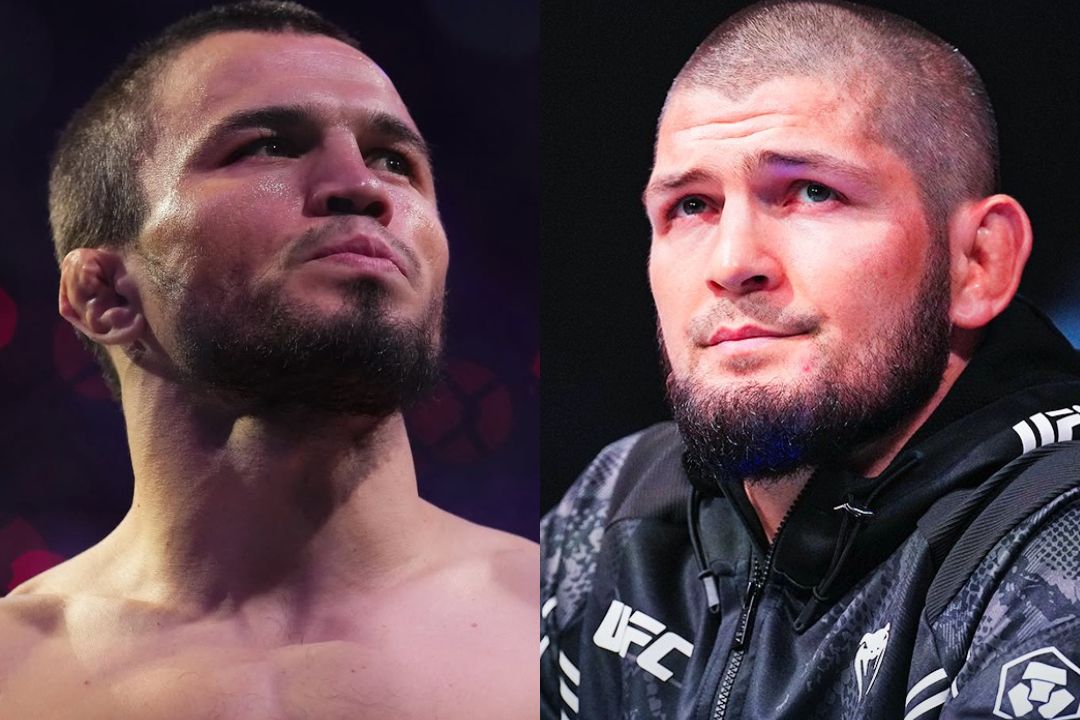
“For me as a young boy, my older brothers have always been an example,” Umar Nurmagomedov once said. That glimpse into his childhood reveals how deeply family and sport were intertwined while he was growing up in Dagestan. Today, with an impressive MMA career of his own, Umar has stepped out of the shadows of his famous relatives. But his story still begins with the culture and family roots that shaped him. Umar Nurmagomedov’s ethnicity offers a fascinating look at the heritage behind one of Dagestan’s rising UFC stars.
Watch What’s Trending Now!
Where is Umar Nurmagomedov from?
Umar Nurmagomedov is from Kizilyurt in the Republic of Dagestan, Russia, where he was born on January 3, 1996. Located in Russia’s North Caucasus, Dagestan has a strong combat-sports culture, and Umar’s connection to the region has been central to his development as a fighter. He has spoken about how fighting was part of everyday life there.
Umar began training in his native Dagestan before eventually developing into a professional MMA fighter. His roots also connect him to the renowned Nurmagomedov fighting family, including his cousin and former UFC champion Khabib Nurmagomedov.
As of now, Umar represents Russia and competes in the UFC bantamweight division, carrying his Dagestani fighting heritage with him into the Octagon.
What is Umar Nurmagomedov’s nationality?
Umar Nurmagomedov is Russian by nationality and was born on January 3, 1996, in Kizilyurt, Dagestan, Russia. He is 30 years old as of August 2026. Umar spent his childhood in his native village in Dagestan, where he began training in freestyle wrestling alongside his younger brother, Usman, before moving toward Thai boxing.
His education also extended beyond combat sports. Umar attended university and earned a degree in Business Management, a qualification his father encouraged him to pursue as a backup for life after fighting. Umar has explained that his father wanted him to have a higher education because a career in sports can be unpredictable.
Interestingly, Umar’s school years were affected by competitions and training, but he said he generally performed well.
What is Umar Nurmagomedov’s ethnicity?
Umar Nurmagomedov hails from the mountainous region of Dagestan, which is part of the Russian Federation. Interestingly, Dagestan lies in the North Caucasus of Eastern Europe, home to around 3,182,054 citizens living along the Caspian Sea.
Ethnically, ‘The Young Eagle’ belongs to the Avars, one of the largest ethnic communities in the North Caucasus. According to Wikipedia, the Avars reside along both the Black Sea and the Caspian Sea, and their language is distinct from modern Russian.
Digging a little deeper, we found that the Avars make up about 30.5% of Dagestan’s population, followed by Dargins at 16.6% and Kumyks at 15.8%, making them the largest ethnic group in the region.
So, as we can see, Umar definitely comes from a rich cultural background, filled with deep history and fascinating traditions. With that in mind, let’s move forward to explore how his early life in Dagestan shaped him into the fighter he is today.
Is Umar Nurmagomedov Muslim? What is Umar Nurmagomedov’s religion?
Yes, Umar Nurmagomedov is Muslim. His Islamic faith is an important part of his personal identity and his connection to his Dagestani roots. Umar was born and raised in Dagestan, Russia, a region with a large Muslim population and a strong tradition of producing elite combat-sports athletes. The UFC lists Dagestan as his birthplace, and in his official profile, Umar names Prophet Muhammad (saw) as his hero, providing direct evidence of his Islamic faith.
His religious identity has also been reflected in his approach to life outside the cage. Umar has also discussed his training routine during Ramadan, the Islamic holy month when Muslims fast from dawn to sunset.
Umar’s Muslim identity is also consistent with his broader family background. His cousin Khabib Nurmagomedov, one of MMA’s most prominent Muslim athletes, has openly spoken about his own Islamic faith.
For Umar, however, religion is more than a label. His UFC profile’s reference to Prophet Muhammad as his hero offers one of the clearest public indications of the role Islam plays in his life.
With that said, do you think he can continue winning? Let us know in the comments section below.