
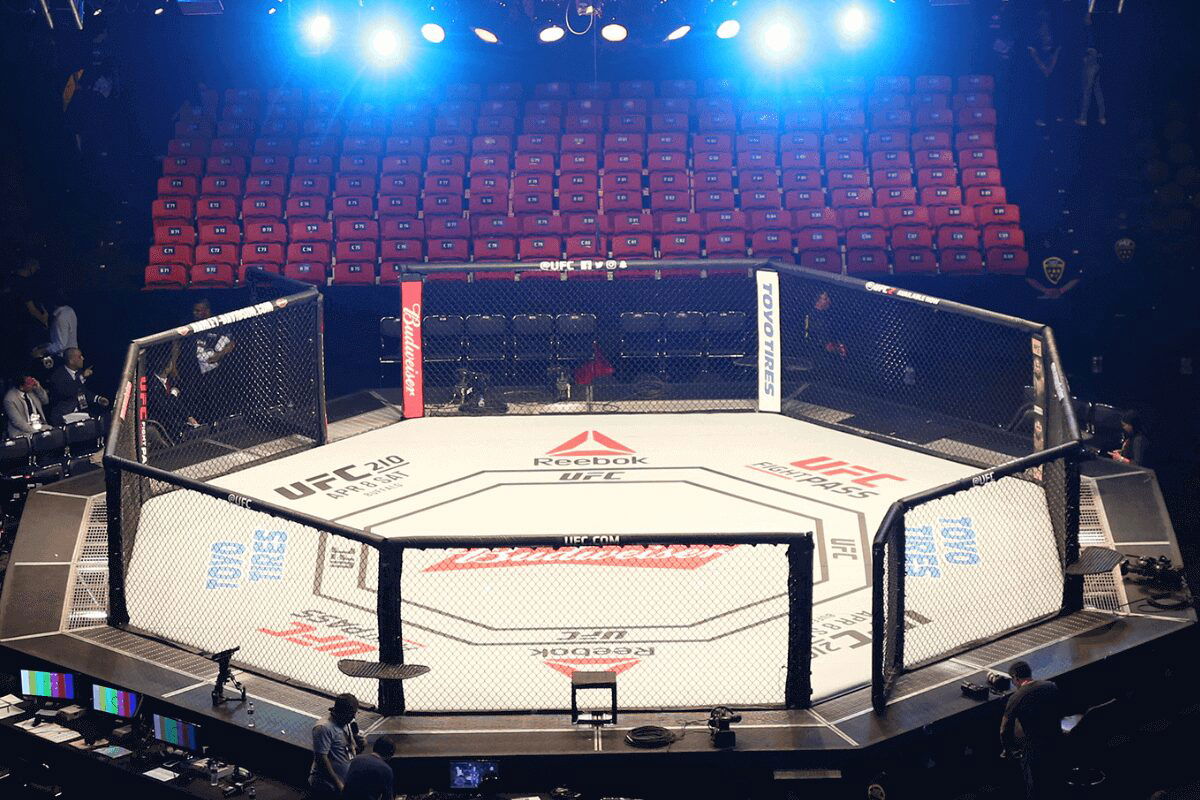
Fresh off a spectacular second-round KO win over Manuel Torres in front of his home crowd at UFC Baku last weekend, the pride of Azerbaijan, Rafael Fiziev, opened up about a fight that pushed him away from a lifelong dream.
Watch What’s Trending Now!
Long before becoming one of the UFC’s most exciting lightweights, ‘Ataman’ dreamed of serving as a police officer. Fiziev was born in Korday, Kazakhstan, in 1993, but did most of his growing up in Kyrgyzstan, and as soon as he was of age, he enrolled in the police academy there. Later, he graduated from the Kyrgyzstan Police Academy, got a law degree, and expected to spend his career fighting organized crime and drug trafficking. Instead, he says he walked into a system plagued by corruption, favoritism, and intolerance. During a recent interview with Ariel Helwani, the 33-year-old explained why his law enforcement career lasted only a few months.
“Not long time, bro,” the 14-5 UFC lightweight said. “A couple of months because I finished Police Academy. I’m going to work and see all of this bulls–t in the Kyrgyzstan police. I see nothing, zero justice, and 100% corruption. I said, ‘What the f–k? I don’t want to be here.’
“When I was studying, it was my dream to stay, against the Mafia, against the drug-dealers, against this bullsh-t. But when I finish academy, I came, I want to be in some position like where I can work, where I can protect, where I can be against the drug dealers or something. But they put in a back position, a sh-t position, where I don’t want to be.”
While he had already begun his MMA career by this point, he was still juggling between his police job and his combat journey. Despite representing the police force in multiple tournaments, he revealed that he was relegated to trivial tasks in the service. This drove him to consider that there might be more to it than meets the eye.

Rafael Fiziev reveals why he quit his job as a police officer in Kyrgyzstan due to corruption: "I went to work and saw all of this bullshit in the Kyrgyzstan police. There was zero justice—100% corruption. I said, 'What the f*ck? I don't want to be here.' It was my dream to Show more
“I see the people who don’t study good, they just pay money to be in good position. But I am a smart guy, I learn good, I study good. I try to be a good officer, a smart officer. And because of corruption, because I have blue eyes and white skin, they don’t put me in good position,” he explained. “So I say okay, I don’t want to stay in bad position because of corruption and because I have different face, so I am going to finish with that and I am going to make my professional (MMA) career.
“This is a hard decision because five years I was studying, before this five years in school. I was dreaming about how I be how to be a police officer. So 10 year totally maybe, I was dreaming about I can be a police officer. and what I do actually, I stand in a bad position f—-ing going and give a ticket to bad parkings. What the f–k, you know, and I and I say, ‘Okay, f–k it. I’m going to leave it.’”
Fiziev’s account also reflects a broader issue within Kyrgyzstan. The country faces a highly pervasive, systemic, and deeply embedded form of corruption, so much so that the widespread public anger over rampant state corruption and cronyism has fueled three separate revolutions (2005, 2010, and 2020) that successfully overthrew sitting presidents. Yet even to this day, the issue persists. In the 2025 Corruption Perceptions Index (CPI) published by Transparency International, Kyrgyzstan scored a low 26 out of 100, ranking 142nd out of 182 countries globally. So one can only imagine how difficult things were in the early 2010s.
But while leaving the force might have been a difficult decision for Rafael Fiziev at the time, things have since worked out well for the 33-year-old. In 2015, after quitting his police job, the lightweight contender moved to Phuket, Thailand, to pursue Muay Thai and MMA full-time.
He initially trained at Phuket Top Team before switching to Tiger Muay Thai in 2017, where he later became a striking coach. And in 2019, at the age of 26, he made it into the UFC. Though he lost his first fight, he has since amassed a respectable 8-5 record in Dana White’s promotion.
The 33-year-old isn’t the only UFC fighter with a background in law enforcement. Former UFC heavyweight Chris Daukaus worked at the Philadelphia Police Department as an officer before quitting in 2021, ahead of his big fight against Derrick Lewis. Trevin Giles actively maintained a double-duty status during his UFC run, working as a full-time police officer with the Houston Police Department while actively competing on major UFC cards.
Meanwhile, there have been others who have taken up a career in law enforcement after their run in the UFC. Former UFC bantamweight title contender Marlon Moraes is part of the Coral Springs Police Department in Florida. Former UFC welterweight champion Johny Hendricks, after his retirement in 2018, pivoted to a career as a licensed police officer in the state of Texas. Even UFC legend Anderson Silva is currently training to become a police officer in Beverly Hills.
For the UFC lightweight star, however, walking away wasn’t about balancing two professions. It was walking away from a system he no longer believed in, and leaving the police force wasn’t the only life-changing decision he made.
The reason Rafael Fiziev stopped representing Kyrgyzstan
Although he had left Kyrgyzstan in 2015 to pursue combat sports, he had continued representing the country internationally for several years. But it changed in 2021.
Despite having issues with his adopted home, he still represented Kyrgyzstan in combat tournaments as well as on the international stage. But in 2021, it changed when Fiziev, who is a devout Shia Muslim unlike Kyrgyzstan, where over 90% of the Muslim population adheres to Sunni Islam, shared a video on social media from a religious pilgrimage to Iraq, where he was filming at the Imam Ali Mosque in Najaf—one of the holiest sites in Shia Islam.
This triggered a wave of cyberbullying and institutional pressure. The Muftiate, the state-approved Islamic religious authority that oversees clergy in Kyrgyzstan, openly targeted Rafael Fiziev. Even high-profile religious figures, including the former Grand Mufti Maksat Toktomushev, released public videos and statements criticizing the UFC lightweight’s Shia beliefs.
Following the religious condemnation from influential figures and a flood of online harassment aimed at the UFC star and his family, Fiziev was forced to turn off the comments on his social media accounts. In a subsequent post, he revealed his decision to turn his back on the country that he had called home for so long.
“That’s it, I’m done. Nothing ties me to Kyrgyzstan anymore. My family and I are considering moving. I will no longer compete for Kyrgyzstan,” Fiziev wrote on his Instagram. “My family and I have been subjected to harassment by the muftiate and other well-known people in Kyrgyzstan. Because of this unjustified harassment and lying videos, my family and I receive angry messages, hundreds of them.”
It’s difficult to fault Rafael Fiziev for his position in this regard. When the home refuses to step up for you, even the most patriotic of us are forced to make a choice. It seems the 33-year-old is happy with the choice he made. Today, he represents his father’s native Azerbaijan and regularly features on UFC cards in the country, like the one last week.