Imago
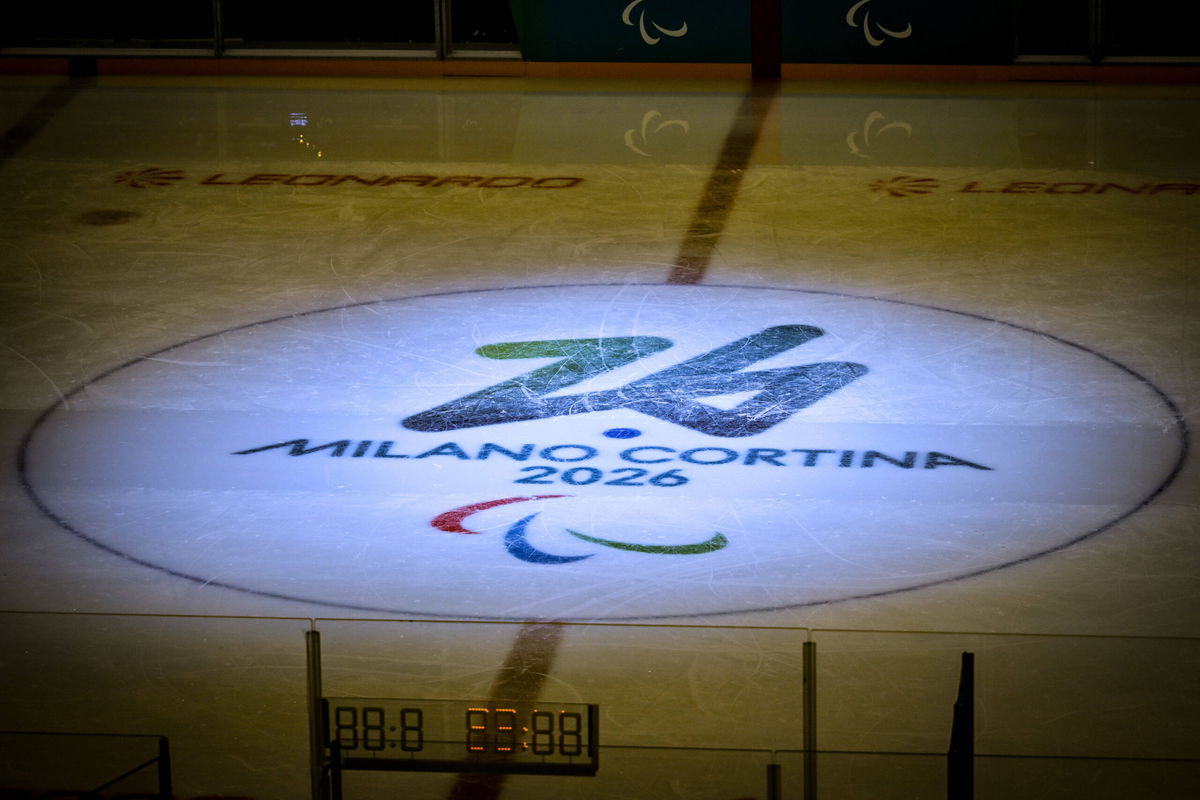
General view of The Milano Cortina Olimpic Logo during the Paralympic Games Milano-Cortina 2026, Ice hockey, Eishockey match between Czechia vs Japan on March 6, 2026 at Arena di Verona in Verona, Italy during Paralympic Winter games, Winterspiele,Spiele, Summer games MILANO-CORTINA 2026 – Para ice hockey – Czechia vs Japan, Olympic Winter Games Milano-Cortina 2026 in Milano, Italy, March 07 2026 PUBLICATIONxNOTxINxITA Copyright: xAlessioxMarini/IPAxSportx/xipa-agency.netx/xx IPA_72501227 IPA_Agency_IPA72501227
Imago
General view of The Milano Cortina Olimpic Logo during the Paralympic Games Milano-Cortina 2026, Ice hockey, Eishockey match between Czechia vs Japan on March 6, 2026 at Arena di Verona in Verona, Italy during Paralympic Winter games, Winterspiele,Spiele, Summer games MILANO-CORTINA 2026 – Para ice hockey – Czechia vs Japan, Olympic Winter Games Milano-Cortina 2026 in Milano, Italy, March 07 2026 PUBLICATIONxNOTxINxITA Copyright: xAlessioxMarini/IPAxSportx/xipa-agency.netx/xx IPA_72501227 IPA_Agency_IPA72501227
At the 2026 Winter Paralympics, Women’s Para ice hockey is still largely pushed to the sidelines. There’s no dedicated event, and most teams, including Canada, have no women on their rosters. Only one female athlete competed, and that was in the mixed tournament. Sure, the U.S and Canada are now battling for the gold medal, but that doesn’t erase the reality: women still have no medal of their own. And now, Claire Buchanan and others are speaking out, raising awareness for real change.


During a recent segment for the Milano Cortina 2026 Paralympic Winter Games, CBC Sports digital host and Paralympian Allison Lang, who won bronze in sitting volleyball at Paris 2024, addressed the mixed-gender status of Para ice hockey. “This is a mixed-gender event,” Lang said, “both men and women can play to represent their nation.”
Watch What’s Trending Now!
Lang then asked Shireen Ahmed, the Canadian writer, sports activist, and award-winning public speaker, why no women’s Para ice hockey teams currently compete at the Paralympics. Ahmed explained that women’s para hockey is not part of the Paralympic program at all. While the sport is labeled mixed-gender, not every team fields a woman. Canada, for example, has none on its Paralympic roster.
“And I think that’s important to recognize, because it’s almost a way of it’s not a loophole, I don’t know if I would say that but it’s not a way of actually addressing the need for having women’s para hockey there.”
Women’s Para ice hockey is yet to be included in the Paralympics, but there is a possibility for that in Paris 2030. However, the journey to get there is not easy. The International Paralympic Committee (IPC) demands that for a sport to be included, it must have a minimum of eight national teams that have competed in at least two Women’s World Championships.
As of now, only one championship has been conducted in 2025, with Buchanan’s side winning silver. But the second championship, which is crucial for the qualification, does not have a host yet for 2026. Moreover, there are not yet eight fully competitive national teams in the world. Without these steps, a Women’s Para Ice Hockey event cannot be added to Paris 2030.
'We deserve more:' Para women’s ice hockey still NOT represented in the Paralympics@_shireenahmed_ & women's Para hockey world silver medallist Claire Buchanan discuss the double-standard for men and women in para ice hockey at the Paralympic-levelhttps://t.co/NzjQJISpuw pic.twitter.com/yVjTyAjtJM
— CBC Sports (@cbcsports) March 13, 2026
Speaking from experience, Buchanan described the challenges female Para athletes face: “And a female para athlete is you can’t just show up and be an athlete and train and compete. You have all these other things you have to push for, and it’s exhausting. And we’ve had athletes actually step away from women’s para hockey because of it. And so we’re losing athletes to other sports. We don’t have the funding, and we don’t have the structure for it to actually be sustainable.”
She added, “Exposure is growing, and World Championships like last year are huge for that, but then again…we don’t have anyone holding their hand up to say hey, we want to host 2026.”
Historically, only three women have ever competed in Para ice hockey at the Winter Paralympics: Britt Mjaasund Oyen, Lena Schroder, and Yu Jing. For decades, women made up less than 1 percent of the global player base, though recent development efforts have raised that to around 20 percent. Still, progress is early, and meaningful inclusion remains a work in progress.
Even as things are slowly changing and the progress is limited, Claire Buchanan sees it as a step forward, but she’s far from happy with being given just the “bare minimum.”
Claire Buchanan slams Paralympics’ Para hockey gender gap as USA faces Canada for gold
Well, the Para ice hockey gold medal game at the 2026 Winter Paralympics is set: Team USA and Team Canada will face off on March 15. Both teams battled their way to the semifinals, with the USA, who were led by the veteran Declan Farmer, beating Czechia 6‑1 and Canada defeating China 4-2, to secure a spot in the final. It will be the third gold medal showdown between the two heavyweights during the Paralympics.
However, during the excitement, women are still mostly absent from the Paralympic ice hockey field. Only one woman, Akari Fukunishi of Japan, saw ice time in the mixed tournament, and that was in her team’s final game. For athletes like Claire Buchanan, a world silver medalist, the lack of a dedicated women’s event is a bitter reality.
She wanted to be part of the Paralympic tournament herself, saying, “If women’s Para hockey was in the Paralympics, I’d be going into my third Paralympic cycle right now.” But at the same time, Buchanan celebrates Fukunishi’s achievement, but she doesn’t hold back her frustration:
“There is a female that competed at the para hockey tournament this year with Team Japan. And yes, she got ice time in the very last game that Japan played in. And then I heard, oh, well, it’s better than nothing. I’m tired of that rhetoric. I’m tired of hearing that. We need more. We deserve more. And the bare minimum is not acceptable anymore.”
These are the underlying struggles that female Para athletes are exposed to, she explained: “We have constantly heard this rhetoric of, well, when you get here, then we’ll support you. But we can’t get there without support… and expecting us to be happy about it.”
While Fukunishi’s appearance is a step forward, Buchanan’s words show the ongoing struggle: women still have no medal of their own, minimal representation on national teams, and limited recognition.