
The Wild West concept of the deadliest race combo split the world during the Ironman Triathlon introduction. Breaking it down–it’s a .93-mile (1.5 km) swim, a 24.8-mile (40 km) bike ride, and a 6.2-mile (10 km) run–added to the table of Olympic sports in 2000. It all began when a marketing executive convinced the masses that each of the individual disciplines was already included in the Olympics.


The Olympic distance triathlon got traction from both its supporters and critics eventually making it to the Olympics menu. Decades since the early backlash, once again triathlon is in the pool of challenges this 2024 Paris Olympics. This time it’s the Paris’ Seine River showing alarming levels of bacteria like E.coli.
Watch What’s Trending Now!
Paris Olympics’ distance triathlon’s troubled history
In 1980, Carl Thomas, an All-American swimmer and water polo player who also worked as a marketing executive at Speedo launched the United States Triathlon Series (USTS) with California-based sports promoter Jim Curl and Davis. Thomas told Inner Voice Media, “It was North American versus the rest of the world…There was a huge contingent, mostly in Europe, which believed the Ironman was the holy grail.”
Reuters
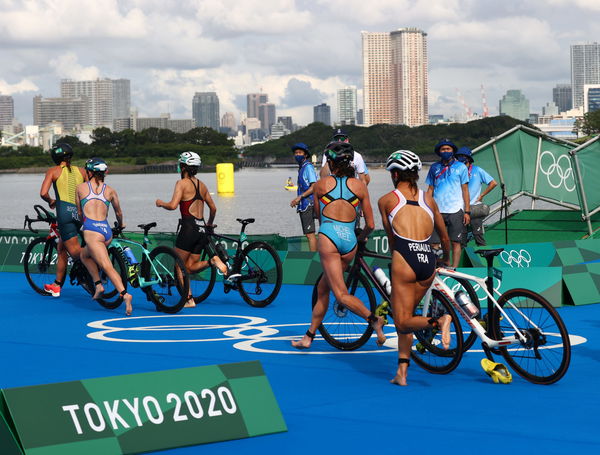
Tokyo 2020 Olympics – Triathlon – Mixed Team Relay – Final – Odaiba Marine Park, Tokyo, Japan – July 31, 2021. Emma Jeffcoat of Australia, Verena Steinhauser of Italy, Yuko Takahashi of Japan, Claire Michel of Belgium and Leonie Periault of France in action REUTERS/Kacper Pempel
The format gained momentum in the U.S. but the most crucial step was still left, the Olympic acceptance, which was a long shot. Thomas was persistent, the Ironman Triathlon first saw a mid-distance format introduced in the 1984 Olympics. He called the sport a “logistical nightmare” but anchored the National Championships in Maui before closing USTS in 1993. Finally, the long-distance format became an internationally regarded event launched at the 2000 Sydney Olympics. The Olympics-distance triathlon shares the longevity of its challenging history with the Seine River.
Seine River to allow swimming after 100 years
Due to an elevated level of metal and fecal bacteria, swimmers were prohibited by law from using the Seine since 1923. In 2022, Time published that “1.9 million cubic meters of untreated wastewater” is dumped in the Seine, making it no less polluted than it always has been. According to Time’s last year feature a $1.5 billion project aimed to clean a 481-mile Seine River spanning from Burgundy through Paris and down to the Normandy Sea by this spring.
Reuters
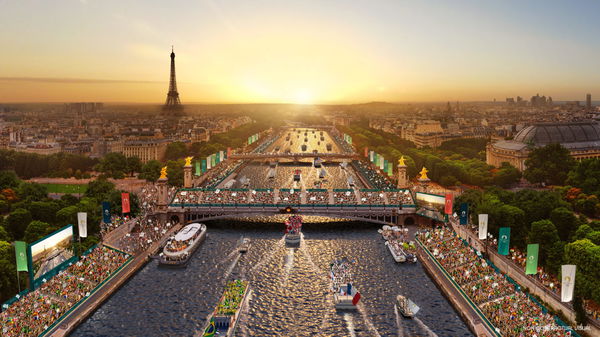
A visualisation of the 2024 Paris Olympic Games opening ceremony is pictured in this undated handout obtained December 13, 2021. Paris 2024/Florian Hulleu/Handout via REUTERS THIS IMAGE HAS BEEN SUPPLIED BY A THIRD PARTY NO RESALES. NO ARCHIVES
The history is so badly ignorant that until the Olympics bid in 2016, no government body even brought up the topic. But later, Seine’s cleanliness was used for many political party agendas while no one took prompt actions. Despite multiple attempts, the only outcome appears to be a postponement of the triathlon swimming event at the Paris Olympics which is set for July 30 and 31.
Written by

Edited by

Sampurna Pal