
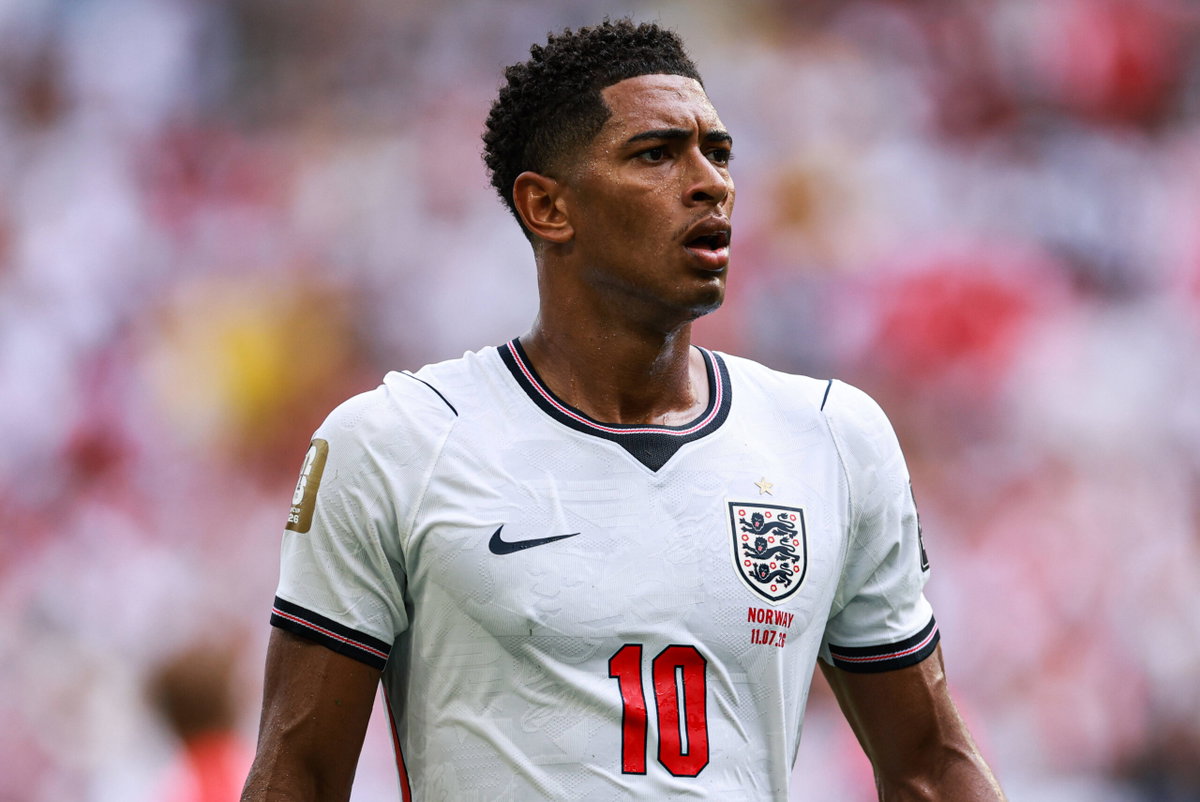
Three minutes into extra time, Ørjan Nyland could only parry Morgan Rogers’ shot, and Jude Bellingham reacted quickest to score the winner. The teams went into the tunnel level at 1-1, but controversy began at the break after new footage came to light. With a sense of injustice thus prevailing, a popular journalist lamented how the VAR couldn’t be properly implemented even in this day and age.
Watch What’s Trending Now!
“If the ball hits something, the rules say that the play has to stop, and it has to be a dropball.” renowned soccer journalist Julien Laurens spoke on ESPN FC. “Clearly, we can all see that even if it was minimal, the wire changes the trajectory of the ball.”
Replays at halftime showed that Nyland’s goalkick struck the spider cam, and the ball had a change in trajectory on its way down. Laurens reiterated that it must have been a drop ball instead of the play going on, which eventually led to England’s equalizer by Jude Bellingham.
“The wire had an influence, and it changed the direction of the ball,” Frank Leboeuf continued on the show.
“VAR has been created to make decisions clear and not allow a club or country to go back to their place and think they’ve been robbed or unfairly judged,” he commented. “These things with VAR should never exist, but they do exist because people don’t know how to use the VAR, don’t know how to make the right judgment.”
The goal and VAR inevitably had a huge say on the game, as Norway saw a goal chalked off due to Erling Haaland’s shove on Elliot Anderson. England relied on the brilliance of Bellingham as he struck in extra time to give them a 2-1 victory and take them to the semifinals of the World Cup.
Norway’s Erling Haaland, who had a quiet game, was disappointed by the result, but his father, Alf-Inge Haaland, shared strong sentiments on social media that Norway had every right to feel robbed.
However, post-game, FIFA Media, FIFA’s official media channel, posted that there was no spike in FIFA’s heartbeat sensor embedded in the match ball. But various match cameras used by media houses clearly show the change in trajectory of the ball, leading to questions over the technology’s credibility.
FIFA had already used connected-ball technology earlier in the World Cup when Croatia’s stoppage-time equalizer against Portugal was disallowed after the ball sensor detected a tiny touch in the buildup, possibly from Igor Matanović’s hair
With more technology implemented, the interpretation and oversight are often becoming debatable subjects, as every match is giving rise to plenty of controversies. As Leboeuf said, the interpretation guidelines must be airtight so that no team feels robbed.