
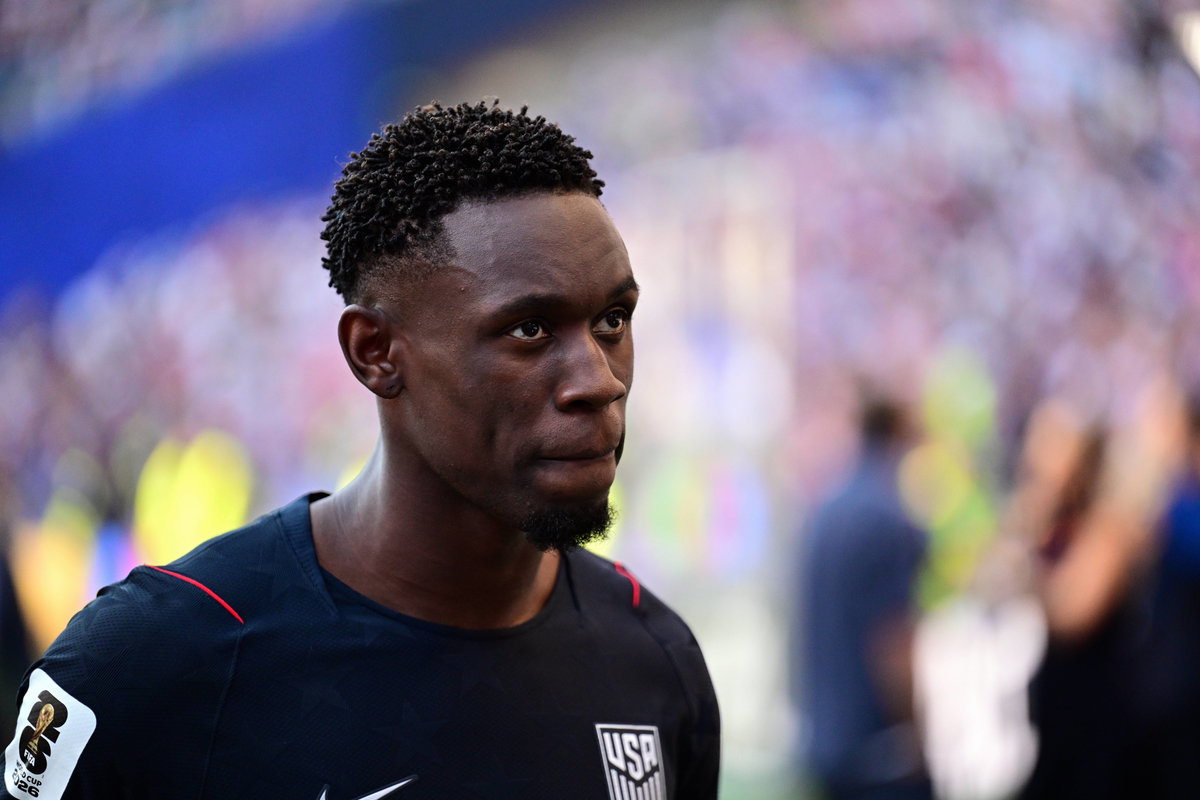
Allowing US striker Folarin Balogun to play against Belgium in the Round of 16 was a unilateral decision after all. The chain of events saw the concerned FIFA committee face backlash, with FIFA president Gianni Infantino becoming the painted target. But now FIFA is ignoring all other panel members and giving the whole responsibility to one official.
Watch What’s Trending Now!
It’s not Infantino.
According to the British newspaper The Times, FIFA disciplinary committee chairman Mohammad Al-Kamali made the decision on Balogun’s suspension all by himself. He did not ask for or receive input from the other 17 members of the 18-member FIFA disciplinary committee before making the decision. More than the decision itself, the manner in which it was made is raising more concerns.
Usually, FIFA lets more than one committee member decide important disciplinary cases. According to The Times, some past disciplinary cases were handled by just one person, but that was usually deputy chairman Jorge Palacio of Colombia.
The Times also reviewed more than 100 previous FIFA disciplinary decisions and found that Mohammad Al-Kamali of the United Arab Emirates had never before made a disciplinary decision by himself. In major disciplinary cases, the decision is made by a panel of three members of FIFA’s Disciplinary Committee instead of a single official.
FIFA has yet to respond to questions regarding the Balogun case, even though there is precedent in their decision.
Article 27 allows FIFA’s disciplinary bodies (the Disciplinary Committee and the Appeal Committee) a route to delay a player’s punishment instead of making them serve it right away. Portugal’s Cristiano Ronaldo was a beneficiary of this after he saw red in his team’s World Cup qualification campaign. The superstar’s three-match ban saw him sit out one match, with the other two suspended for a year.
FIFA’s rules do not explain exactly when they can choose to use this power.
For Balogun, though, FIFA found him guilty of not just the card. According to the statement they put out on July 6, he even re-entered the field to celebrate after he was ejected.
While a player is under probation for the duration of their suspended ban, they can play. However, a similar or greater offense will see the original punishment that was imposed brought back, along with a new one.
It all started when Balogun accidentally stepped on defender Tarik Muharemovic’s ankle. In real time, no card was shown, and the foul also wasn’t called. After watching the incident again on the Video Assistant Referee (VAR) replay, the referee showed Balogun a red card, which normally means an automatic one-match suspension.
Balogun joined Garrincha to set up a unique World Cup Club
This was only the second time FIFA had allowed a player to avoid serving a World Cup sending-off suspension immediately. The first time happened in 1962, when Brazil’s Garrincha received permission to play in the World Cup final even though he had been sent off in the semifinal.
Though red cards and bans didn’t exist at the time, there was a disciplinary committee that took the call. As all five players sent off in the tournament before Garrincha had been banned, many expected the same for the Brazilian.
According to The Athletic, the 1962 incident saw Peruvian President Manuel Prado y Ugarteche step in to make a favorable case for Garrincha. He urged the Peruvian ambassador in Chile to have a word with his compatriot and referee, Arturo Yamazaki. The referee cited that he acted on the word of the linesman in sending off Garrincha.
The Brazilian Federation’s representative put in a favorable word for the player, concealing that he had been sent off before. This saw Garrincha get cleared to appear in the final, which Brazil won 3-1. He was the team’s top scorer ahead of the match, but did not score against Czechoslovakia.
Donald Trump’s involvement in the entire red-card drama
After Balogun’s automatic one-game suspension, President Trump asked Infantino to review the decision. Subsequently, the striker was cleared to play in what was a highly controversial call.
“All I did – I asked for a review because I didn’t think it was a foul,” Trump said later.
Many football fans, including some U.S. fans, felt FIFA had given the United States special treatment and had not applied its rules fairly. On the FOX Sports desk, Thierry Henry and Alexi Lalas were openly divided on the issue. While Henry agreed the red card was not the right call, two wrongs did not make a right for him.
“What happened here is America stood up for itself,” Lalas told Fox News.
After the notion started circulating, FIFA’s president, Gianni Infantino, also had to defend the situation.
“They operate autonomously, apply the FIFA Disciplinary Code, and decide cases based on the applicable regulations and the specific facts before them,” Infantino said.
“Yes, I regularly discuss matters related to the FIFA World Cup with the President of the United States, and on this matter, I did receive a call from President Donald Trump, just as I receive calls from heads of state, government officials, football stakeholders, and business executives from around the world on many different issues.”
But despite all the off-field drama, on the field, the US team couldn’t win against Belgium and ended up with a 1-4 loss.