
Imago
Georgia v Portugal- UEFA EURO, EM, Europameisterschaft,Fussball 2024 – Group F – Arena AufSchalke Portugal s Cristiano Ronaldo drinking water before the UEFA Euro 2024 Group F match at the Arena AufSchalke in Gelsenkirchen, Germany. Picture date: Wednesday June 26, 2024. Use subject to restrictions. Editorial use only, no commercial use without prior consent from rights holder. PUBLICATIONxNOTxINxUKxIRL Copyright: xNickxPottsx 76682286
Imago
Georgia v Portugal- UEFA EURO, EM, Europameisterschaft,Fussball 2024 – Group F – Arena AufSchalke Portugal s Cristiano Ronaldo drinking water before the UEFA Euro 2024 Group F match at the Arena AufSchalke in Gelsenkirchen, Germany. Picture date: Wednesday June 26, 2024. Use subject to restrictions. Editorial use only, no commercial use without prior consent from rights holder. PUBLICATIONxNOTxINxUKxIRL Copyright: xNickxPottsx 76682286
Last year’s FIFA Club World Cup June and July schedules triggered widespread concern among players and managers, who were forced to compete in extreme heat. Chelsea’s Enzo Fernández admitted he felt “dizzy” playing in “very dangerous heat.” In fact, Thomas Tuchel said he might keep his substitutes in the dressing room to shield them from the high temperatures. With criticism mounting over player safety and match scheduling, FIFA has now introduced a new measure ahead of next year’s World Cup. But the fans don’t align with the solution.
Watch What’s Trending Now!
Under the updated rule, every game at the tournament will now include a three-minute hydration break in each half. These breaks will commence after the 22-minute mark. Previously, cooling breaks were only mandatory when temperatures exceeded 32°C, but FIFA now says the policy will apply universally, regardless of venue, climate, or whether the stadium has a roof. The organization described this as a “streamlined and simplified version” of similar protocols used in past competitions, including the FIFA Club World Cup.
Chief Tournament Officer Manolo Zubiria explained the new structure in detail.
“For every game, no matter where the games are played, no matter if there’s a roof, [or] temperature-wise, there will be a three-minute hydration break,” he said. “It will be three minutes from whistle to whistle in both halves.”
FIFA has confirmed there will be three-minute hydration breaks in each half of every game at next year's World Cup ⌚️ pic.twitter.com/0rvo2GyOHS
— Sky Sports Football (@SkyFootball) December 8, 2025
But what if there is an injury stoppage at the 20-minute or the 21-minute mark? According to the Chief Tournament Officer, if the injury stoppage is still ongoing, it’ll be addressed on the spot with the referee.
Despite FIFA’s assurances, online reaction has been mixed, with some supporters welcoming the emphasis on player welfare while others argue the new breaks may disrupt match flow. But most fans brought out another hidden stance – advertisements.
Fans break down the truth about FIFA’s hydration breaks
When Sky Sports Football broke the news on X, the fans began to perceive the hydration breaks as a front for commercial breaks. While these can help broadcasters secure high-value advertising slots, help FIFA increase its revenue, and aid sponsors in gaining guaranteed exposure, fans still stood against it. One fan even called it a shameless move.
“Three-minute water breaks in EVERY match is absolutely shameless ad revenue farming disguised as player care 😂 we see through you FIFA,” the comment read.
Another fan wrote, “They are only doing this for advert breaks btw.”
Meanwhile, one of the fans decided to break things down. According to him, it was a move to destroy the game.
“Advert breaks disguised as hydration stops. Dynamic pricing with tickets costing thousands. Expanded to 48 teams. Fake peace prizes for Donald Trump. Infantino and FIFA constantly putting commercial interests ahead of match-going fans. Determined to destroy our game,” he wrote.
Imago
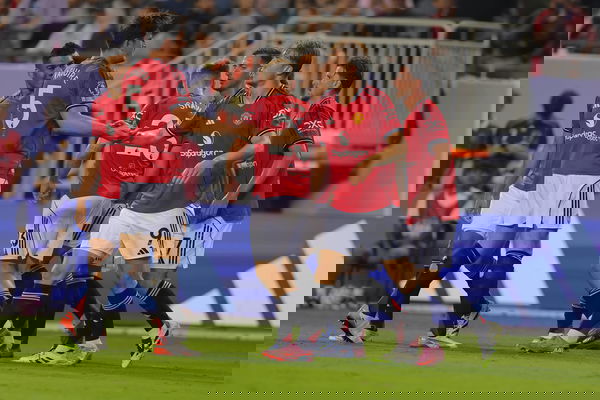
CHICAGO, IL – JULY 30: Rasmus Hjlund 9 of Manchester United, ManU celebrates after scoring during the first half of the Premier League Summer Series against Bournemouth on July 30, 2025 at Soldier Field in Chicago, Illinois. Photo by Melissa Tamez/Icon Sportswire SOCCER: JUL 30 Premier League Summer Series Manchester United vs AFC Bournemouth EDITORIAL USE ONLY Icon250730010
If we look at the FIFA World Cup 2026 ticket prices, then the range initially starts from $60 for group stage matches and goes up to $6,730 for the final. And that’s where the twist lies, because the soccer’s top event is adopting dynamic pricing for the first time. Interestingly, dynamic pricing was also used for this year’s FIFA Club World Cup, where tickets were cut from $473.90 to $13.40 for the semifinal between Chelsea and Fluminense at MetLife Stadium.
The tournament next year runs from June 11 to July 19 and will be played at 11 sites in the U.S., three in Mexico, and two in Canada. To top that, the tournament expanded from 32 nations to 48 and from 64 games to 104.
Concurrently, another fan shared an AI overview from Google. According to the screenshot provided, it was clear that an average commercial break goes on for about 2-3 minutes. And in a sarcastic tone, the fan commented, “What are the chances…”
Nevertheless, the players don’t really prefer to drink water during the matches. Nobody likes to run around for 90 minutes with water sloshing in their bellies. The players simply take a mouthful, gush it around in their mouths, and spit it out. They drink only in small sips through the matches.
But regarding the hydration breaks, one fan seemed to have a different concern: “So what happens if there’s an injury at say 16 or 17 mins where all the players trot off to the their respective dugouts for a few minutes to have a drink. Will they still then have another one at 22 mins so tv stations can show pre arranged ads.”
Manolo Zubiria explained about the 20-21-minute mark. It seems like he still has more explaining to do.
Whether intended for safety or commercial gain, FIFA’s hydration breaks have sparked more questions than clarity, ensuring the controversy will persist as the World Cup draws closer.