
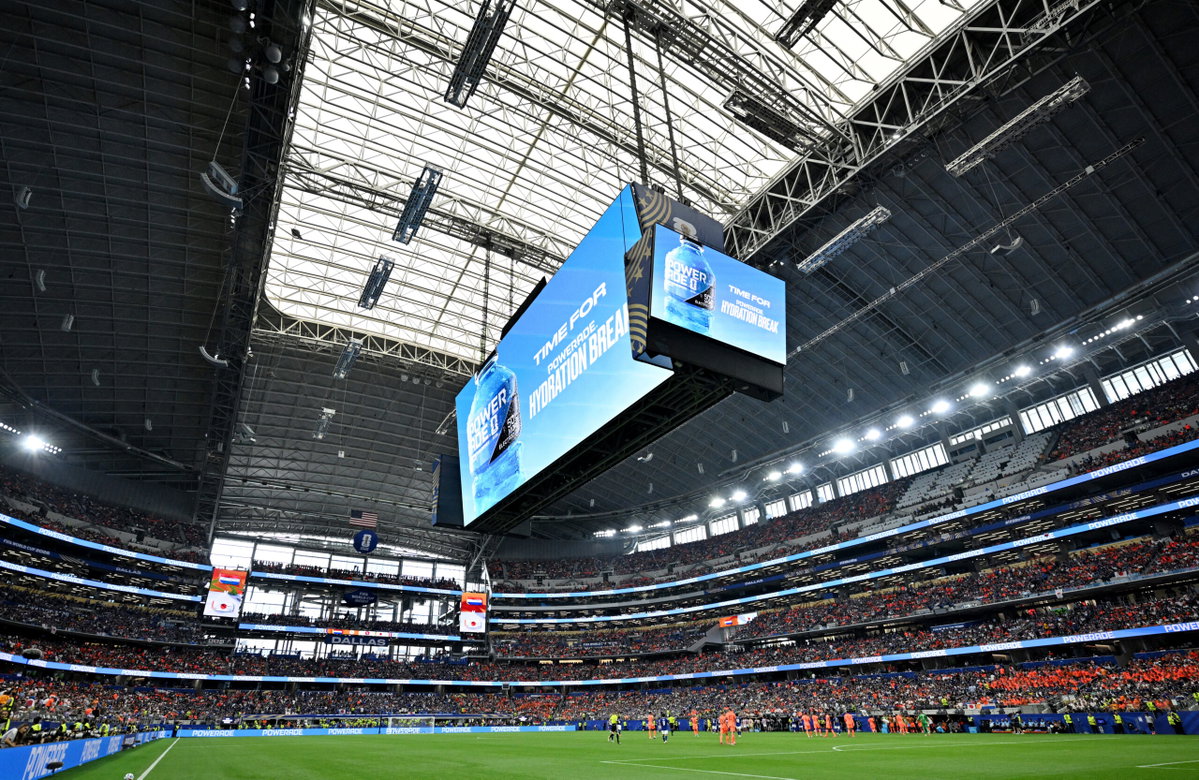
FIFA’s hydration break, designed to protect players from the intense North American summer, sparked intense heat at the World Cup. The break faced accusations of Americanizing soccer and widespread criticism. A former USMNT legend blamed the very concept of the break and its enforcement for reshaping the game.
Watch What’s Trending Now!
FIFA President Gianni Infantino reiterated that the hydration break was purely for sporting purposes. While noting the tactical advantage it offered to coaches, the Swiss administrator pushed back on comments that it was for commercial reasons.
Dissecting Infantino’s ‘sporting purposes’ stance on Golazo Network on CBS Sports Golazo, Marcelo Balboa, a National Soccer Hall of Famer, couldn’t disagree more. In agreement with his former colleague Tony Meloa, who was equally critical, he pointed out the flaws of the hydration break.
“There’s no break, we all love a game of 45 mins, there’s rhythms, there flow that goes back and forth. There’s no need to stop the game at 70°-80° Fahrenheit. I get it if it’s 90°, and it’s dangerous for players, but over the tournament, there are only five games that hit the heat requirement. Now we’re stopping the game, we’re stopping the rhythm,” he said.
FIFA set the foundation for the hydration break back in 2025 when they implemented it at the 2025 Club World Cup. Undeterred by its mixed reception back then, Manolo Zubiria, the World Cup’s chief tournament officer, declared in December 2025 that the hydration break would be mandatory at the World Cup.
“Look at England, they were in rhythm, stopped for 3 mins, and got into that rhythm, find that rhythm again, and it takes a little bit of time. I am not a fan of it; I think it’s hurting the game. You keep seeing people doing this as they do it in football, for four quarters(four fingers on one hand). It’s not our sport, you’re changing our sport, and it’s not good,” he added.


“You're changing our sport, and it's not good.” @marcelobalboa17 isn't a fan of the hydration breaks, with momentum shifts becoming a major talking point at this World Cup 🌎🏆
Mandatory enforcement is backfiring, even in conditions where breaks seem unnecessary. A torrential downpour in Philadelphia delayed the France-Iraq game by over two hours at halftime. Yet in the second half, as the rain poured on, the referee decided to bring the game to a halt for a hydration break.
The frustration from the fans reached the boiling point as boos echoed around the stadium. Reacting to the situation on the show along with Marcelo, Meloa described what happened on the pitch.
“It was raining, and these guys were taking a hydration break. Everyone was miserable, and the guys coming out of the dugout were miserable; they were just sitting in the rain doing nothing. It just didn’t seem like these players needed a break at all,” he added.
While the debate around the break rages on, FIFA and one of its ideological rivals are at loggerheads once again on this decision.
UEFA rejects Infantino’s idea that could be set to stay
When the hydration break was called during the England-Croatia match at the AT&T Stadium, the largest air-conditioned stadium in the world, boos were inevitable. But according to Infantino, it would be unfair to enforce the rules at some games and then not at others.
“If we were to use hydration breaks only in those matches where it was too hot and not in the other matches, we would give an advantage or a disadvantage to some of the coaches or some of the teams,” Infantino said.
“Why would the coach have the opportunity to influence the game in one match just because it’s hot and in another match where it’s a bit less hot, he wouldn’t have this opportunity?” he added.
Infantino is unfazed by the negative reception as he revealed FIFA will use this experience and will consider the hydration break at all its future events.
UEFA, which has been at an ideological war with FIFA for decades over multiple issues like the expansion of the Club World Cup, the World Cup, and player welfare rules, took a swipe at Infantino’s hydration break idea.
The European governing body recently confirmed that the 2028 Euros will not have a mandatory hydration break every break, as revealed by a spokesperson to the Telegraph. The tournament will instead assess the situation on a game-by-game basis and use the standard Wet Bulb Globe Temperature (WBGT) as a parameter.
The decision helped UEFA get fans back on its side after an earlier disrespectful comment from president Alexander Ceferin about the expanded World Cup drew heavy criticism.
The hydration break promises to be one of the biggest talking points of the 2026 FIFA World Cup, alongside the incredible goals and drama on the pitch.