
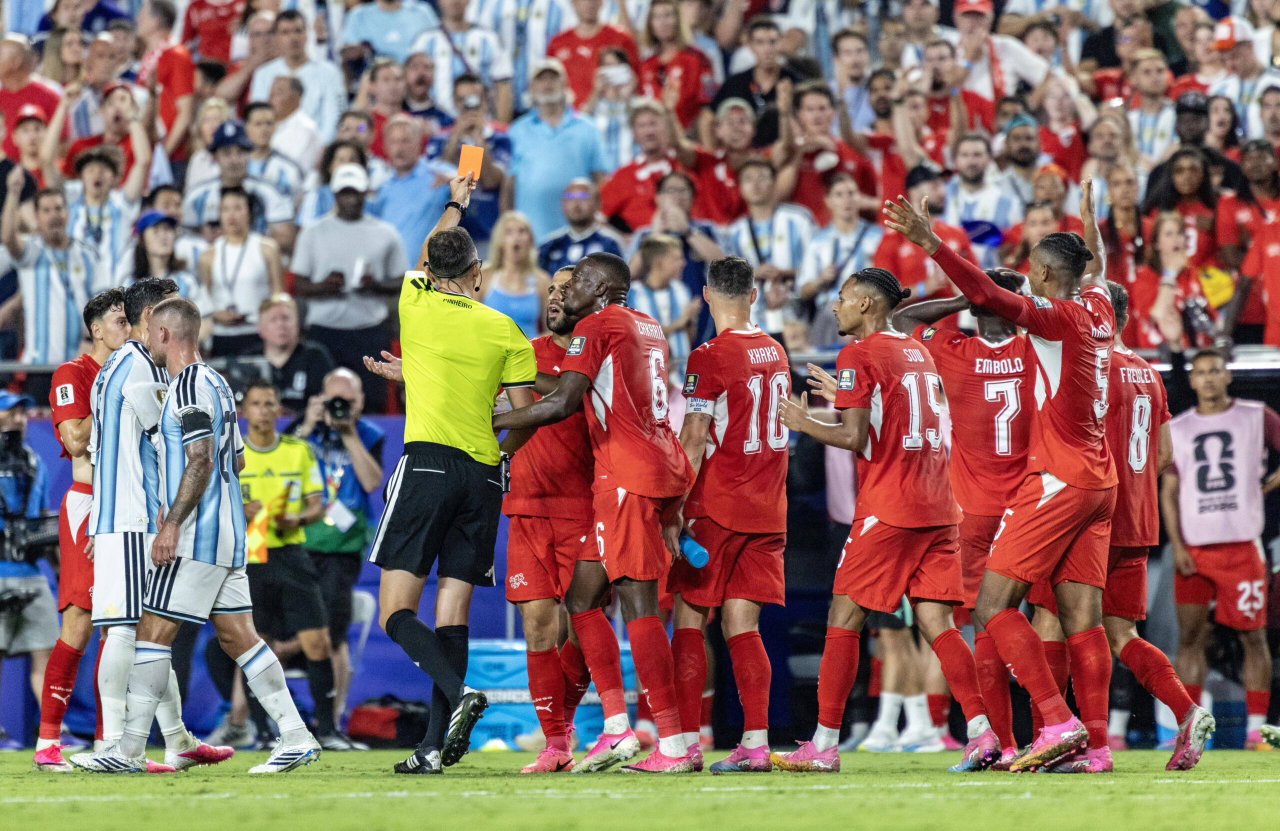
There were many incidents during the 2026 FIFA World Cup that raised concerns about the refereeing. One such event came during the Argentina-Switzerland clash, and it looks like the one decision that changed that game was not the correct decision.
Watch What’s Trending Now!
“The IFAB confirms in a circular that mistaken identity should not be used for simulation, as it was at the World Cup,” reported Dale Johnson of the BBC.
IFAB has admitted that the “mistaken identity” rule was not interpreted correctly during the 2026 FIFA World Cup. And this has reopened one of the biggest topics from the 2026 edition.
With this statement, the IFAB has said that the VAR officials should never have changed a foul into a simulation after reviews, including the decision that sent Switzerland striker Breel Embolo off against Argentina.
That ruling has now become the clearest indication that a broader interpretation than the law actually allowed governed the World Cup.
The board commented on this and said, “A yellow card (caution) which is not a second yellow card can only be reviewed to identify the player who committed the offence that was penalized.”
The statement also made it clear that “the offence itself cannot be reviewed or changed.”
In simple terms, VAR can correct the player who committed a foul, but it can’t change the foul that a referee gave to a completely different one.
The confusion started because IFAB had expanded the mistaken identity rule before the World Cup. It gave VAR officials greater authority to correct obvious errors during the game. Referees applied that interpretation in games like the United States-Paraguay, where they removed Tim Ream’s yellow card and booked Miguel Almirón for diving.
The referee later used the same approach in the Switzerland-Argentina quarter-final, turning a foul call into a simulation decision. IFAB now believes that the referees didn’t have the right idea. But the damage has been done.
Switzerland are the clearest example of how this affected the game. When the game was tied at 1-1 in the 72nd minute, referee João Pinheiro booked Leandro Paredes for fouling Embolo. But VAR came into play and asked the referee to check. And during the check, it was clear that there was no foul on Embolo, and he dived.
So the referee cancelled the yellow card on Paredes and gave a yellow to Embolo for diving (simulation). As Embolo already had a yellow in his name, this was his second yellow and sent him off. And this clearly affected how Switzerland played because they went full defensive and went on to lose 3-1.
That outcome left Swiss coach Murat Yakin furious, saying the rule had “destroyed” the game and changed the result. As was the case with Argentina for most of the tournament, this refereeing decision that worked in their favor drew intense scrutiny.