
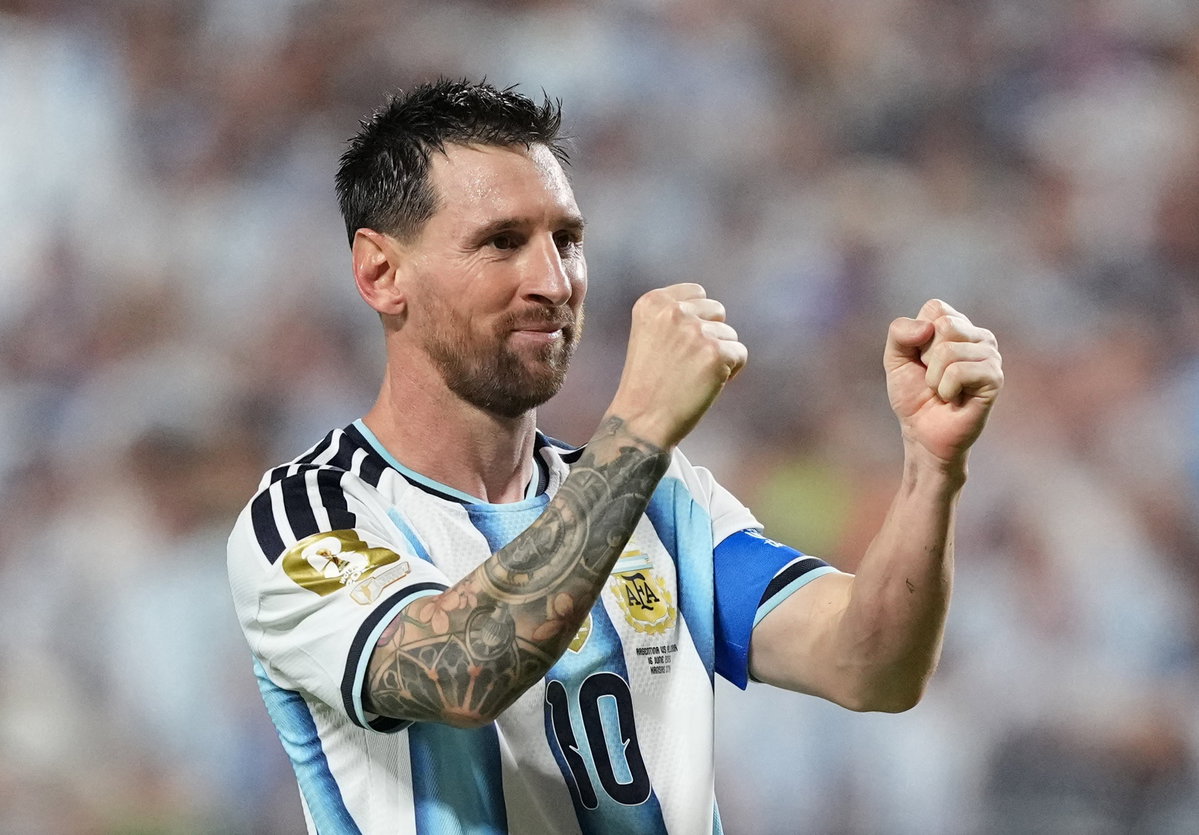
The Merriam-Webster dictionary states that there are around one million words in the English language. Yet somehow, none seem capable of fully capturing what Lionel Messi did against Austria. Scoring two goals wasn’t the highlight, as bizarre as that may sound. Messi has done that time and again throughout his career. It was the records he broke that truly added to the myth of the greatest performer in FIFA World Cup history.
Watch What’s Trending Now!
According to the Guinness Book of World Records, on Matchday 2, in Argentina’s 2-0 win over Austria to ensure qualification into the Round of 32, Lionel Messi broke four records.
The first record was already in Messi’s possession before the tournament began. The former Barcelona star entered the 2026 FIFA World Cup with 26 appearances at the finals, one more than Germany legend Lothar Matthaus (25), giving him the outright record for most World Cup appearances among men. His games against Algeria — against whom he scored a hat-trick — and Austria only extended that mark, taking his tally to 28.
The second record fell 38 minutes later, with Messi at the heart of it, as he so often is. He collected a pass from Rodrigo De Paul, played it out wide, and began to jog forward. Meanwhile, his teammates sprinted into position, creating overloads, setting screens, and acting as decoys. As Facundo Medina charged down the left flank, Thiago Almada glanced over his shoulder and saw nothing but open grass ahead of him. By then, everyone watching knew what was about to happen.
Medina squared it expertly, Almada dummied, and there was Messi. It was a goal the world had seen countless times before, but this one carried greater significance. With the finish, the Argentine became the outright leading goalscorer in men’s FIFA World Cup history.
It was goal number 17 at the FIFA World Cup, moving him past German legend Miroslav Klose (16) and into sole possession of the record. But it wasn’t the final milestone of the night. That arrived two minutes before the final whistle, when Messi sparked a counterattack, exchanged passes with Julián Álvarez, and followed up his own blocked effort to score from the rebound.
The goal took Messi’s World Cup tally to 18. He now has the most FIFA World Cup Finals goals out of any player, although France’s Kylian Mbappe isn’t too far behind, with his brace against Iraq on Monday taking him to 16 goals. Records 3 and 4, however, are ones that Mbappe remains slightly farther behind.
After referee Amin Mohamed Omar blew for full-time, Messi added two more milestones, becoming the player with the most minutes played at the FIFA World Cup (2489) and most matches won (18). This came in his sixth World Cup, whereas Mbappe, in his third, has amassed 1310 minutes and secured 11 victories.

Messi LITERALLY rewriting record books 😭🐐

All in all, it was a euphoric night for Messi, his fans, and Argentine soccer as a whole. Argentina is now guaranteed to finish top of Group J and can approach its final group-stage encounter against Jordan on Saturday with a little less pressure. Their objective remains unchanged: keep winning and take another step toward defending their World Cup crown. If Messi happens to add a few more records along the way, that will be an added — and very welcome — bonus.
However, the four records recognized by Guinness World Records were only part of the story. Across Argentina’s opening two matches at the 2026 FIFA World Cup, Messi set, equalled, or extended a host of records, further strengthening his case as the greatest player the game has ever seen.
More records set or broken by Lionel Messi at the 2026 World Cup
Now the outright leading goalscorer in FIFA World Cup history, there is little left for Messi to prove on the sport’s biggest stage. Yet the records kept coming against Austria. In addition to moving past Klose at the top of the scoring charts, the Argentine also became just the third player to score in six consecutive World Cup appearances. That is as per OptaJoe, soccer’s official stats keeper.
The last two players to achieve that feat were Jairzinho in 1970 and Just Fontaine in 1958, two icons of the game in their own right. Messi also strengthened his position among the oldest goal scorers in FIFA World Cup history. Having already become the third-oldest player to score at the tournament with his hat trick against Algeria, the Argentine added two more goals against Austria to extend that mark. Only Roger Milla and Pepe remain ahead of him on the all-time list. And there’s more.
He is the second player to score his nation’s first five goals at a single World Cup, with Oleg Salenko being the first to do so for Russia in 1994. Messi also recorded the most touches of the ball (71), making him the oldest player on record to register 50+ touches in a World Cup match. Not all of them were memorable, however, as he also became the player with the most penalties taken (7) and missed (3) in World Cup history.
That does exclude penalty shootouts, though, and all of this came on Matchday 2. On Matchday 1, Messi became the oldest player to score a hat trick at a FIFA World Cup. He broke Cristiano Ronaldo’s record (33y 130d) when he found the net against Algeria at the age of 38y 357d. He is also the second player, after Ronaldo, to score at five World Cups and is tied with Rivellino for the most goals scored from outside the box (5) in World Cup history.
There are many more records besides those. Messi also became the first South American to make 200 international appearances and only the third player overall to reach that milestone. Perhaps more than anything, that speaks to the longevity of his career.
The scary part for everyone else is that the tournament is only two games old. If the opening week is anything to go by, Messi may not be done rewriting the record books just yet.