
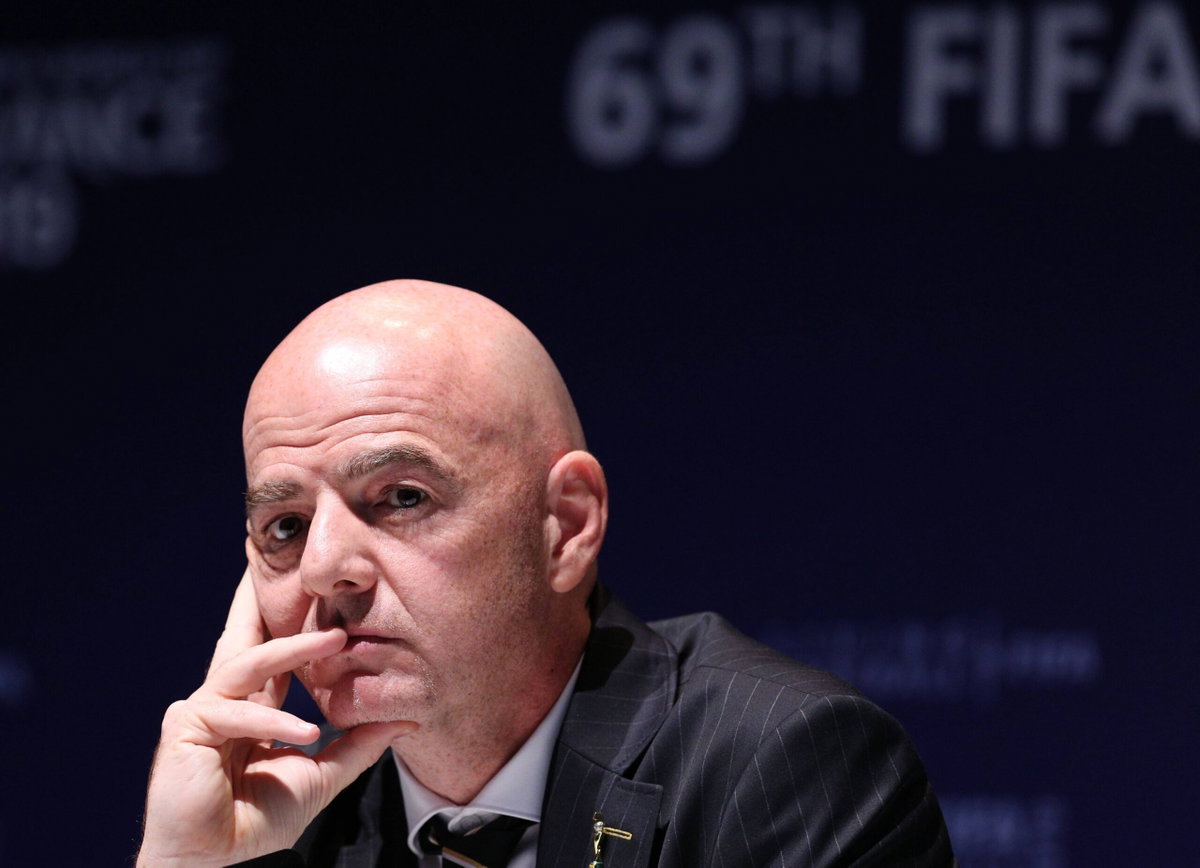
Gianni Infantino’s future as FIFA president is facing fresh questions as the debate over his presidential term limits takes a legal turn. Although FIFA’s rules restrict its president to a maximum of three terms, Infantino could still seek another four-year stint in 2027 because the governing body does not count his first period in office, from 2016 to 2019, towards that limit. However, a former senior FIFA official believes this interpretation goes against the organisation’s own statutes and could provide a way to block the Swiss-Italian’s re-election bid.
Watch What’s Trending Now!
The controversy was brought into focus by Matt Slater, a senior news reporter at The Athletic (part of the New York Times) and former BBC and Press Association journalist. Sharing his latest report on X on November 4, Slater questioned whether Infantino’s critics had been focusing on the wrong approach to challenging his leadership. “Having tried (& failed) to oust him via shame, a coup, a coalition of the willing & the threat of legal action, are Gianni Infantino’s critics missing the easiest way to stop him winning another term as FIFA boss?” he wrote. He then raised the central question behind his report: “Is he even eligible to run again?”
In the accompanying article, Slater revealed that he spoke to Portuguese lawyer Miguel Poiares Maduro, the former chairman of FIFA’s independent Governance Committee, who believes Infantino has already reached the maximum number of terms allowed under the statutes. Maduro suggested that critics should challenge the FIFA president’s eligibility through the organisation’s Review Committee and, if necessary, take the matter to the Court of Arbitration for Sport.
Infantino first became FIFA president in February 2016 after Sepp Blatter stepped down amid a corruption scandal that shook world football. He was subsequently re-elected in 2019 and 2023. Under Article 33, paragraph 2 of FIFA’s statutes, no person may serve as president for more than three terms. However, shortly before the 2022 World Cup final in Qatar, FIFA’s Council unanimously agreed that Infantino’s first period in office, between 2016 and 2019, should not count because he had been completing Blatter’s remaining mandate.
That interpretation changed the calculation of his time in office. FIFA treated the 2019 election as the beginning of Infantino’s first full term and his 2023 re-election as the second. This means he could stand for another four-year term in March 2027 and potentially remain president until 2031.
Maduro, however, believes FIFA has misinterpreted its own rules. He was appointed chairman of the Governance Committee in May 2016, during Infantino’s first year as president, but was removed from the position around 10 months later after refusing to approve the appointment of Russian deputy prime minister Vitaly Mutko to the FIFA Council.
Speaking to journalists during a conference call organised by human-rights advocacy group FairSquare, Maduro argued that the wording of FIFA’s statutes leaves no room for the distinction made by the Council. “Article 33, paragraph 2 of the FIFA statutes is very clear when it says no person may serve as president for more than three terms,” he said.
He then directly questioned how FIFA could justify allowing Infantino to seek another term after being elected three times. “Gianni Infantino has been elected three times. He has been president of FIFA for three terms. So, there’s no way to reconcile another term for Gianni Infantino with this rule,” Maduro added. According to Maduro, the matter should have been referred to FIFA’s Review Committee, a three-member body within the Governance Committee that examines candidates’ eligibility.
Comparing FIFA’s approach to a president interpreting a country’s constitution to stay in power, Maduro said: “It is the same as if a president of a state interprets the constitution himself so he can run again, instead of the supreme or constitutional court.”
Maduro also argued that the statutes do not distinguish between complete and incomplete terms, or between four-year terms and shorter periods in office. “The rule is intended to limit the concentration of power, so any interpretation that expands power needs to be supported by very strong arguments,” he explained. Maduro believes Infantino’s critics still have a way to challenge the decision before the next election. He suggested that football associations should first ask FIFA’s Review Committee to rule on the president’s eligibility. If the committee declares him eligible, critics could then appeal the decision at CAS.
He also pointed out that FIFA could have put the interpretation to a vote at a Congress attended by its member associations, effectively changing the term-limit rule through the proper process. However, that did not happen. Maduro warned that accepting FIFA’s current interpretation could create a wider problem for the organisation.
The issue has also attracted the attention of FairSquare, which has written to FIFA’s Governance, Audit and Compliance Committee. As part of its FIFA Reboot campaign, the human-rights organisation argued that the 2022 decision went against both the wording and the purpose of the term-limit rule. It also questioned why the FIFA Council made the decision instead of leaving it to the Review Committee.
Maduro believes that the lack of opposition from football federations is partly explained by the political climate within FIFA. He suggested that officials who openly challenge the president risk losing influence and being pushed aside. However, opposition to Infantino does not mean he has lost the backing of the wider football community. The FIFA president still enjoys considerable support, particularly across Africa and South America, where national associations have publicly endorsed his plans to seek another term.
Infantino retains support across Africa and South America despite growing opposition
The Confederation of African Football, whose 54 member associations represent a quarter of FIFA’s total membership, unanimously backed Infantino’s re-election for the 2027-2031 period in April 2026. CAF president Patrice Motsepe has also reaffirmed the continent’s support for him. South America has shown similar backing, with all 10 member associations belonging to CONMEBOL endorsing Infantino.
Support has also come from parts of Asia. Asian Football Confederation president Sheikh Salman bin Ebrahim Al Khalifa publicly backed Infantino’s re-election in October, while countries including Saudi Arabia, Qatar and Kuwait have also supported him. Mexico has emerged as another supporter, although the wider North American football community remains divided. Some Oceania associations, including the Solomon Islands, Tahiti and New Caledonia, have also expressed support.
However, Infantino’s backing is far from universal. UEFA has emerged as one of his strongest critics, while England, France and Italy have withdrawn their support. The United States and Canada have also joined the opposition. New Zealand has withdrawn its backing as well, showing that even within regions where Infantino has supporters, his leadership remains contested.
With Infantino’s next presidential election approaching in March 2027, the debate is no longer limited to whether his critics can find enough support to challenge him. Despite backing from several powerful football regions, a legal challenge could present a different obstacle, one that political support alone may not be enough to overcome.