
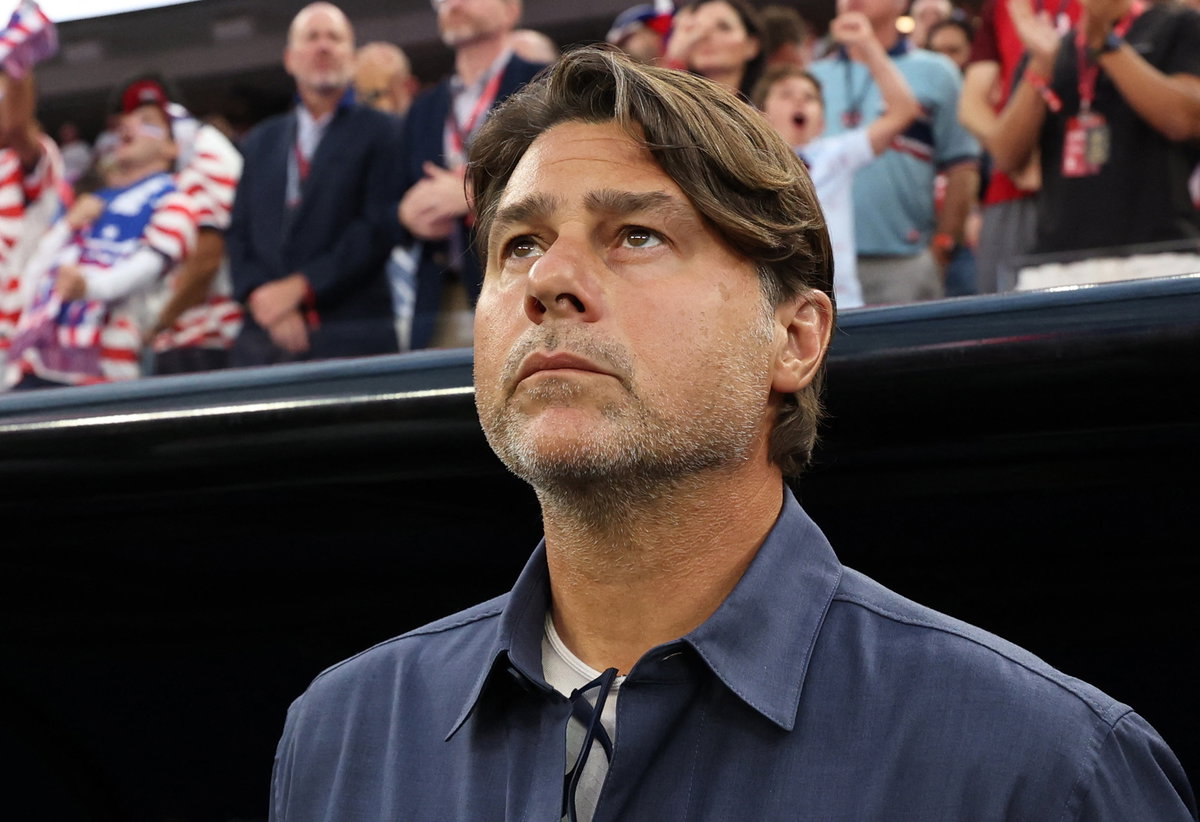
Folarin Balogun, the USMNT’s leading scorer with three goals in four games, had received a straight red card in the 64th minute of the United States’ 2-0 round of 32 win over Bosnia-Herzegovina on July 1. An automatic one-match ban followed, ruling him out of Monday’s round of 16 clash against Belgium. But by Sunday morning the ban was gone, for the time being, which led to significant backlash involving fair play.
Watch What’s Trending Now!
Now, head coach Mauricio Pochettino has said that he “wasn’t involved” in the decision and found out “before training” on Sunday. Still, he came out firmly behind it at his pre-match press conference.
“For me, there isn’t much debate here, though I do understand Belgium’s perspective,” Pochettino told reporters in a media interaction. “If anyone was harmed in this whole situation, it was the United States. Can anyone justify the idea that we weren’t punished? I mean, playing 30 or 35 minutes a man down in a World Cup knockout match? It’s not as if we’re benefiting. No, no. There’s no extraordinary gain we’re getting out of all this. I mean, ultimately, we aren’t victims, but we aren’t the villains of this story either.”

Head coach Mauricio Pochettino launched an impassioned defense of the controversial decision to suspend Folarin Balogun’s red-card ban, thereby allowing the USA forward to play against Belgium in the round of 16 Monday. “If anyone was harmed in this whole situation, it was the Show more

FIFA’s Disciplinary Committee announced that it had suspended Balogun’s ban for a one-year probationary period, citing Article 27 of the FIFA Disciplinary Code, which gives the judicial body discretion to “fully or partially suspend the implementation of a disciplinary measure.”
Several sources confirm that it was the first time since Garrincha in the 1962 World Cup semifinals that a red card issued during the tournament itself had not led to a suspension. And the pushback from outside the American camp came fast.
Belgium’s Royal Football Association said in a statement it was “astonished” by the reversal, noting that Article 66.4 of the FIFA Disciplinary Code and Article 10.5 of the World Cup regulations both mandate automatic suspension after a red card, and that every other red card at this tournament had been enforced exactly that way. The federation also said it was “investigating all potential options.”
Belgium coach Rudi Garcia likened the ruling to “April Fool’s Day.” On BBC coverage, Wayne Rooney didn’t hold back: “I think it’s an absolute disgrace, I really do. To suspend it for a year makes a mockery of the whole tournament. All this is to keep the big stars in the competition. America are one of the co-hosts. We all know what it is. FIFA need to do better.”
“That’s a big mistake by FIFA….What about the next red card? What happens then? It’s a bad, bad, bad, bad, bad decision. I also feel for the USA. If they win, it hangs in the background. Not good for the sport,” Norway coach Stale Solbakken agreed.
Article 27 does have prior uses, but in narrower circumstances. FIFA deferred the final two games of Cristiano Ronaldo’s three-match qualifying ban last November, keeping him available for the tournament’s opening games. Argentina’s Nicolás Otamendi and Ecuador’s Moisés Caicedo both had one-match qualifying bans deferred earlier this year for the same reason.
Balogun’s situation is different because his red card came inside the World Cup, where the competition regulations are more specific and where the stakes of any exception are much higher. That gap between past precedent and what happened Sunday is exactly what Belgium is leaning on, and it’s why Pochettino’s argument hasn’t quieted much of the backlash.