
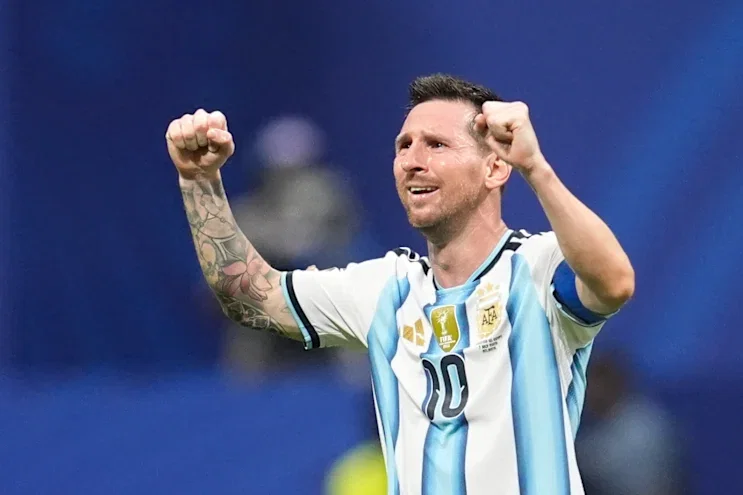
Lionel Messi did not score against England, yet he still walked away as the defining figure of Argentina’s dramatic World Cup semifinal comeback. The 39-year-old set multiple tournament records while orchestrating two late goals that overturned a 1-0 deficit and sent Argentina into a second straight FIFA World Cup final.
Watch What’s Trending Now!
But Messi’s latest masterclass was only part of a semifinal that quickly became one of the tournament’s defining matches. England’s tactical collapse, one of the World Cup’s most physical contests, a politically charged post-match celebration and clashes involving supporters ensured the drama extended well beyond the final whistle.
Here’s a look at the biggest talking points from Argentina’s 2-1 victory over England.
Late comeback
England appeared to have one foot in the final after Anthony Gordon’s 55th-minute opener, but the game changed completely once Thomas Tuchel abandoned his attacking setup. Replacing Gordon with defender Ezri Konsa in the 71st minute shifted England into a deep defensive block, inviting sustained Argentine pressure. Over the final stages, Argentina dominated possession while England struggled to regain control of the ball.
Lionel Scaloni responded by introducing Rodrigo De Paul and Gonzalo Montiel before moving Messi into wider areas on the right, allowing him to escape England’s congested midfield. The tactical adjustment paid off almost immediately. Messi found Enzo Fernández from a short corner in the 85th minute, and Fernández curled home the equalizer from outside the penalty area.
Seven minutes later, Messi again proved decisive. Operating from the right flank, he delivered a cross that Lautaro Martínez met with a close-range header to complete Argentina’s comeback and book a second consecutive appearance in the FIFA World Cup final. After the match, Scaloni summed up his side’s mentality: “We were under a bit of pressure, but the opponent doubted themselves. We all felt it, we smelt blood and went for it.”
Thomas Tuchel later admitted England retreated too much after taking the lead. “We suddenly played with a feeling that we had a lot to lose. We dropped into a deep block… we struggled to win any duels, have any ball possession anymore,” the England manager said after the defeat. Harry Kane echoed that assessment, adding: “Once we went 1-0 up we seemed to just try to hold on… it was just wave after wave.”
Number of fouls and cards
Physicality shaped the contest from kickoff. Argentina and England combined for 26 fouls, well above the tournament average of 21.8, with 19 coming before halftime alone. Argentina committed 15 fouls to England’s 11, while referee Ismail Elfath handed out four yellow cards, three to Argentina and one to England.
Bellingham found himself at the center of several flashpoints throughout the match, repeatedly clashing with Argentine players as tensions escalated. The confrontation continued after the final whistle when he became involved in a brief altercation with substitute Valentín Barco, an incident now reportedly under review by FIFA after broadcast footage emerged.
Records Lionel Messi broke in the match
Although he finished without a goal, Messi produced one of the most statistically significant performances of his World Cup career. Named FIFA’s Player of the Match, the Argentine captain registered two assists while extending or breaking several all-time tournament records.
Opta also credited Messi with another historic milestone. He became the first player on record since detailed World Cup data began in 1966 to complete nine successful dribbles and provide two assists in the same knockout match.
Messi’s influence stretched well beyond the record books. After the victory, he praised Argentina’s resilience, saying: “This group doesn’t surprise me… when we come together and are united, it always gives us an extra boost.”
After his 2 assists in the semifinals, Messi has registered either a goal or an assist in 13 straight appearances. These appearances included both his teams, Inter Miami and the Argentina national team.
Now set to go head-to-head with Spain in the finals, Messi became the second person to step onto the pitch in three separate FIFA World Cup Finals. He matched the legendary record held by the Brazilian GOAT, Cafu.
Argentina’s political celebration and how it may backfire
Argentina’s celebrations also sparked an international controversy. During the post-match festivities, several players held a banner reading “Las Malvinas son Argentinas” (“The Falkland Islands are Argentinian”), a longstanding political slogan tied to Argentina’s claim over the disputed islands. According to the research, the banner was passed to players by supporters rather than being part of an official team display.
The display has prompted calls for FIFA to investigate potential breaches of tournament regulations prohibiting political messages. Similar disciplinary action has precedent. Before a 2014 friendly against Slovenia, Argentina displayed the same banner and the Argentine Football Association was fined 30,000 Swiss francs by FIFA. While formal proceedings are expected after officials submit their reports, confirmed potential sanctions currently center on financial penalties and official reprimands rather than confirmed player suspensions.
Fan Clashes After the Final Whistle
The tension surrounding the semifinal carried beyond the stadium as supporters from both nations became involved in isolated clashes after the final whistle. Police detained multiple fans following confrontations outside Atlanta Stadium, including near the Hudson Grille sports bar.
The Atlanta Police Department confirmed the disturbances were brought under control without any major injuries or security breaches. Authorities had designated the semifinal as the tournament’s highest-risk fixture and deployed additional officers around the stadium well before kickoff.