
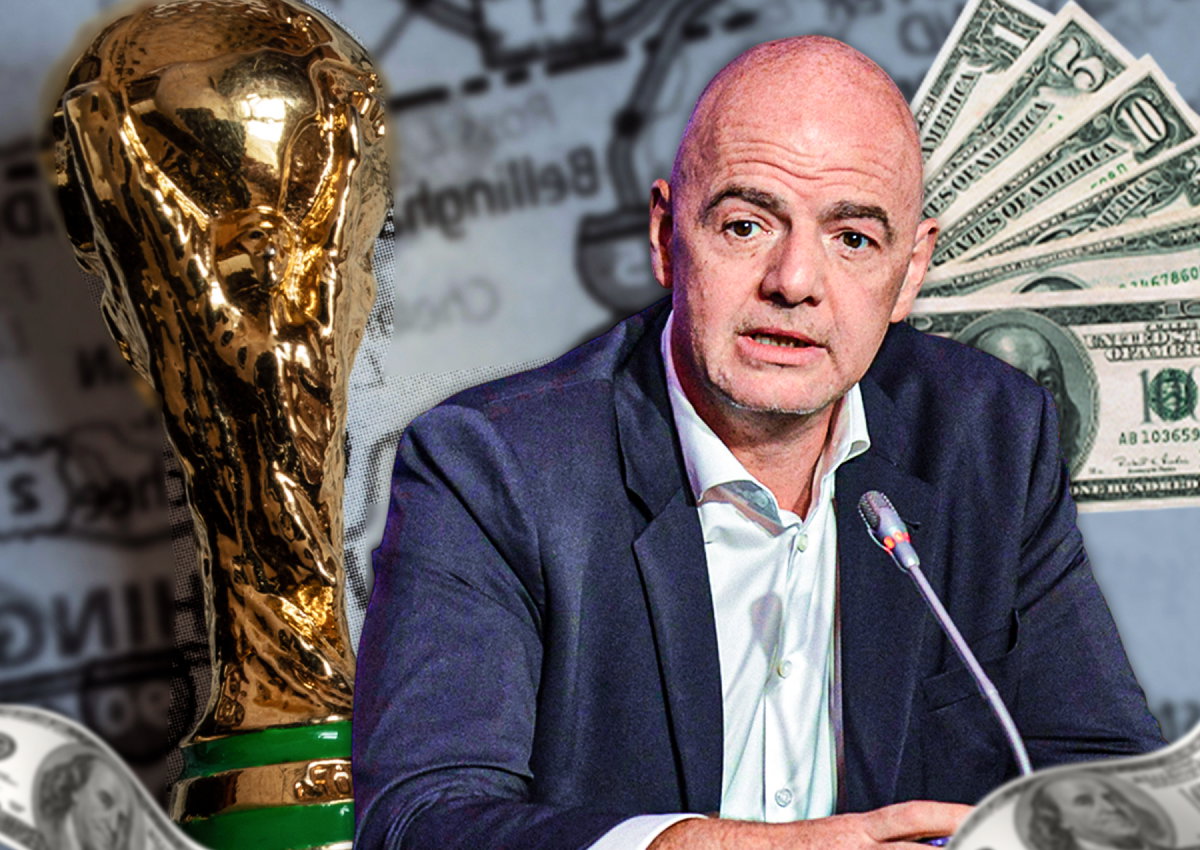
The 2026 World Cup has already proven to be the most environmentally damaging tournament in the competition’s history. Now FIFA’s own president is adding to the very problem researchers have been warning about. He has been criss-crossing the continent by private jet to catch as many matches as he can.
Watch What’s Trending Now!
Gianni Infantino has been using a private jet to attend two matches a day, where possible. It has drawn sharp criticism from environmental campaigners already alarmed by the tournament’s overall footprint. The jet is not something Infantino arranged independently. It was provided to him by Qatar Airways as a value-in-kind element of the airline’s sponsorship deal with FIFA.
His itinerary so far makes for a striking case study in just how much ground he has been covering. After attending the opening match of the tournament in Mexico City, Infantino immediately flew on to Guadalajara to watch South Korea beat Czechia. The next day, he was in Los Angeles for the United States’ win over Paraguay, before taking in games in San Francisco and Vancouver the following day. He missed matches only on the Sunday because he was hosting a FIFA summit in Miami for representatives of the organization’s 211 member associations before flying straight back to Los Angeles that evening to catch Iran’s tournament opener against New Zealand.
FIFA sources say Infantino intends to keep attending two games a day for as much of the remaining tournament as possible, despite the grueling travel that requires it. The comparison to the last World Cup makes the scale of the undertaking clear. In Qatar in 2022, he was able to attend almost all 64 matches because the longest distance between any two stadiums was just 46 miles.

The 2026 World Cup is projected to be the highest pollution sporting event in history. On top of the estimated 9,000,000 tons of emissions, FIFA President Gianni Infantino is now travelling in his private jet constantly to watch 2 matches a day.


This tournament spans four time zones and three countries, with stadiums as far as 2,800 miles apart. Competing nations are also feeling the same geographic strain. Bosnia and Herzegovina face one of the toughest schedules of any team in the group stage, traveling more than 3,000 miles between Toronto, Los Angeles, Seattle, and their training base in Salt Lake City.
This is just one example. Research published by the New Weather Institute, in collaboration with Scientists for Global Responsibility, the Environmental Defense Fund, and Cool Down, calculated the greenhouse gas emissions attributable to the tournament, and the picture gets bleaker.
Once you include the air travel for fans and teams, and other match-related emissions, the resulting figures make this the most polluting tournament ever staged, with nine million tonnes of CO₂ equivalent released. In comparison, Qatar 2022 generated 5.25 million tonnes. Team air travel alone is expected to account for roughly 7.7 million tons of CO₂ equivalent.
Frank Huisingh, founder of Fossil Free Football, described the tournament as probably the most polluting event humanity has ever staged. “Governing the world’s greatest game, FIFA has a huge responsibility but shows a fatal climate blind spot in its duty of care to fans, players, and the future of the sport,” the study declared, adding that the organization’s actions reveal a reckless disregard for the climate consequences of its own decisions.
The climate criticism is not happening in isolation. It is one of the latest issues to arise in this already-controversy-laden FIFA World Cup.
Emissions are just one item on a growing list of grievances against FIFA 2026
Football Supporters Europe has argued that the lowest-priced final tickets available to the public are more than seven times higher than the cheapest tickets sold for the 2022 final. The projected cost of attending eight matches ranges from roughly £5,225 to over £12,000 for premium seats.
Football Supporters Europe and the consumer group Euroconsumers have since filed a formal complaint with the European Commission, accusing FIFA of abusing a monopoly over ticket sales. FIFA did eventually slash some prices after the backlash, with seats becoming available for as little as $60.
The geopolitical backdrop has added another layer of tension entirely.
The United States finds itself at war with one of the competing nations, Iran. They have been restricted to staying in Mexico for the tournament. Iranian fans who chanted anti-American slogans at the team’s farewell parade have been banned from attending altogether.
Although an exemption was issued for athletes, staff, and their immediate families, unrelated supporters have still faced visa complications. Human rights groups and media outlets are raising concerns that Immigration and Customs Enforcement could create further problems for traveling fans.
Even the conditions players will compete in have drawn scrutiny well beyond the carbon report. Extreme heat has emerged as a genuine concern across several cities, a factor that could shape results. Historically, only one European team has successfully won a World Cup away from Europe, Germany in 2014.
Taken individually, any one of these stories might have passed as a footnote to the football. Taken together, these incidents paint a picture of a World Cup defined by what is happening away from the pitch.