
Humanoid robots have been turning heads at China’s second robot Olympics edition, but not every moment has gone according to plan. Just two days after beating Usain Bolt’s 100m record, a very different scene unfolded when another robot competing in weightlifting lost its balance and crashed into the judges’ table.
Watch What’s Trending Now!
The incident took place on August 24, 2026, at Beijing’s National Speed Skating Oval, the same venue used during the 2022 Winter Olympics. Weightlifting was making its debut at the World Humanoid Robot Games, with four robots taking part in the heavyweight competition.
The competition started with a 15kg barbell. One robot managed to pick up the weight, but things quickly went wrong as it struggled to stay balanced.
The machine suddenly lurched forward before falling headfirst into the judges’ table, as per a social media post. The officials had little time to react as the robot collapsed directly in front of them. Watch the moment here.
The attempt was immediately stopped and marked unsuccessful. Then came an unusual sight. Staff members rushed over to deal with the fallen machine and carried it away on a stretcher.
Of course, there was no injured athlete to treat. The stretcher was simply used to safely move the robot out of the competition area after the crash. While one robot struggled, another managed to make history.
The Beijing Humanoid-HUST team won the weightlifting event after its robot successfully lifted 16kg, claiming the first humanoid robot weightlifting title at the Games. Tiangong and Tianzhuo followed with successful 15kg lifts.
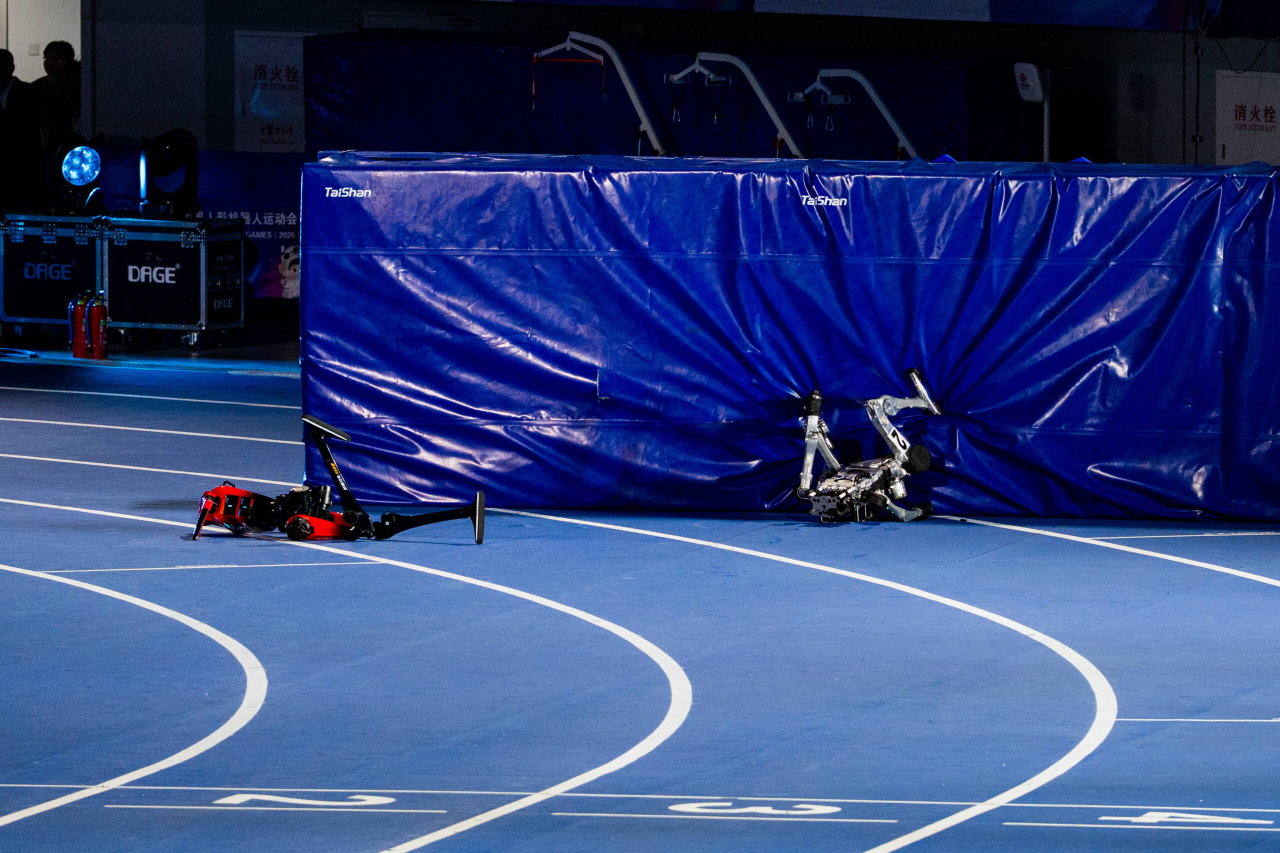
And the weightlifting crash was not the only wild moment surrounding the competition. Before the Games officially began, another Chinese humanoid robot had a rough moment during a running test after crashing into a safety cushion or barrier.
The impact caused the robot’s body to bend sharply, with sparks reportedly visible after the collision. But the weightlifting crash was far from the only moment that grabbed attention at the Games.
Humanoid robots make history
On August 22, China’s Tiangong Ultra, developed by the Beijing Humanoid Robot Innovation Center, ran the 100m in 9.39 seconds during a preliminary heat.
That time was faster than Usain Bolt’s 9.58-second human world record, set in 2009. Honor’s Lightning also finished in 9.47 seconds, putting both robots ahead of Bolt’s famous mark.
The robots then made headlines again in the standing high jump. A humanoid robot from the Beijing Humanoid Robot Innovation Center cleared 2.88 metres, well above the men’s human world record of 2.45 metres, set by Cuba’s Javier Sotomayor in 1993.
The jump was a huge improvement from the previous Games, when the best humanoid result was only around 0.95 metres. The sprinting records continued on August 23.
In the 400m final for large robots, a machine from the Beijing Humanoid Robot Innovation Center won in 38.15 seconds, comfortably inside Wayde van Niekerk’s human world record of 43.03 seconds. The smaller robots had their own 400m event, where Tiangong Omni won in 45.66 seconds.
Its running style also caught attention. Instead of swinging its arms naturally like a human sprinter, Tiangong Omni ran with its arms raised near its face.
According to a motion-control engineer, that unusual technique was not directly programmed by engineers. It emerged through reinforcement learning, with the robot effectively finding its own way to run. That made the performance especially interesting.