
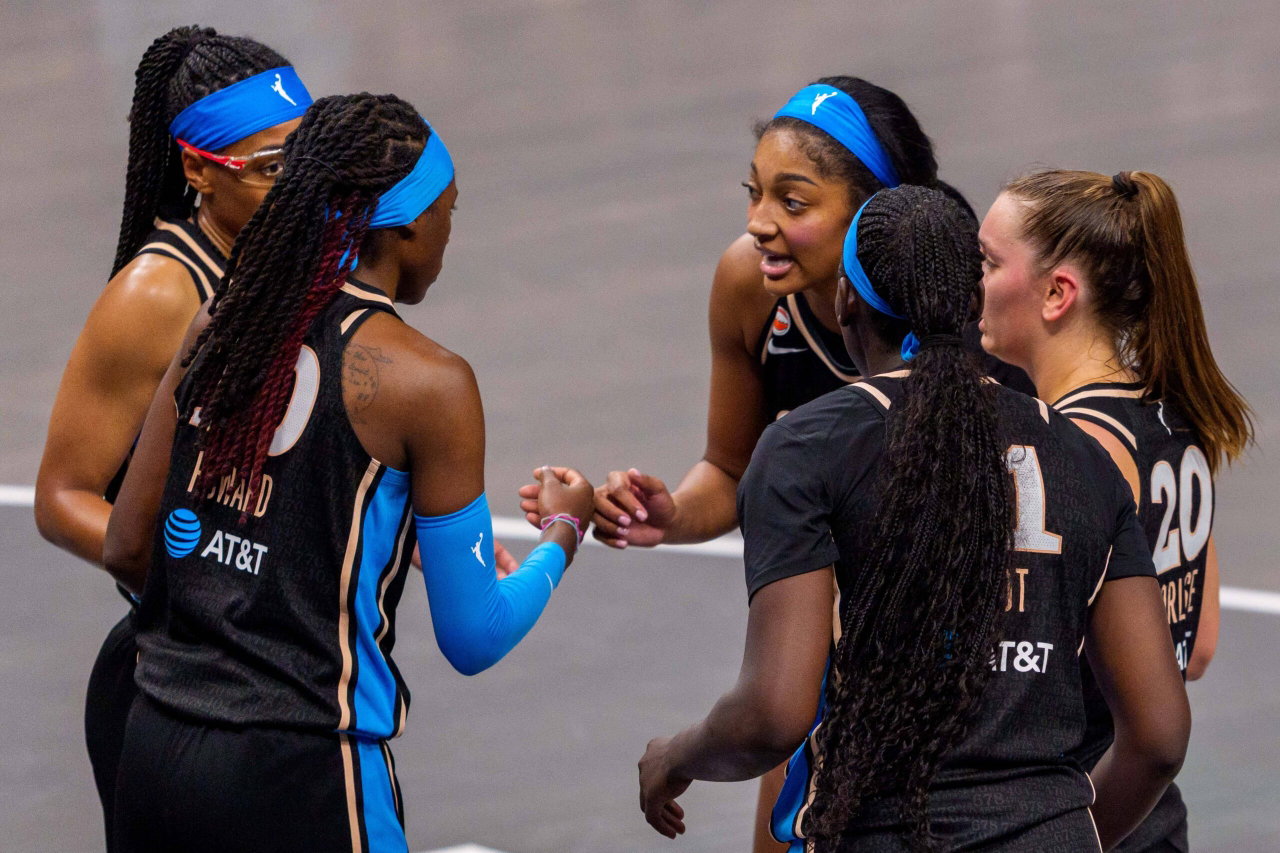
The New York Liberty had already made history by becoming the first No. 8 seed to eliminate a No. 1 seed in WNBA playoff history. But their remarkable run met a significant roadblock in Atlanta on Sunday. The Dream weathered New York’s early dominance, exploded in the third quarter, and secured a 92-82 victory to take control of the semifinal series.
Watch What’s Trending Now!
There was considerably more to the victory than the final score, however. From Angel Reese’s memorable defensive performance and Allisha Gray’s hand injury, to DeWanna Bonner turning in a veteran masterclass as Atlanta flipped a tied halftime contest into a double-digit victory, here are the biggest storylines from Atlanta’s Game 1 win.
Angel Reese’s Defensive Display
Angel Reese definitely made a compelling case for her 2026 WNBA Defensive Player of the Year award in Game 1. The Atlanta forward was everywhere defensively, finishing with 17 points, seven rebounds, four steals, and three blocks. But her impact extended well beyond the numbers, particularly during the third quarter when the Dream completely changed the complexion of the game.
One of Bayou Barbie’s most memorable moments came when she rejected Sabrina Ionescu’s driving attempt outright. The Liberty guard was attacking the basket and appeared to have a clear path to a layup before Reese arrived to emphatically swat the ball away.
However, what made the play even more striking was what followed. After completing the block, Reese held her gaze on Ionescu in a brief but unmistakable staredown. It was one of the defining images of the night and a reminder of exactly the kind of defensive presence Atlanta has in their corner.
Allisha Gray Ruled Out For Entire Game After Hand Injury
The biggest concern coming out of Atlanta’s Game 1 victory will undoubtedly be Allisha Gray’s left hand. Gray went down with 3:59 remaining in the first quarter after absorbing hard contact on a screen, heading to the locker room holding her hand and wrist. And after she briefly returned to the floor in the second quarter with her pinky and ring fingers taped, with 3:44 remaining before halftime, she appeared to dislocate a finger while diving for a loose ball on the defensive end. She then left the court in visible pain and was officially ruled out just before halftime.
The significance of the injury cannot be understated. Gray is one of Atlanta’s most important offensive weapons, and she played only 11 minutes, finishing with seven points, before her night was cut short. Her absence definitely placed additional responsibility on Jordin Canada and DeWanna Bonner, and both veterans responded emphatically.
Atlanta will be hoping Gray’s injury proves less severe than it appeared, and that she can return for the remainder of the series. The fact that they won comfortably without her for most of the game offers some comfort, but her presence will be important as the series develops.
DeWanna Bonner’s Domination
If anyone had any remaining questions about why the Atlanta Dream signed DeWanna Bonner just before the playoffs, her Game 1 performance provided the full and comprehensive answer. With Gray unavailable for the majority of the contest, Bonner stepped into a considerably larger role and delivered precisely what Atlanta needed.
The veteran forward finished with 23 points and nine rebounds, shooting 10-of-18 from the field and 3-of-6 from three-point range. Sixteen of those 23 points came after halftime, as the Dream began pulling away.
Bonner’s experience was particularly valuable when New York mounted its fourth-quarter challenge, repeatedly cutting Atlanta’s 16-point advantage back to five. The Dream answered each time, and Bonner was consistently at the centre of those responses, keeping Atlanta composed whenever the momentum threatened to shift back toward the Liberty.
Simply put, in this game, Atlanta could not afford to lose their leading scorer in Gray. And when they unfortunately did, they needed a player capable of immediately absorbing a larger offensive burden. Bonner did exactly that.
Jordin Canada’s Explosive 25-Point Performance
If Bonner provided the veteran stability, Jordin Canada provided the offensive explosion. Canada finished with a team-high 25 points alongside five steals and four assists, and she saved her best basketball for the second half, scoring 20 of her 25 points after the break.
She was particularly effective from beyond the arc, converting four of her six three-point attempts. Her ability to push the pace in transition and then knock down shots from the perimeter made it extremely difficult for New York to find a foothold once Atlanta had taken control.
Also, when the Liberty made their most serious fourth-quarter push, repeatedly cutting the deficit back to five, Canada delivered the decisive responses. She knocked down a clutch three-pointer late in the shot clock before following it with a transition layup off a defensive stop. Those two consecutive plays effectively ended New York’s realistic hopes of completing the comeback and sealed Atlanta’s grip on the game.
Atlanta Dream’s Stunning Third-Quarter Takeover
The third quarter was where Game 1 was truly decided. New York entered halftime with a 40-37 lead after a tightly contested opening 20 minutes featuring 14 lead changes and three ties. Neither team had managed to establish any lasting control. That changed the moment the second half began.
Atlanta opened the third quarter with a 13-3 run and never relented. The Dream ultimately outscored the Liberty 32-15 in the period, a swing so decisive that a three-point halftime deficit became a 14-point lead heading into the fourth.
The engine behind that third-quarter explosion was Atlanta’s defence. New York repeatedly turned the ball over as the Dream’s defensive intensity overwhelmed them, and Atlanta capitalised by consistently getting out in transition. The Dream produced 16 points off turnovers in the third quarter alone. That tied the playoff record for most points off turnovers in any quarter since the WNBA switched to quarters in 2006
Sabrina Ionescu’s 27-Point Effort Goes in Vain
Sabrina Ionescu did everything within her power to keep the Liberty within striking distance. The New York guard led all scorers with 27 points, shooting 10-of-20 from the field and connecting on three three-pointers, and continued pushing even after Atlanta had built a double-digit lead. Her fourth-quarter aggression helped New York mount a run that briefly made the game interesting again.
Breanna Stewart also added 19 points, while Jonquel Jones recorded 12 points and 11 rebounds. However, as it appears, all this, alongside Ionescu’s brilliance, was not enough to overcome the structural damage the Dream inflicted in those ten minutes after halftime.
Jonquel Jones Extends Her Historic Playoff Rebounding Streak
Jonquel Jones continued writing WNBA playoff history even in defeat. She grabbed six rebounds in the first quarter alone, extending her record streak to 53 consecutive playoff games with at least five rebounds, the longest such run in WNBA postseason history.
Jones was particularly important early, as New York dominated the glass in the opening period, outrebounding Atlanta 11-3, with Jones central to giving the Liberty the extra possessions that helped them build their early lead. She ultimately finished with 12 points, 11 rebounds, four assists, one steal, and five blocks, a comprehensive performance that reflected just how complete a player she is on both ends.
Atlanta’s Defensive Pressure Creates WNBA Playoff History
Atlanta’s defensive performance was arguably the single biggest reason the Dream walked away with the victory. The Dream finished with 14 steals and consistently disrupted New York’s offensive rhythm throughout the game. Their 10th steal of the night also placed them alongside the Los Angeles Sparks for the most playoff games with at least 10 steals in WNBA history.
Beyond the record book, those steals translated directly into points. Atlanta converted New York’s turnovers into 32 points, tying the WNBA playoff record for points off turnovers in a single game. The Liberty ended up committing 21 turnovers overall, with nine of them coming in the third quarter alone as Atlanta blew the game open with their defensive intensity.
That pressure was especially important because New York had already demonstrated during their first-round sweep of Minnesota that they could punish opponents when given the opportunity to control the game. Atlanta simply refused to give the Liberty that opportunity for long enough to make it matter.
Liberty’s Early Rebounding Advantage Fades Away
Interestingly, the game began with New York looking like the more physical team on the floor. The Liberty outrebounded Atlanta 11-3 in the first quarter, with the Dream’s three rebounds tying for the fewest by any team in a postseason first quarter since 2021. It was a concerning early sign for Atlanta.
New York was generating second-chance opportunities, and Jones and the Liberty’s frontcourt were dominating the glass with the kind of physicality that had defined their first-round sweep of Minnesota. But the Dream became progressively more physical as the game developed, and as their defensive pressure began creating turnovers and transition opportunities, the rebounding imbalance from the opening quarter became increasingly irrelevant. By the third quarter, Atlanta had flipped the entire narrative of the game.
New York’s Historic Playoff Run Takes Its First Setback
The Liberty entered the semifinal series carrying perhaps the most compelling storyline of any remaining team in the postseason. They had already made WNBA history by becoming the first No. 8 seed to eliminate a No. 1 seed, sweeping the Minnesota Lynx in a performance built on physicality, experience, and control of both ends of the floor. But Game 1 against Atlanta offered a very different kind of challenge.
The Dream had already swept the Washington Mystics in the first round and entered the semifinals having won two of their three regular-season meetings with New York. Both of those victories came during the final week of the regular season, including an 18-point win on September 23. The Liberty therefore knew they were facing a team that had already demonstrated a clear ability to give them problems. Game 1 only reinforced that point with considerable force.
Atlanta now holds a 1-0 lead in the best-of-five series and has two more home games ahead of them, a significant structural advantage they will be looking to press immediately in Game 2. For the Liberty, the task is now clearly defined. They need to find a way to neutralise an Atlanta defence that proved capable of completely dismantling their offence in ten second-half minutes, and do it quickly before the series slips further out of reach.