
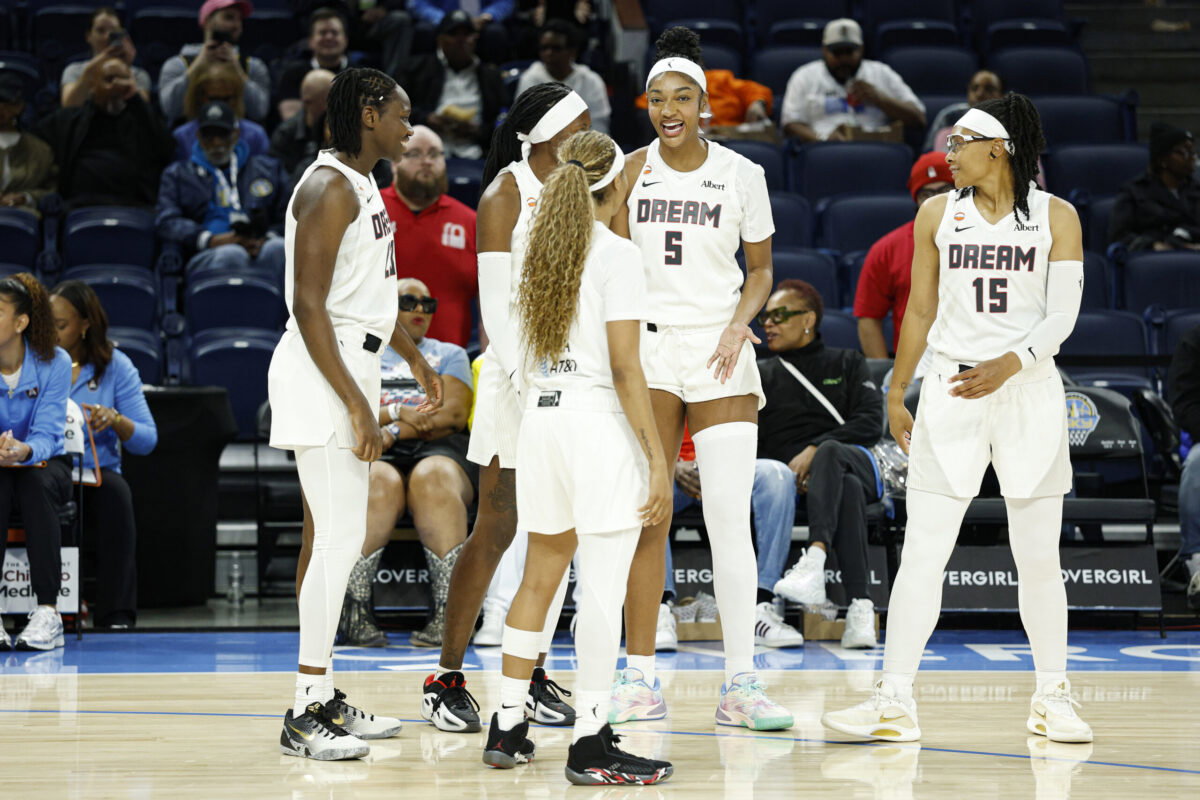
Last season was one of the best campaigns in the history of the Atlanta Dream. The franchise recorded a franchise-best 30-win season. And with everything they have done heading into the 2026 season, it appears they are doubling down on that momentum, particularly with the acquisition of Angel Reese.
Watch What’s Trending Now!
According to franchise general manager Dan Padover, the goal heading into this season is to simply continue from where they stopped in 2025. It’s to make sure last season was only the beginning. As he said, “Last year we had a great year, and our goal is to continue to keep that up.”
How the Dream Became One of the WNBA’s Most Ambitious Teams
Six seasons prior to the 2025 season were losing seasons for the Atlanta Dreams. However, throughout these periods, they steadily transformed and rebuilt the team into what it turned out to be last season. The transformation actually started in 2021. After a new ownership took over in February 2021, they began a complete overhaul of the franchise. They hired Dan Padover as General Manager, who, building on their young core, began an aggressive veteran acquisition specifically from 2023-2025. They added established leaders like Brionna Jones, Jordin Canada, and Brittney Griner. And what completed the final “brick” was the 2025 hiring of head coach Karl Smesko.
And of course, after six consecutive losing seasons, the Atlanta Dream delivered a historic campaign last year. They finished with a franchise-record 30-14 regular season record. They also secured the No. 3 seed, which was their highest finish since 2018. More importantly, the Dream looked like a completely different team on the court. Under head coach Karl Smesko, they adopted a faster, more aggressive offensive system. And the transformation was immediate, as they finished with the league’s second-best offensive rating after ranking near the bottom the previous year.
Of course, their postseason ultimately ended in disappointment with a first round crash out. However, they defeated the Indiana Fever in Game 1 of their first-round series, and that earned them the franchise’s first playoff victory in seven years. So even though the Dream eventually lost the series, the overall feeling around the franchise was not frustration. Instead, they intend to run with that momentum this new season.
Angel Reese Changes Everything
General manager Dan Padover has consistently made aggressive moves to push this Atlanta Dream team forward. In 2025, he brought in Brittney Griner who played a significant role as a veteran leader for the team last season. Now, he’s brought in Angel Reese.
Imago
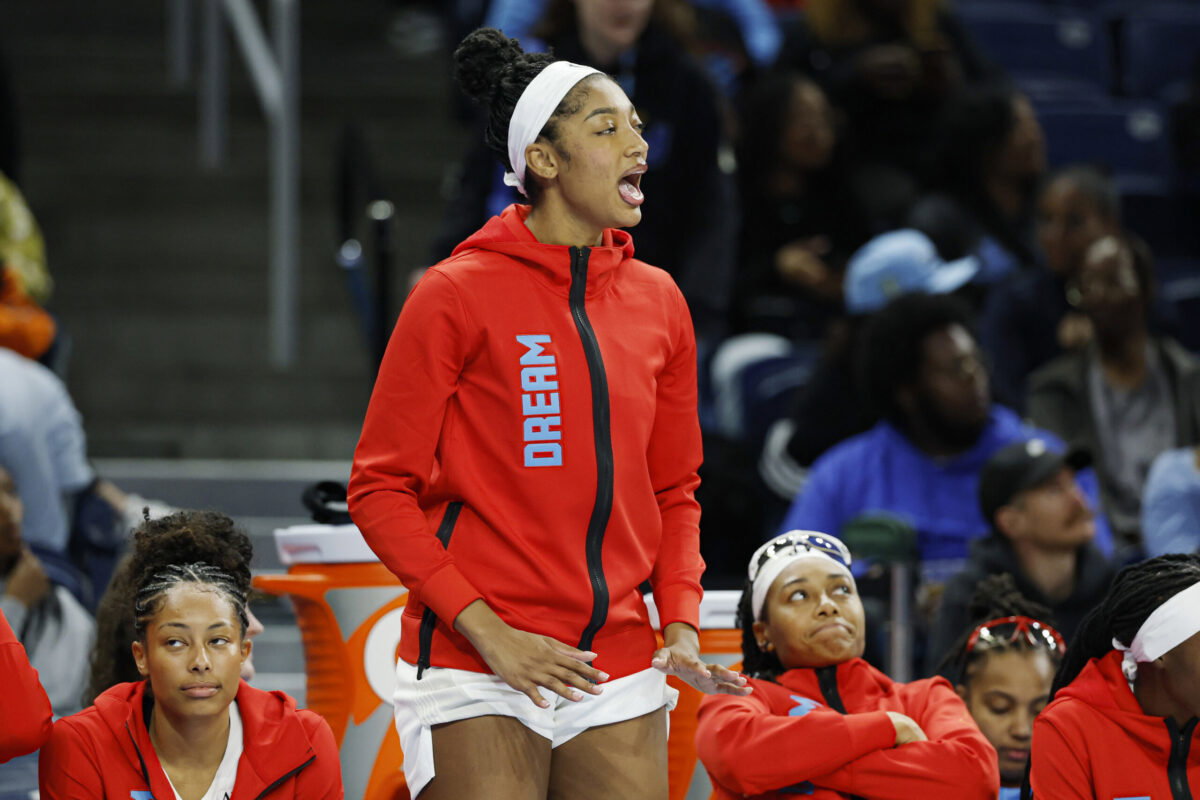
Apr 29, 2026; Chicago, IL, USA; Atlanta Dream forward Angel Reese (5) reacts during the second half of a WNBA preseason game against the Chicago Sky at Wintrust Arena. Mandatory Credit: Kamil Krzaczynski-Imagn Images
The addition of Angel Reese has the potential to completely change the trajectory of the Atlanta Dream. After winning a franchise-record 30 games last season, Atlanta already looked like one of the league’s rising contenders. But Reese’s arrival gives the team something it previously lacked, a relentless interior force capable of impacting every aspect of the game on both ends of the floor.
In fact, the feeling in Atlanta now is more or less like Reese is the missing piece that the team needs to move to the next level. Specifically, Allisha Gray following Reese’s trade mentioned that the addition is “the missing piece” needed to push the team “over the top. And of course, even if not for anything, Angel Reese will definitely transform Atlanta’s rebounding identity. She has led the WNBA in rebounding in each of her first two professional seasons and already owns a career average of 12.9 rebounds per game.
Alongside her energy, defensive activity, and willingness to battle in the paint, Reese could also be an offensive asset for this team. She will be playing alongside elite perimeter scorers like Rhyne Howard and Allisha Gray. And because the defense will also have to concentrate on these two to prevent open three-point shots, Reese will have clearer driving lanes and more room around the rim.
And of course Reese is wasting no time, as she’s already showing what she’s capable of. In her first two preseason outings for the Atlanta Dream, she’s averaging 9.0 points, 5.5 rebounds, and 2.5 steals. And she did all these while playing 24 minutes across the two games.
Off the court, Reese’s impact has been just as immediate. Her arrival has significantly elevated the Dream’s visibility and commercial momentum. Ticket prices for Atlanta’s home opener reportedly surged within hours of the trade announcement. Her jersey quickly sold out across multiple sizes. The franchise also experienced a major spike in social media engagement almost overnight.
So, Angel Reese has not only strengthened the team’s on-court identity, and raised their competitive ceiling. She has also amplified their brand.
Betting on Continuity: Why Re-Signing the Core Matters
Like Dan Padover said, the goal as the Atlanta Dream head into this 2026 season is to continue building on last season’s momentum. And they’ve done exactly that. They have made sure to keep their core of Allisha Gray, the team’s leading scorer last season, alongside Rhyne Howard, Brionna Jones, Jordin Canada, and Naz Hillmon.
Gray enters the season after a career-best 2025, she was named to the All-WNBA First Team. Howard, who was drafted No. 1 overall in 2022, has consistently been one of the WNBA’s top two-way players. In fact last season she had the 2nd best defensive rating in the league. Meanwhile she also averaged 17.5 points per game. Canada, on the other hand, provides veteran leadership and defensive intensity in the backcourt. And in the frontcourt, Hillmon’s energy and versatility complement Brionna Jones’ physical interior presence and experience as a multi-time All-Star.
Retaining this core also gives Atlanta an important competitive advantage because they already have a team chemistry. Also, the fact that the were able to add Reese to the team without sacrificing any of their core players means thay have now improved the team without having to weaken the existing foundation that they have.
Inside Karl Smesko’s System
Keeping last season’s core together is especially important because of head coach Karl Smesko’s system. Karl Smesko’s offensive philosophy is built around pace, spacing, ball movement, and shot efficiency. After years of success running a similar approach at the college level, Smesko brought that philosophy to the Dream. It immediately transformed them into one of the WNBA’s most explosive offenses during the 2025 season.
The foundation of the system starts with shot selection. Smesko strongly believes in generating the most efficient shots possible, which means prioritizing three-pointers and shots at the rim while avoiding difficult mid-range attempts. In his view, long two-pointers are among the least valuable shots in basketball. So Atlanta’s offense is designed to create either open perimeter looks or direct attacks toward the basket. And of course, the team was one of the league’s best three-point shooting offenses last season. They also dramatically reduced their reliance on mid-range scoring.
That offensive identity also explains why spacing is so important within the system. Smesko wants the floor stretched at all times to create driving lanes, passing angles, and open perimeter opportunities. This is why the Atlanta Dream team often operates with five-out concepts that pull defenders away from the paint and force opposing defenses to cover more space. And once the floor opens up, they attack quickly before defenses can recover or reset. That up-tempo approach helped them become one of the highest-scoring teams in the WNBA last season.
Another major pillar of the system is ball movement. Rather than relying heavily on rigid set plays, Smesko prefers a read-and-react style that is dependent on quick decisions and player freedom. The expectation is that players recognize defensive coverages and respond accordingly. If defenders leave space, the offense attacks immediately. If defenders collapse, the ball moves quickly to the next open shooter. The emphasis is on keeping the defense constantly shifting instead of allowing it to settle into predictable rotations.
This attacking philosophy which is often referred to as “Smeskoball,” naturally creates a positionless style of basketball. And Atlanta’s current roster is almost perfectly designed for that approach. Rhyne Howard and Allisha Gray are ideal perimeter stars for the system because both players can score efficiently from deep while also attacking off the dribble. Also, Howard’s ability to create high-volume three-point offense makes her one of the most dangerous players in the system. Gray also thrived within the system last season and elevated herself into MVP-level conversations. Jordin Canada also played a critical role because of her speed, decision-making, and ability to control tempo.
Of course, players have admitted that learning Smesko’s system initially required a major adjustment because of its unique terminology and demanding pace. However, by bringing back the same core, the Dream avoids restarting that learning process from scratch. Instead, they’ll now have a deeper understanding and help newer additions like Angel Reese adapt more quickly.
What Success Actually Looks Like in 2026
Ending the 2025 season with a winning record and a playoff appearance was enough to make it a successful year for the Atlanta Dream. That will not apply in 2026, especially after the franchise achieved a franchise-best 30-win season last year.
However, the realistic expectation going into 2026 is for the Dream to still finish somewhere within the 28-to-32-win range again. And after finishing as the No. 3 seed in 2025, anything less than a top-four finish now would likely be viewed as underperforming this year. It will also not be a stretch to set the benchmark for this Atlanta Dream team at the WNBA Semifinals. After consecutive first-round exits in previous years, another early playoff elimination would feel like a major disappointment given the roster investment and rising expectations surrounding the franchise.
What do you think? Can they make it as far as the semifinals, or last season’s performance was just a one-time thing?