
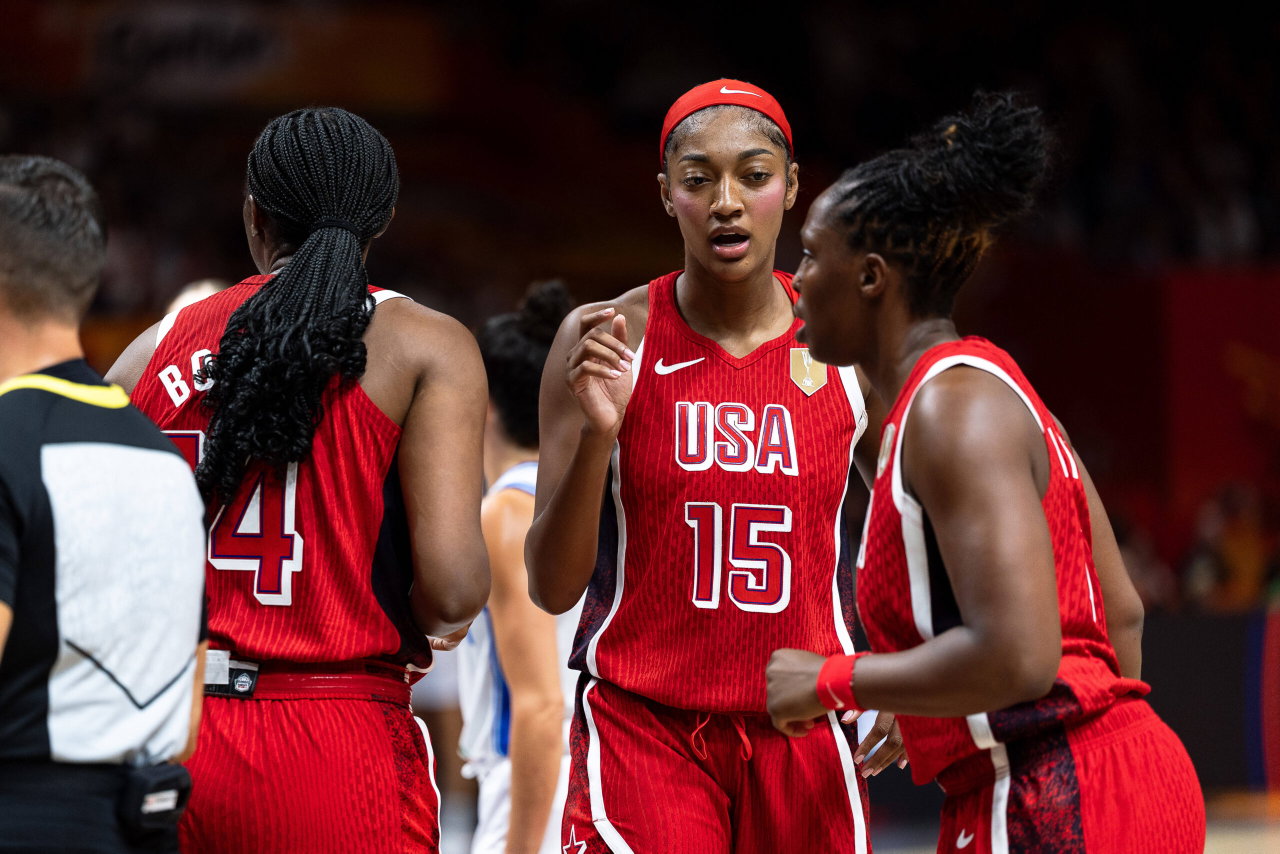
The group stage raised a few questions about Team USA, especially after that historically low-scoring performance against Italy. Against Hungary, though, those questions were quickly put to bed. Kara Lawson’s squad came out strong, racing to a 36-12 lead and never taking its foot off the gas on the way to a record-breaking 108-56 win. And there were plenty of storylines worth digging into.
Watch What’s Trending Now!
From Caitlin Clark and Angel Reese continuing to build their chemistry to Napheesa Collier leading the way and Sonia Citron taking a blow to the head, here’s a closer look at the biggest takeaways from Team USA’s crushing quarterfinal win.
59-Point First Half Sets World Cup Knockout Record
Team USA poured in 36 points in the opening quarter, then added another 23 in the second, taking a commanding 59-30 lead into the locker room. According to FIBA, those 59 first-half points marked Team USA’s highest-scoring first half in World Cup knockout-game history. It’s a huge turnaround from what happened against Italy.
The team was efficient, aggressive, and relentless from the opening tip. And Hungary had very few answers for the pace and pressure being applied. And so by halftime, the quarterfinal was already effectively decided. But amidst all that, there was one moment that gave Team USA a jumpscare!
Sonia Citron takes a blow to the head
Sonia Citron had a scary incident during the third quarter. While playing defense under the basket, Citron caught an accidental hit to the face from a Hungarian player. She was visibly shaken up and holding her head and face, after which she was immediately subbed out of the game. She then spent a brief period on the bench before being taken down the tunnel to the locker room for a quick medical evaluation.
However, after remaining on the bench for a period of time, she later returned to the game to start the fourth quarter and finished out the game with no further issues. She eventually ended the game with two points, one rebound, one steal, and a team-high two blocks in the 11 minutes that she played.
Thankfully, that was the only brief scare the team faced, as it turned out to be a night of positives. Starting with the growing connection between two of Team USA’s biggest stars.
Clark and Angel Reese’s Chemistry Continues to Grow
A genuine, productive connection between Caitlin Clark and Angel Reese, perhaps the WNBA’s most discussed rivals over the past few seasons, was not something anyone anticipated heading into this tournament. And yet, once again, the two provided another compelling glimpse of the chemistry beginning to develop between them.
Clark’s playmaking naturally creates opportunities for everyone around her. But when those plays involve Reese, they carry an extra layer of intrigue given everything their WNBA rivalry represents. In the final group stage game against Czechia, Clark’s slick pass into the paint to find Reese for a layup became one of the most discussed moments of that game online. The two decided to produce more than double that in the quarterfinal.
Clark finished with two of her nine assists credited directly to Reese, and this time, Reese returned the favor with one of her own. One particular play saw Clark drive the ball, use a Reese screen to navigate past a defender, and then deliver a final pass back to Reese, who finished it off cleanly. The play-within-a-play quality of their connection in that moment was a sign of genuine on-court understanding developing between two players who spent much of the WNBA season looking to beat each other. That chemistry was one thing, but individually, too, they made a huge impact.
Caitlin Clark Continues to Embrace Her Creative Role
Caitlin Clark finished with 10 points and a game-high nine assists, shooting 3-of-8 from the field and 1-of-3 from three-point range. After leading Team USA in assists through the group stage at 6.3 per game, she once again showed how comfortable she has become in her creative role.
Rather than looking to force her own offence, Clark consistently sought to get teammates involved, using her court vision to keep the ball moving and identify the right matchup, while her ability to push pace gave Team USA another dimension of pressure that Hungary could not contain. The impact of her floor presence showed most clearly in the plus-minus column, as she finished with a team-best +36, meaning Team USA outscored Hungary by 36 points during her 20 minutes and 25 seconds on the court.
Clark’s willingness to prioritize creation over volume, while still managing to contribute 10 points while averaging 8.5 per game across the tournament, makes her dual-threat potential all the more valuable as Team USA chases a fifth consecutive world title.
Angel Reese Continues Her All-Around Hot Form
Angel Reese’s nine points may not jump off the box score compared with Napheesa Collier’s 19 or Rhyne Howard’s 15, but her overall performance was once again difficult to overlook.
Reese made her impact felt across the floor, finishing with 9 points, 6 rebounds, 3 assists, 2 steals, and a block while going 4-of-5 from the field in just 17:52. That is the type of performance that has become increasingly familiar from Reese during this tournament.
Through Team USA’s first three group-stage games, she averaged 8.7 points, 6.0 rebounds, and 1.3 steals per game, while shooting an incredibly efficient 64.3% from the field, going 9-of-14. Her performance in the second game against Italy was particularly impressive. In a game that was generally a poor showing for the entire team, she was one of the few positives.
And so far, she’s continuing to prove that she doesn’t have to dominate the scoring column to make an impact. Whether it’s creating extra possessions through offensive rebounds, disrupting passing lanes, protecting the rim, or finishing around the basket, she keeps finding different ways to influence games. That all-around impact is definitely an advantage for Team USA as they continue their push through the tournament.
Napheesa Collier Leads Team USA With a 19-Point Masterclass
While plenty of Team USA players contributed to the offensive explosion, Napheesa Collier led the way on the scoreboard. She finished with 19 points, seven rebounds, and one block, making her presence felt at both ends of the floor throughout. What stood out most was how efficiently she went about her business.
Collier delivered those 19 points on 9-of-13 shooting, a 69 percent clip from the field, including 73 percent on two-point attempts, and connected on one of her two three-point attempts. She has come a long way, because at the start of this tournament, she was not carrying the heavy scoring load for Team USA, averaging 7.3 points per game across the three group stage games. But her scoring has steadily climbed with each game.
Collier scored four points against China, six against Italy, 12 against Czechia, and now 19 in the quarterfinal. This kind of progression couldn’t have come at a better time than this for Team USA.
Rhyne Howard, Aliyah Boston and the Supporting Cast Show Off Team USA’s Depth
One of the most frightening things about this Team USA roster is that there are simply too many ways for opponents to get hurt. Rhyne Howard was another major contributor against Hungary, finishing with 15 points on 5-of-7 shooting, including an excellent 3-of-5 from three-point range. Her ability to stretch the floor gave Team USA yet another perimeter threat.
Aliyah Boston also made an impact with eight points, while shooting 3-of-7 overall and an impressive 2-of-3 from beyond the arc. Boston’s ability to contribute from the perimeter only makes an already difficult Team USA offense even harder to defend.
Then there was Paige Bueckers, who added seven points and three assists, finishing with a +25 plus-minus. Jackie Young and Kahleah Copper also each scored 10 points, with Copper putting together a particularly efficient night by going 3-of-3 from the field, 2-of-2 from three and 2-of-2 from the free-throw line.
That, right there, is exactly the point. Team USA doesn’t need one or two players to do everything. Their performance against Hungary showed just how much depth this team has, and Coach Kara Lawson has been incredibly effective in managing and taking advantage of that depth.
All 12 Players Score and Play at Least 10 Minutes Again
The depth this team has became even more obvious when you look at how Coach Lawson distributed the minutes. For the second straight game now, all 12 Team USA players scored at least one point, and all 12 played at least 10 minutes.
When a team can put up 108 points and still give every player meaningful minutes, it says quite a lot about the depth available at the coach’s disposal. And that is a remarkable luxury to have at this stage of a major tournament.
Instead of relying exclusively on its stars, Coach Lawson has been able to spread the workload across the roster while continuing to build an enormous lead. It also gives her the opportunity to keep her players fresh as the tournament moves toward the medal rounds.
Team USA’s Defense Turns 17 Steals Into 44 Points
The offensive numbers that Team USA put up in this game will definitely occupy the bulk of the talking points and discourse. However, Team USA’s defense was just as responsible for turning this quarterfinal into a blowout.
The team recorded 17 steals, more than twice Hungary’s eight, and those turnovers were converted into a staggering 44 points off turnovers. Hungary, by comparison, scored just seven points off Team USA’s turnovers. They also held a massive 28-3 advantage in fast-break points, showing how quickly those defensive plays translated into offense.
This is definitely a perfect example of the kind of basketball coach Lawson wants from her team: defend aggressively, force mistakes, and immediately punish the opposition.
USA Finally Finds Its Three-Point Rhythm
After battling heavy perimeter slumps during the group phase, averaging just 29% from beyond the arc through the first three games, Team USA completely blew the lid off the basket in the quarterfinals against Hungary, shooting a blistering 52%, going 12-of-23 from downtown. Specifically, Rhyne Howard led the way from deep with three makes on five attempts, while Kahleah Copper and Chelsea Gray were both perfect from three. Aliyah Boston also knocked down two of her three attempts. Meanwhile, Caitlin Clark went 1-of-3 from deep, while Paige Bueckers also connected once.
After watching a team like France set a record with 22 three-pointers made against Nigeria in their final Group B match, some analysts had quite a bit of panic given Team USA’s output from beyond the arc, especially with France being one of the real challengers to Team USA. Perhaps those concerns can now relax, as Team USA appears to have finally found that rhythm from deep. Hopefully, it will only get better from here.
Team USA Rewrites FIBA Women’s World Cup Records With Dominant Hungary Win
Team USA did end the night with enough to rewrite a couple of records in the FIBA Women’s World Cup record books. First, the 108-56 victory ended up being the team’s highest-scoring game and largest margin of victory of the 2026 World Cup so far. But even more impressively, those 108 points were the most points by a team in a FIBA Women’s World Cup quarterfinal. And with the 31 assists that the team delivered in total, they also became the first team to tally 30+ assists in a quarterfinal.
This quarterfinal performance was simply a statement, particularly after they were pushed to the limit by Italy earlier in the tournament. They will now go on to face either Spain or Australia in the semifinal round on Saturday. And if this performance was any indication, whoever comes through among these two teams better be scared.