Imago
Credit: Imagn Images
Imago
Credit: Imagn Images
Seventeen months into negotiations between the WNBA and the WNBPA, and we’re still waiting on a new CBA. What we do know is that both sides continue to go back and forth, countering proposals in what has become a high-stakes chess match. The league’s latest counteroffer could be a game-changer for the next generation, offering meaningful financial gains for stars like Paige Bueckers and Caitlin Clark.
Watch What’s Trending Now!
As per the Associated Press, the league submitted a fresh CBA proposal Sunday night that includes provisions allowing young cornerstones such as Caitlin Clark and Paige Bueckers the opportunity to earn max-level salaries sooner in their careers.
Under the current CBA, players on rookie contracts become eligible for a max deal only after completing their rookie agreement, which is generally a three-year contract with a fourth-year team option. The league’s latest proposal would change that. It would allow young players to qualify for a maximum extension in their fourth year itself if they earn First- or Second-Team All-League honors. Additionally, those players would not be eligible for a franchise tag designation following that extension.
For Caitlin Clark, who earned All-WNBA First Team honors in her rookie season, and Paige Bueckers, a rookie All-WNBA Second Team selection, the current proposal could fast-track what was already going to happen someday. Clark would be in line for a max contract by 2027, while Bueckers would be eligible in 2028.
This would be a huge financial breakthrough for these rookies. Under the league’s current proposal, the salary cap would increase to $5.75 million in the first year, which is a 280 percent jump from last year’s $1.5 million. Reports also suggest that with revenue sharing, the cap could grow to $8.5 million by the sixth year of the deal. Maximum salaries would rise from $249,000 to $1.3 million, while the average salary would increase from $120,000 to $540,000 in the very first year.


So for the likes of Caitlin Clark and Paige Bueckers, who are currently earning $78,066 and $78,831, respectively, they could be earning in excess of $1 million by 2027 and 2028 — that’s more than a 12-times jump from their current salary.
But we still don’t think a deal will be made anytime soon. Why? Because the league’s latest proposal does not make any changes to the revenue-sharing model from the previous offer. And that’s something you can’t ignore. It has already been a source of frustration, even for Paige Bueckers, who openly criticized the current state of negotiations ahead of the Unrivaled semifinals.
“At this point, it’s not really a negotiation anymore,” Bueckers said. “Like, both sides aren’t moving. So I feel like we need to continue to have these conversations, continue to actually have change implemented for us to move on our stance. We as players, we don’t want to strike. We want to have a season. I love playing basketball. That’s all I want to do. But again, there are things that need to be handled, and we want to do it as professionals.”
As things stand, the league has proposed giving players more than 70 percent of net revenue, while the union is asking for an average of 26 percent of gross revenue, before expenses, over the life of the deal. This is something the league officials even called unrealistic.
But there are some positives in the direction these negotiations are heading. Speaking Monday ahead of the Unrivaled semifinals, Kelsey Plum said convincing the league to adopt a revenue-sharing model for the first time is something “we fought really hard for,” describing it as a “significant win.”
“I’ve always been someone that’s focused on the gain, not the gap.” Plum said. “And to be honest, I think if you look at where we’ve come from, shoot, since I came into the league until now, and now that we’re in a revenue share, it’s a tremendous win. Obviously, we’re going to continue to negotiate. I can’t emphasize that enough. Like we’re not just settling. I want to be very clear about that. But I’m super proud to be a part of this opportunity to change women’s sports.”
While forcing the league to even offer revenue sharing is seen as a win by many in the union, we can clearly see that there remains a significant gap between what the players are demanding and what the league is willing to offer. Unless both sides find common ground soon, the March 10 deadline could pass without a deal. And if that happens, the league may begin missing games… something that has not occurred in the 30 years since its establishment.
This was something confirmed by Breanna Stewart as well. “If you look at… the union’s deal, or the league’s deal… both are not ready to be voted on. Because both need to be negotiated up or down, or in a number of ways.”
We will be hoping that both sides reach common ground soon. But beyond the revenue-sharing model, there’s another issue that could create challenges for franchises, and it’s something that needs to be addressed as well.
Rookie Max Contracts: A Problem for Franchises such as Caitlin Clark’s Fever
While it sounds wonderful to see these talented rookies earn a max contract just a year earlier in their WNBA careers, especially when we’re talking about millions, it does feel great from a player perspective. But for teams like the Fever, who drafted two No. 1 picks in back-to-back years, it could spell trouble.
Imago
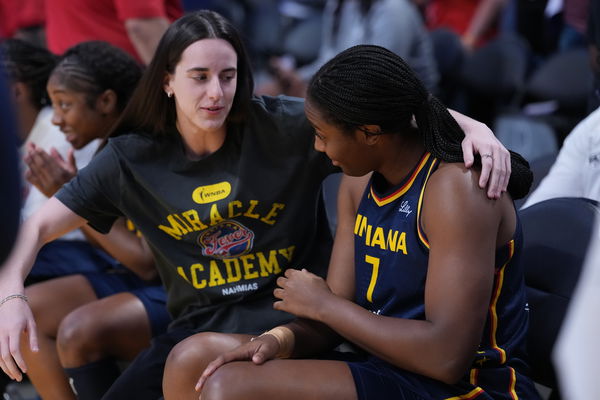
Aug 5, 2025; Los Angeles, California, USA; Indiana Fever guard Caitlin Clark (22) gives a hug to forward Aliyah Boston (7) in the first half against the LA Sparks at Crypto.com Arena. Mandatory Credit: Kirby Lee-Imagn Images
As per the league’s current proposal, Caitlin Clark would not be the first Indiana Fever in line for a max deal. Aliyah Boston would become eligible before her. Now, if the Fever hand out max contracts to both Kelsey Mitchell and Aliyah Boston this year, and then extend Caitlin Clark on a max next year, you’re suddenly looking at three players potentially consuming more than 50 percent of the proposed $5.75 million salary cap.
Which is why the union is pushing for a $9.5 million salary cap, a number that remains well above the league’s proposal. While the league’s current proposal creates significant opportunities for elite players to earn big money, it could leave role players and those not consistently winning end-of-season awards at a disadvantage if the deal goes through as it stands.
For teams like the Fever and the Wings, who have drafted/will draft back-to-back No. 1 picks, resource allocation could quickly become a serious challenge. The same applies to contenders like the Liberty, Lynx, and Aces. Every franchise would want to hand out multiple max deals, but doing so could leave the rest of the roster thin and imbalanced. It’s definitely something we need to keep an eye on as negotiations continue.
Related Newsletters