
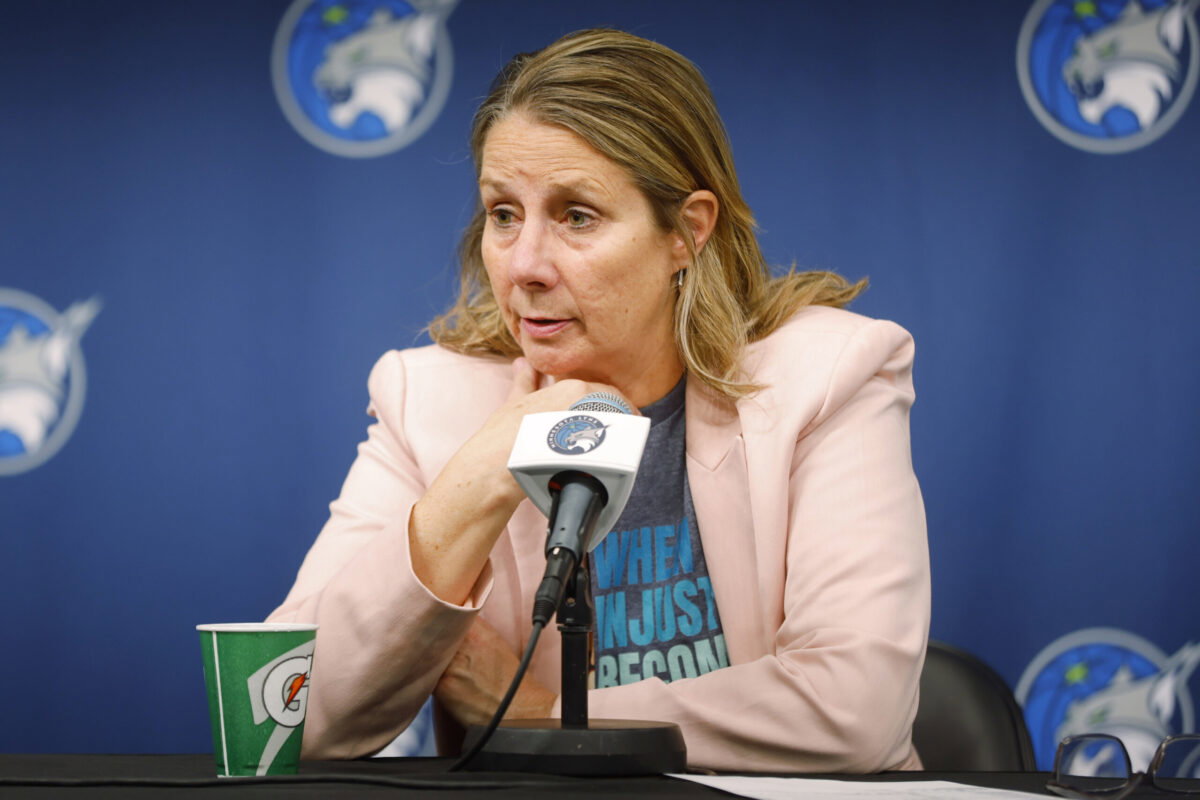
There’s been a lot of changes in officiating across the WNBA this season. And that has resulted in a noticeable increase in foul calls. But according to Minnesota Lynx HC Cheryl Reeve, the spike in foul calls isn’t simply the result of referees being overly aggressive, it simply reflects behavior that was happening on the court.
Watch What’s Trending Now!
What makes Reeve’s perspective particularly worth listening to is that she was an active part of the decision-making process that produced these changes. In a video shared by Colin Salao on X, Reeve, speaking at her postgame press conference following Minnesota’s victory over the Chicago Sky, revealed that she was a member of the task force that helped shape the officiating adjustments now being implemented across the league. “You know, Sandy is on the task force, so is myself. Can’t say all the names… Those that are on the task force, we are trying to represent the entire league. Not our teams, the entire league and for the good of the game,” she said.


Cheryl Reeve credited referees for their receptiveness to league-wide officiating concerns. “I think we’re on the right path… I know they’re working really, really hard to get this game where we want it to be.” She called officials “an open book” to feedback. Full comments ⬇️
The motivation behind the task force’s work was clear. “We don’t want those fouls,” Cheryl Reeve said. And the just-concluded game against Chicago illustrated precisely why change was necessary. Interestingly, the Lynx actually secured a comfortable 79-58 win, their second victory over Chicago in three meetings this season. It was also their fourth consecutive season coming away as the winning side in the Lynx-Sky series. But much like many other games this season, the high volume of whistles heavily impacted the rhythm of play. The contest produced 36 total personal fouls; 19 for the Chicago Sky and 17 for the Lynx. “We are fouling,” Reeve said simply. There simply needed to be a change.
The process that led to these officiating changes appears to have taken shape at the conclusion of the 2025 WNBA season, when league leadership arrived at a point of genuine reflection. As Reeve described it, “They, the leadership that I was talking about, at the end of last season, sort of got to the space where they said, ‘Okay, we do have a problem, we need to listen to our key stakeholders a little bit more. There has to be a little more collaboration around what’s happening.” For Reeve, that willingness to actively seek input and engage with those closest to the game is impressive.
And what has followed those conversations has been encouraging. In fact, as Reeves further revealed, in a recent meeting, referees opened the floor to feedback in a way that Reeve found genuinely refreshing. “That meeting, like recently, was like, ‘How do you think we are doing, what do you think you can do better?'” she said. And of course, the officials, as Reeves noted, received a lot of honest feedback. That receptiveness to it earned them considerable credit in Reeve’s eyes. “I give them credit, as they are an open book right now,” she said.
Cheryl Reeve was however also clear about the fact that the transition was never going to be seamless. Change of this magnitude takes time, and there will be an adjustment period before the new standards feel natural on both sides of the whistle. “There are things that players are doing that they have to adjust to and stop doing,” she acknowledged. And from the officiating side, further calibration was always expected. As she said, “There’s no question, we all knew coming out that this thing was probably going to need some recalibrating.”
Hopefully, that recalibration arrives sooner rather than later. The intent behind the changes, cleaner basketball, better flow, a product that is more enjoyable to watch, is definitely one that everyone around the league supports. And hopefully, with time, that goal will be achieved.
Cheryl Reeve Believes WNBA Officiating Changes Are Working
Even though the current foul counts might suggest otherwise, Cheryl Reeve genuinely believes the officiating changes across the WNBA are heading in the right direction. “I think we are on the right path,” she said.
Part of the reason why she has this belief is because of what the numbers are already showing in terms of scoring. “As we know, scoring is up. Some of it is because of the free throw shooting, but I also think it’s because there’s more freedom of movement,” Reeve said.
And the data appears to back her up. Teams are now averaging 22.4 free throw attempts per game, a steep rise from the 18.2 recorded last season. The league-wide scoring average has also climbed from 81.2 points per game last season to 85.6 this year. And so, it seems that while the increase in free throws has clearly played a role in that jump, Reeve’s point about greater freedom of movement might also be contributing, however little.
For Reeve, the foundation is now in place. What the league needs next is consistency. “I think the biggest thing now, from my perspective, is the consistency across crews. We want the basic things we are talking about to be consistently officiated regardless of teams, regardless of players, regardless of officials,” she said.
And Reeve has full faith that the officials will get there. “I know that they are working really, really hard to get this game where we want it to be,” she said. Hopefully that happens sooner than later.