
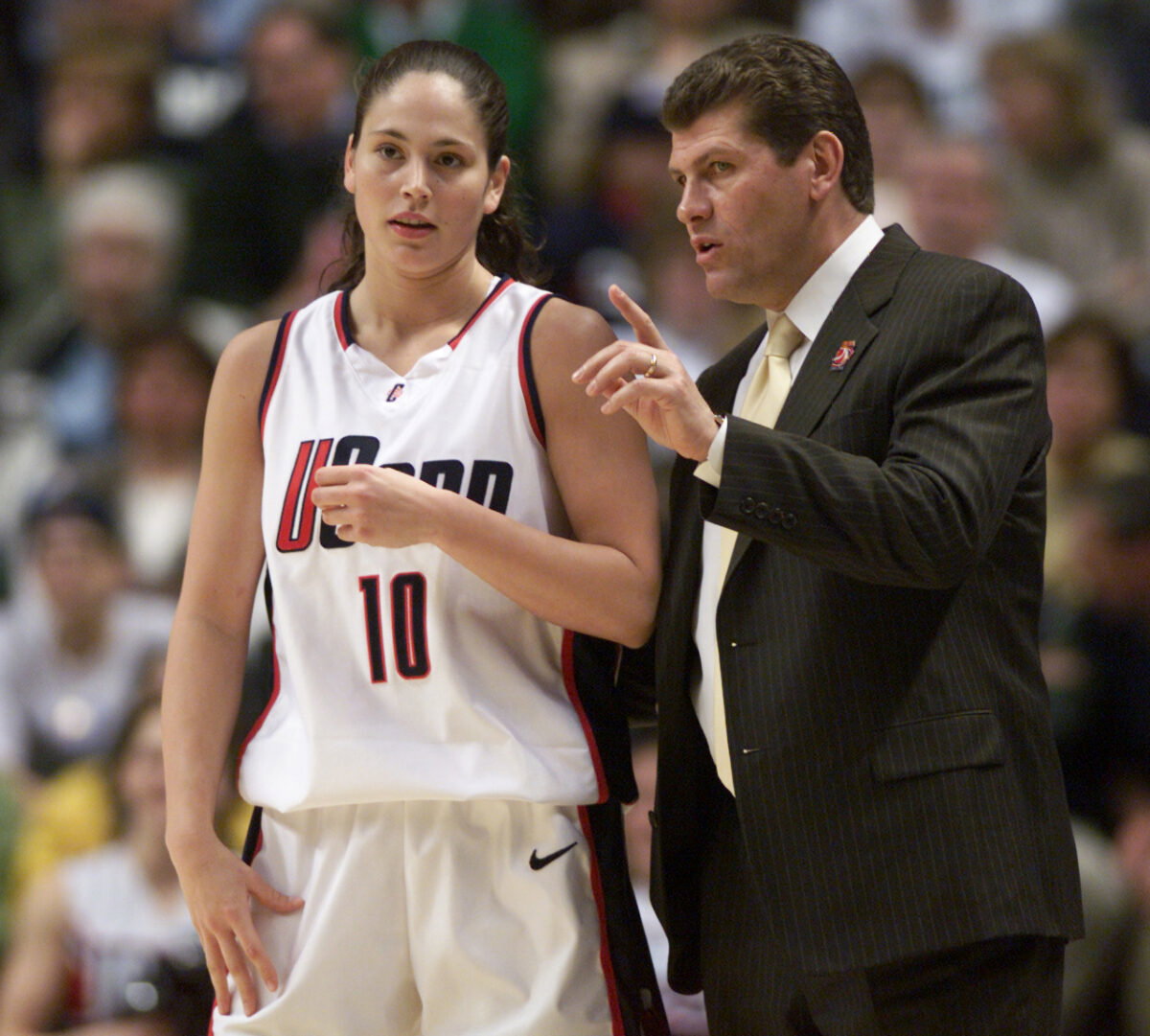
For almost two decades, Sue Bird made the daunting days look easy. One-of-one. That’s the phrase Geno Auriemma used to describe his former point guard. “There was never a sometime; it was all the time,” Auriemma said on her trustworthiness and dedication as a player. “That carried over to the WNBA, the Olympic team, just legendary, one-of-one.” Now, the legendary point guard has inspired a statewide change as the Senate has passed a rare, albeit puzzling, honor in recognition of the WNBA legend.
Watch What’s Trending Now!
During her time with the Huskies, she won two NCAA National Championships and three Big East Championships while recording 1,378 points and 585 assists. Bird went on to win four WNBA titles, became a 13-time WNBA All-Star, and won five Olympic medals with Team USA. While she is all that, Sue Bird is not a literal bird (as if that needed any explanation). Yet, the Connecticut Senate has passed a law naming her the State Bird.
The American robin has been the state bird of Connecticut since 1943. Now, it will have some company, but only in March. In an amendment passed during a late Tuesday night session in the state’s Senate, the robin will be joined by two new birds: Jordan Hawkins and Sue Bird.
“The American robin, Turdus migratorius, shall be the state bird, provided in the month of March of each year, the American robin, Jordan Hawkins, and Suzanne Brigit Bird, also known as Sue Bird, shall be the state birds,” the amendment reads.
View this post on Instagram
This is an unprecedented gesture to two Connecticut legends who have made the program what it is. Pelicans star Hawkins played for two seasons with the Huskies, winning their fifth national championship. Usually, such honors are given via naming a street after the athlete or even building a statue, like the Seattle Storm did for Bird. She also had her jersey retired by the program just last year, and this honor only adds to how much she means to the state of Connecticut and the university.
“I think it’s a great honor,” House Speaker Matt Ritter told reporters on Wednesday. “It speaks well to our love affair with our university and our basketball team and the month of March and what it means to the state, so I think it’s a nice gesture.”As the proclaimed basketball capital, the state economy earns a lot from the university’s success. According to a 2022–23 report, women’s basketball contributed a whopping $34.2 million to the state economy. And since then, the game has grown at a rapid pace, so the number is very likely even higher in 2026. So, this honor and the relationship with the university make even more sense considering that.
Sue Bird is the beacon of the Huskies, even today. Bird is currently the managing director of Team USA and owns a part of the Seattle Storm. Hosting her Bird’s Eye View podcast, Bird has played an important part in the game’s explosion. She remains active to this day. Beyond getting named as the state bird, Sue Bird also called for a new rule to be named after her that could help the WNBA playstyle.
“The Sue Bird” Rule Could Shake Up the WNBA
The physicality of the WNBA has been a hot topic of discussion lately. Cheryl Reeve emphasized how the coaches have worked with the league during the offseason.
“We’re working really hard because we don’t want the level of physicality that we’ve seen in our game,” Reeve said. “I’m confident the game is going to be more fluid and have more freedom of movement.”
The league has imposed stricter fines on technical fouls and introduced fines for flopping as well. We have already seen more fouls called than usual and on less contact than it used to take. Even Azzi Fudd joked about it.“I thought you could be physical in the W, and anytime you touch someone, it’s a foul,” she said. If the WNBA is moving in that direction, then the Sue Bird rule might be the way to go.
“My fix is putting it back on the players and giving us only five personal fouls. I don’t know why we have six. You’re going to be a lot more careful if you pick up your first foul and then your second in the first half. It changes the whole trajectory of your game,” Bird said. “I can’t wait until this happens and it’s called the Sue Bird rule. I’ve been waiting my whole life for that.”
Bird argues that the WNBA can’t copy the NBA in every aspect. Largely because the games are eight minutes shorter while allowing the same number of fouls. It would instantly make the game more attack-friendly. Players already operate under this rule in college basketball, international leagues, and FIBA play. So, there is not much change required from the players’ side either.