
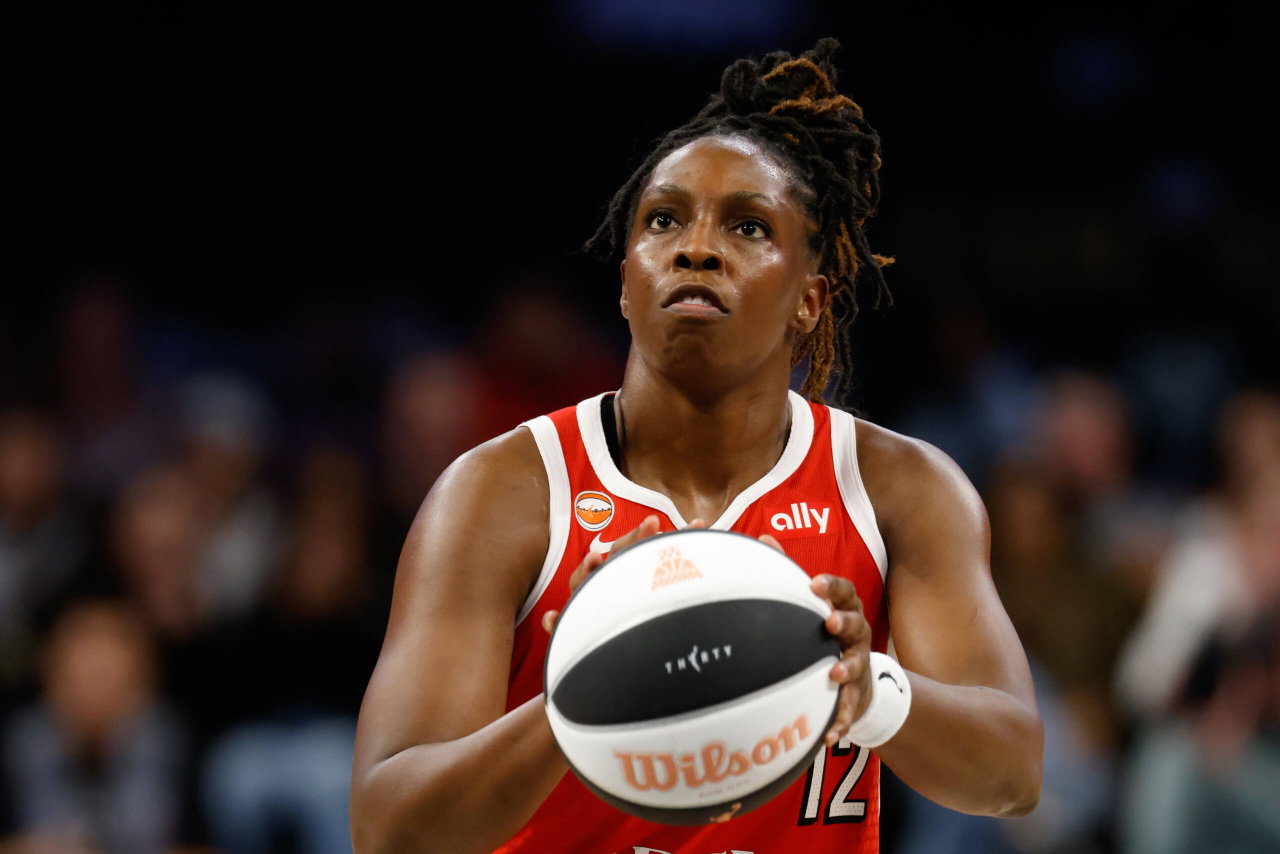
Scoring just 60 points in a playoff game is hardly the standard for a championship contender. And so after that disappointing 71-60 loss to the Golden State Valkyries in Game 1 of the WNBA semifinals, the Las Vegas Aces clearly have serious adjustments to make. Thankfully, Chelsea Gray appears to have already identified some of them.
Watch What’s Trending Now!
Speaking in a training ground interview ahead of Wednesday’s Game 2, a video of which basketball journalist Nekias Duncan shared on X, Gray discussed how the Valkyries’ aggressive backcourt pressure disrupted the Aces’ usual offensive rhythm and transition actions. She also reflected on the team’s spacing, admitting that their positioning and movement away from the initial action could be significantly better.
“I think that any time somebody picks up our outlets, whether it’s me, usually it’s me, or Jackie, it slows down our breaking and secondary action, which teams have been doing all year,” Gray said. “It’s just that we were taking the ball out of the net, get the ball forward, and get the ball free. So we just got to be better there and ready to do kick-and-hits and everything.
“I think our spacing could be a ton better. And it would make our looks a little bit cleaner. And it’s exactly where our cuts are going to go. Our spacing outside of the initial action, how to move the ball outside — I think would be better when our spacing gets a little better,” she added.
In Game 1, the Valkyries executed a defensive game plan that effectively dragged the league’s top-scoring offence into the mud. Their relentless point-of-attack pressure forced the Aces completely out of their preferred system, choking off the ball movement and timing that makes Las Vegas so difficult to contain at full strength. Chelsea Gray herself, who still managed 16 points, was held to just three assists, a telling sign of how thoroughly the Valkyries, on the back of Kiah Stokes and Aminata Gueye’s big presence, disrupted the Aces’ ability to operate in their usual structure.
Jackie Young faced equally difficult conditions throughout the game. Veronica Burton and the fresh waves of Kaitlyn Chen off the bench consistently denied Young clean touches and comfortable positions. She never found her rhythm, finishing with a deeply inefficient 4-of-15 from the field, and though she logged five assists, each one required considerable physical effort to create against relentless pressure.
Beyond the backcourt pressure, the Valkyries also deployed an ultra-aggressive crash-and-recovery system that completely eliminated Las Vegas’ transition attack. The Aces thrive when they can secure a defensive rebound and push, using Chelsea Gray’s elite vision to create advantages in the open court before defences can set.
Golden State removed that option entirely, pulling down 17 offensive rebounds to the Aces’ two while controlling the glass by a margin that made transition opportunities virtually non-existent. In fact, the Las Vegas Aces were held to just three fast-break points for the entire game, an astonishing suppression of one of their most reliable offensive weapons.
The Valkyries’ rotation management was another deliberate and effective element of their game plan. With the Aces missing rotation depth due to injuries, Golden State purposefully deployed a high-energy wave of guards, led by an incredibly active Kaitlyn Chen off the bench, to keep fresh legs on Jackie Young and Gray throughout the game.
The relentless nature of that pressure meant both players had to expend more energy to advance the ball, and as fatigue accumulated, the Aces’ shooting fell off sharply. The team shot a season-low 33.9 percent from the field and generated eight combined assists from the starting backcourt. A’ja Wilson specifically was routinely met by double teams, contributing to her uncharacteristic 8-of-21 shooting night despite finishing with 24 points.
As it appears, all the issues are now clearly identified. The spacing needs to be cleaner, the transition offence needs to be liberated, and the backcourt needs to handle Golden State’s pressure more efficiently.
Whether the fixes the Aces have worked on ahead of Game 2 translate into results on Wednesday night, and whether they can do it without the depth that injuries have stripped from their roster, remains to be seen.