
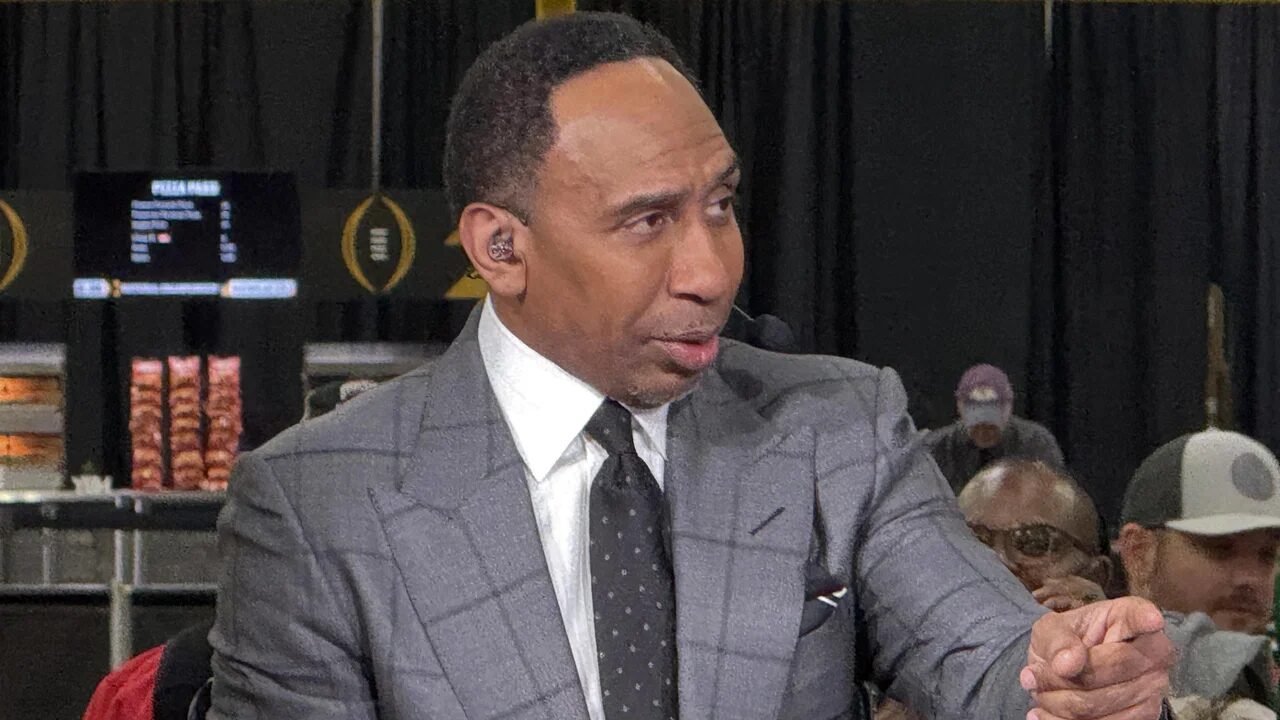
A team reaching the WNBA Finals should be celebrating the chance to bring Finals basketball to its home crowd. Instead, the Atlanta Dream found themselves caught in a venue dispute, with questions emerging about whether the biggest games of their season could accommodate the fans eagerly awaiting to watch them. For Stephen A. Smith, the situation was difficult to accept.
“Congratulations, you got an arena,” he said during an episode of The Stephen A. Smith Show. “Let’s think about that sentence that I just dropped down on you. It’s the WNBA finals, and we’re congratulating you because you got an arena for the Atlanta Dream to play. You got to be kidding me. That’s a dereliction of duty. I don’t know on whose part. Somebody wasn’t prepared.
“And I ain’t blaming the Atlanta Dream either… This ain’t a Little League contest. This is a professional sports league, charging paying customers, just reaching a deal, collectively bargained for hundreds of millions of dollars. The h— is going on?”
The controversy Smith is referring to unfolded over the last few days. The Dream, which reached the WNBA Finals to face off against the Golden State Valkyries, wanted to play at State Farm Arena, which can hold about 17,000 fans, for their home games: 3, 4, and 6. But the dates conflicted with other events at the venue.
On Oct. 22, the day of Game 3, music artist Sombr is putting on a concert, while on Oct. 24 and 29, the NBA’s Atlanta Hawks, which call State Farm Arena home, are scheduled to open their season against the Houston Rockets and face off against the Cleveland Cavaliers, respectively.
However, the Dream tried to relocate the game to alternate arenas, with Dream president Morgan Shaw Parker explaining that the team was “finalizing details” on where they would play. Two venues under consideration were Gas South Arena (approximately 13,000 seats) and Georgia Tech’s McCamish Pavilion (8,600 seats), but both fell through.
This left Gateway Center Arena, where the Dream played most of their regular-season games, which can only seat 3,500 fans, and wouldn’t be enough to meet demand. In their first three playoff home games, the team went to State Farm Arena and saw major attendance numbers despite not opening sales for seating in the entire arena. They drew 9,766 against the Washington Mystics in Round 1, then 9,745 and 9,574 in the two games against the New York Liberty in the Semifinals.
Ultimately, the parties involved came to an agreement. The Hawks and the Dream, owned by different ownership groups, released a joint statement on the matter.
“Relocating Games 3 and 4 of the WNBA Finals from Gateway Center Arena to State Farm Arena was a complex undertaking that required extraordinary collaboration to navigate numerous challenges in a short time period,” the statement read (via CBS). “The Dream is grateful to the Golden State Valkyries, the Hawks, the NBA, the WNBA, and both league’s broadcast partners. Without their focus and flexibility, this would not have happened.”
Game 3 was moved a day earlier, to Oct. 21, removing the conflict with the Sombr concert. Then, the Game 4 matchup was moved earlier in the day, from 3:30 p.m. ET to 1:00 p.m. ET, while the Hawks moved their home opener by half an hour to 8:30 pm ET.
There is still the question of where a potential Game 6 would be played, which the Dream are set to play at home, since it conflicts with another Hawks game. However, the newest resolution is a start, and the hope is that they can either clinch the title in five games or resolve the conflict in the two weeks before Game 6.
These scheduling conflicts should be scarce next season, especially with the Dream moving into State Farm Arena full-time for all 25 home games. But the fact that such an issue for the all-important WNBA Finals popped up in the first place is what frustrated Stephen A. Smith.