
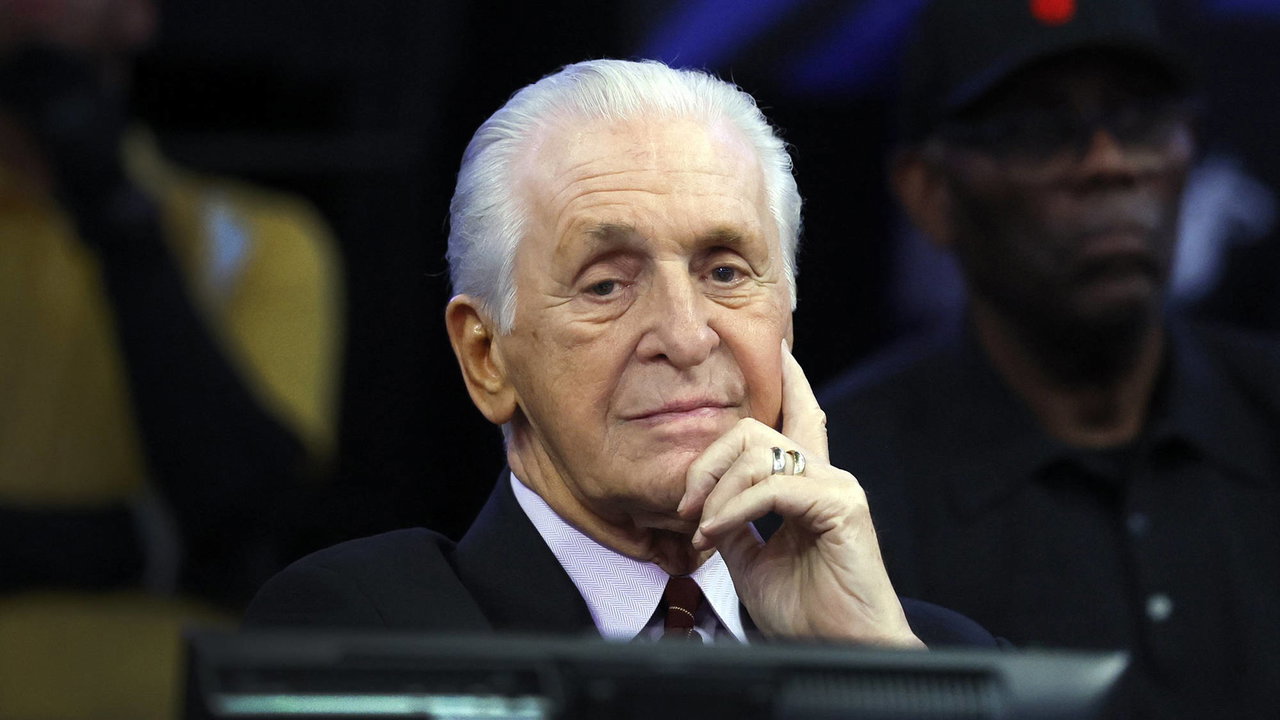
The story of Nancy Lieberman playing for the Los Angeles Lakers’ men’s team with Pat Riley as coach is one of the most well-known tales in basketball history. It has resurfaced prominently in basketball media again, and in a clip shared by All the Smoke, Lieberman herself offered some fascinating first-hand details about the experience.
Watch What’s Trending Now!
“The next day, Jerry West called my mom’s house,” Lieberman said. “I was in New York. He says, ‘Nancy, I’m with Dr. Buss, the owner of the Lakers, and we’d like for you to come play for the Lakers.’ …And the coach was Pat Riley, his first coaching gig. I’m super excited. I’d play against anybody. So I go out there, and I didn’t know until later on in life, like 30 years later, that Pat Riley did not want me.”
Although Lieberman ended up spending several weeks playing for the Lakers’ men’s team during the Summer Pro League in July 1981, Pat Riley, who was just beginning his professional coaching journey at the time, had not wanted her on the team even though he did not say it directly at the time. That, however, was something she would not discover for decades.
Riley would eventually reveal his true initial position at a coaching symposium years later, and in doing so, he also revealed what Nancy Lieberman’s presence had ultimately taught him about mental fortitude, relaying the lessons her unmatched heart and confidence had provided him.
“This is what I didn’t know until Pat is speaking at the symposium,” Lieberman said. “He goes, ‘There were times that I was coaching and I felt overwhelmed or outmatched. Every day, they were bigger, stronger, faster, more athletic. And every day, she walked in the building like she was the best player on the floor.’ And it helped him when he felt overwhelmed in certain situations during his young career.”
As Lieberman also revealed, Riley not wanting her was only the beginning of what she had to endure. She faced heavy physical punishment from her male teammates during drills, to the point where she tried to start fist fights with them on a couple of occasions in response.
There was also a deliberately uncomfortable hazing incident right from the moment she first arrived at training camp. When she opened her gear bag, she found a jockstrap placed inside, a calculated attempt to get inside her head. But she did not flinch.
Instead, she walked directly to the team trainer and, with complete composure, joked that it was too small and that she needed something bigger. The tension she had walked into was diffused entirely by the confidence with which she handled it.
However, none of it; the initial unwillingness to have her there, the locker-room tricks, or the extreme physical play, discouraged her for a single day. As Riley himself would later say, even though “they beat the crap out of her,” she got up every time. She did not cry. She did not sit out. And she ultimately featured in the summer league circuit as a legitimate point guard.
What is perhaps most remarkable is that Lieberman did not perceive any of those experiences as deliberate acts against her personally. She looked at all of it purely through the lens of sport—standard basketball competition, nothing more and nothing less.
“And even now, we talk (she and Pat Riley), and I’m like, I had no clue,” she said.
The folding of early women’s leagues and the chronic financial instability of professional women’s basketball had played a significant role in bringing Lieberman to that Lakers tryout in the first place. She had led Old Dominion University to consecutive AIAW National Championships in 1979 and 1980, earning the nickname “Lady Magic” for her brilliant floor vision and passing.
She was even drafted first overall in the newly formed Women’s Pro Basketball League by the Dallas Diamonds in 1980. But those early women’s professional leagues were financially fragile and constantly on the verge of collapse, limiting the professional opportunities available to even the most elite players of her generation.
After her summer with Riley and the Lakers, Lieberman continued seeking out competition wherever she could find it. In 1986, she made history by joining the Springfield Fame of the United States Basketball League, becoming the first woman to play in a men’s regular-season professional league.
And when the WNBA officially launched in 1997, Lieberman played in the inaugural season for the Phoenix Mercury at 39 years old, completing one of the most remarkable and trailblazing careers women’s basketball has ever produced.
Nancy Lieberman’s Brief but Historic WNBA Career
When the WNBA finally launched in 1997, Nancy Lieberman was selected 15th overall in the WNBA Elite Draft by the Phoenix Mercury. Years earlier, NBA Commissioner David Stern had told her that his only fear was that she would not be around to see a women’s professional basketball league come to fruition. Fortunately, Lieberman lived to witness that dream become a reality, and on opening night, Stern personally called her to tell her how proud he was that she had made it.
Playing as a 39-year-old rookie, Lieberman appeared in 25 games for the Mercury. She played a complementary role off the bench, averaging 2.6 points, 1.6 assists, and 1.3 rebounds per game in approximately 11 minutes of action.
While her box-score numbers were modest, her leadership and veteran savvy helped the Mercury secure a playoff spot in the league’s inaugural season. She was also quickly embraced as a fan favorite in Phoenix.
Immediately following that season, Lieberman transitioned into coaching, becoming the head coach and general manager of the WNBA’s Detroit Shock, positions she held from 1998 to 2000.
However, in a shocking return to the court, Lieberman made another piece of WNBA history in 2008. At the age of 50, she signed a seven-day contract with the Detroit Shock, breaking her own record as the oldest player in WNBA history.