
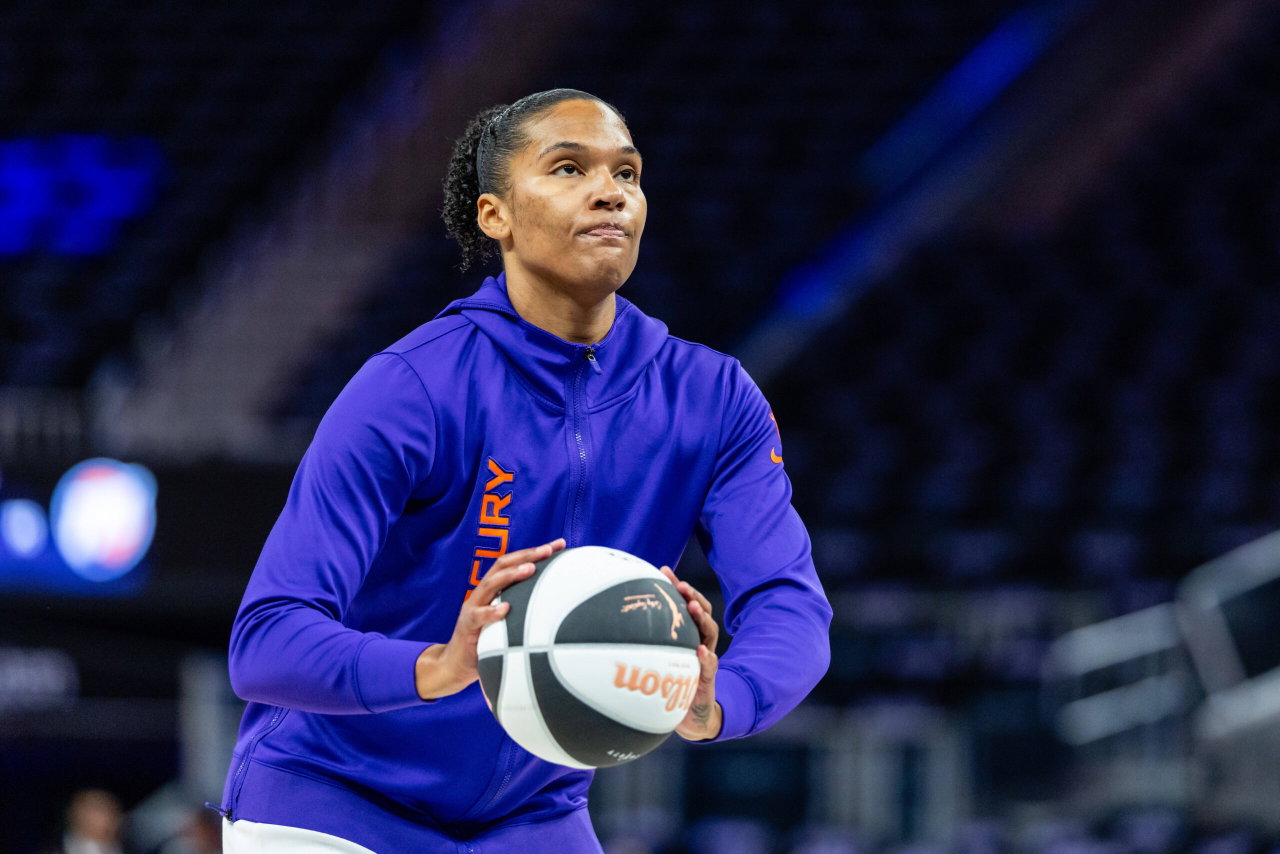
Alyssa Thomas has seen firsthand how quickly criticism online can cross the line. Now, with sports betting continuing to become a bigger part of professional sports and major sports leagues across North America taking steps to protect their players, the WNBA veteran is making sure that the danger isn’t being overlooked.
Watch What’s Trending Now!
Thomas, who spoke with reporters following the Phoenix Mercury’s final regular-season game against the Las Vegas Aces, was asked about the growing problem of betting-related harassment that players face, especially online. Her verdict on the matter was clear, and her response was caught on camera by local reporter Dana Scott.
“At the end of the day, I just don’t feel that people should send death threats or things of that nature over betting,” she said.
“I think we all understand it’s a hard thing to control. Sports are one of the most popular things… At the end of the day, we’re doing our jobs, that has nothing to do with us. And yeah, I think we just gotta continue to grow and find better ways to limit those things.”
Thomas’s call echoes a broader crisis: Recently, the five major American sports leagues – the NFL, NBA, NHL, MLB, MLS – came together to push for stronger protections for athletes, coaches, and officials against bettors. On September 15, the leagues and their players’ associations sent a joint letter to gaming regulators in 35 states, as well as Washington, D.C., requesting that people verified to have sent threats or harassed personnel be permanently banned from betting.
This comes at a time when sports betting is on the rise. According to Fortune, Americans legally wagered $166 billion on sports in 2025, which marked an 11% increase from the previous year.
However, the initial letter did not mention the WNBA or the WNBPA. That omission quickly became part of the story, given that several players across the league have already faced harassment stemming from sports betting. This led to a statement from the players’ union’s executive director, Terri Carmichael Jackson, who was not pleased.
“It is deeply disappointing that, given the very public and troubling incidents of betting-related harassment experienced by our members over the past several seasons, the NBA determined that WNBA players did not warrant inclusion in a joint position statement intended to address this very issue,” she said, per Front Office Sports.
The omission stung because WNBA players had already endured a season filled with betting-related abuse.
Alyssa Thomas and Her Peers Have Already Seen How Bad Online Harassment Can Get
Alyssa Thomas is no stranger to online hate. Just earlier this season, she was part of a highly publicized altercation with Caitlin Clark that saw Thomas strike her in the throat area and subsequently earn a Flagrant 2 foul after the game. In the aftermath, Thomas revealed she had faced d**th threats and racial slurs, calling on the league to protect their players.
“It’s unfortunate that it’s come to this over basketball,” she said back on June 30.
“A lot of us, myself included, didn’t even know the play took place until after the game. Now we’re being painted as thugs. There’s d**th threats out on us. It’s really unacceptable. It’s something that needs to change in this league, and I’m just really sick and tired of it.”
Thomas’s June incident gave her credibility on the issue, and now she’s speaking for players facing the same harassment. One of these players was Minnesota Lynx guard Courtney Williams, who responded to a voice note on Instagram in a viral exchange.
Later, Chicago Sky guard Natasha Cloud revealed how she had been targeted online by hateful messages from sports bettors.
“I’m called a b****, I’m called a n*****, I’m called everything under the sun. I’ve been told that they hope that our plane crashes on the way home,” she told FOS.
“We got NBA players being followed out in public because of not hitting parlays… At the end of the day, your job, your first priority, is on the protection of the players, the protection of your investment into your players, and the safety surrounding the players.”
Thomas’ call for a better system highlights a problem that the WNBA already faces, and one that is becoming harder for sports leagues to address and deal with as time goes on.