
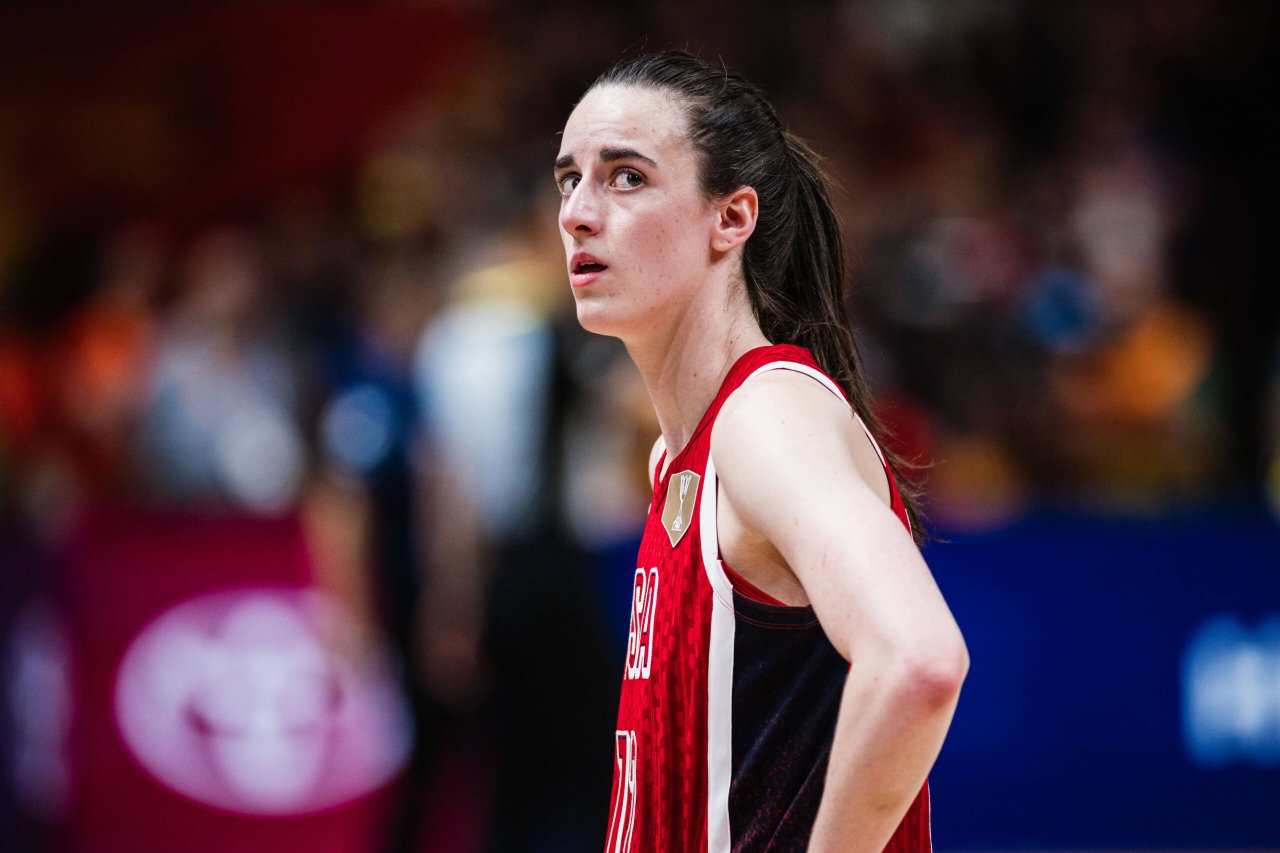
Caitlin Clark has had her moments in Berlin. She made an immediate statement in her very first senior World Cup game against China, delivering 14 points, three rebounds, and 11 assists to set a Team USA record for the most assists in a Women’s World Cup debut. The quarterfinal against Hungary was another night where she imposed herself, finishing with 10 points, nine assists, and three rebounds in just over 20 minutes of action. For WNBA journalist Aya Abdeen, however, Sunday’s gold-medal game is a different kind of challenge entirely.
Watch What’s Trending Now!
In a post shared on her X page on Saturday, Abdeen made an unflinching assessment that the final against France could bring a level of physicality that is different from what Caitlin Clark has faced so far. Abdeen hinted that it’s the kind of intensity the Indiana Fever star may not yet be equipped for.
“I’m going to put out my brutally honest take for tomorrow’s gold medal game between the United States and France,” Abdeen wrote.
“Some of y’all are not going to like this one: I don’t think Caitlin Clark is ready for the type of physicality France is going to bring. Yes, she has contributed for the US, but France is going to provide a new challenge.”
It is difficult to dismiss Abdeen’s observation entirely, because as strong as Clark’s best moments in Berlin have been, she’s also had some difficult nights. And coincidentally, some of those performances have come against some of the strongest teams Team USA has had to face so far in this tournament, sides that have brought quite a significant physical challenge to the game.
Most notably, in the Italy game that Team USA only managed to grind out 55-52, Clark finished with just one point, one assist, four rebounds, and two turnovers across 18 minutes. She also went 0-of-6 from the field and 0-of-3 from deep, as Italy’s physical guards harassed her relentlessly across half-court and completely disrupted any rhythm she attempted to find.
There is, of course, a strong case to be made that the Italy performance was a collective failure rather than a Clark-specific one. The entire team shot 29 percent from the field and an abysmal 8 percent from three-point range, producing the lowest-scoring World Cup game Team USA had played in 42 years. When the whole group struggles that badly, it is difficult to isolate any single player’s struggles as uniquely telling.
That same excuse, however, does not apply as cleanly to the Spain semifinal. Team USA’s broader offensive performance was significantly better in the 76-66 win. However, Caitlin Clark again finished with just one point, one assist, one rebound, and two turnovers across 16 minutes, matching her tournament low in points and scoring zero field goals.
Of course, there are arguments that there were legitimate tactical reasons for her limited involvement. Some believe Coach Kara Lawson’s rotation decisions restricted her minutes, and there were plays in which her own teammates appeared to deliberately bypass her. Yet, regardless of the surrounding context, the pattern of single-point outputs in the tournament’s most demanding games has been real.
That said, it would still be both premature and short-sighted to conclude that this pattern will necessarily define her performance in the final. Throughout her career, Clark has been most dangerous when the stakes are highest, and the scrutiny is most intense. And time and time again, she has responded to adversity with her best basketball.
Of course, she has not yet shown that in the toughest assignments of this particular tournament, but a player of her caliber cannot be written off before the biggest game has even been played. Whether or not Abdeen is right with her take, this Sunday’s final will definitely tell us something about Clark.