
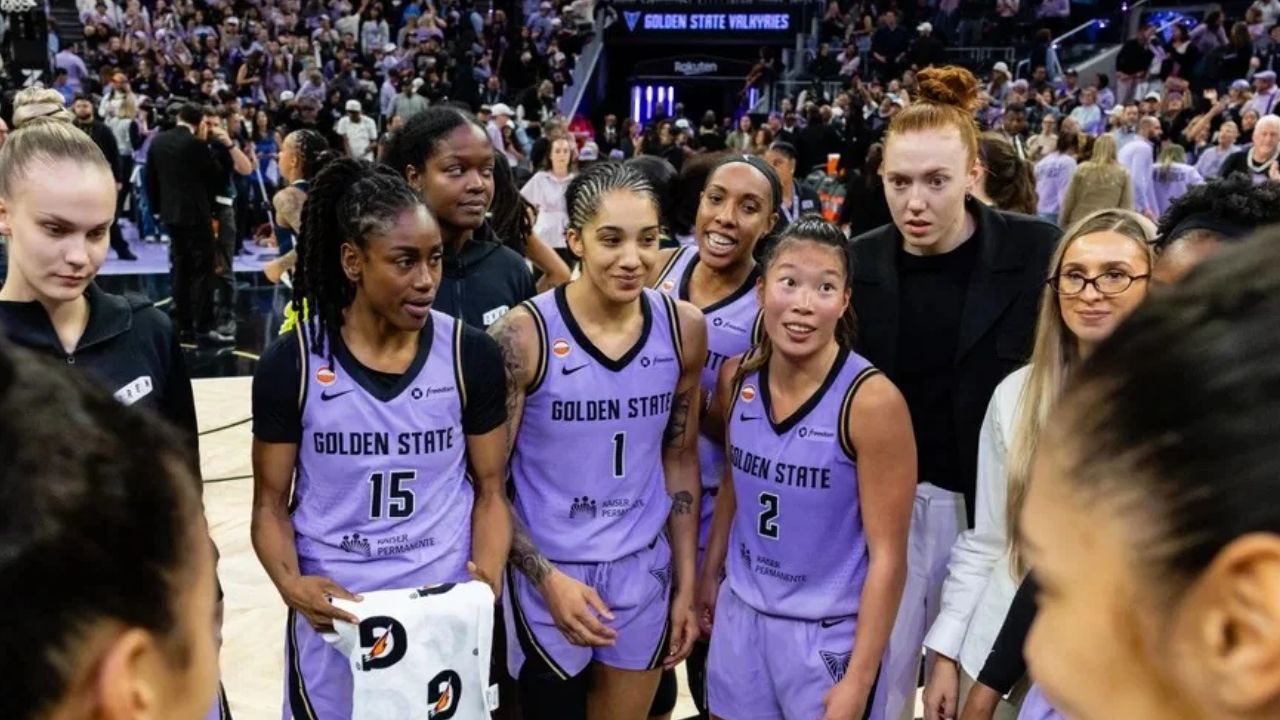
Three years after the WNBA closed locker rooms to reporters and cameras, championship celebrations may have opened a small exception to the rule. The league’s locker-room policy has remained one of the most debated media-access issues in women’s sports, with reporters arguing that restricted access limits storytelling opportunities while players and agents continue to cite privacy concerns.
Watch What’s Trending Now!
That debate resurfaced following the Golden State Valkyries’ championship-clinching victory, when select media members were granted limited, authorized access to document the team’s postgame celebrations.
“Valkyries’ championship locker room,” Kendra Andrews wrote on X, sharing four videos from inside the celebration after Golden State captured its first WNBA championship in just its second season.
The Golden State Valkyries granted ESPN and USA Network permission to film portions of the celebration, marking the first championship locker-room media access since 2022.
Andrews was not alone in documenting the moment. USA Network also aired footage from inside the celebration as part of its postgame coverage.
NBC Sports and The IX reporter Jackie Powell highlighted the significance of the moment.
“The first time #WNBA media was allowed in the championship locker room since 2022. Huge hat tip to the Valkyries for understanding why this matters.”
Powell later clarified that the access remained limited. Despite the exception, not all credentialed media members were allowed inside the locker room.
According to information reported by Awful Announcing, other reporters were directed to a separate room inside Chase Center, where players conducted media scrums while family members and friends gathered nearby.
The WNBA changed its media-access policy in 2023, ending traditional locker-room availability. Players and agents largely supported the move, citing privacy concerns and a desire for more personal space. Many reporters, however, argued that the restrictions limited access to some of the most authentic moments in sports.
Ahead of this season, the WNBA introduced a two-tier credential system for media access. Tier 2, with gray as the color code, grants access to practices and general press conferences. Meanwhile, Tier 1, with orange as the color code, grants access to team shootarounds, practices, press conferences, pre/postgame player interviews, and court access.
Locker rooms, however, remain off limits under standard league policy.
That distinction is what made the Valkyries’ celebration notable. While it did not represent a wholesale policy change, it appeared to be a rare exception to a rule that has frustrated many media members since its introduction.
Questions about media access resurfaced throughout the 2026 playoffs.
During the Valkyries’ semifinal series against the Las Vegas Aces, former ESPN reporter Jemele Hill and broadcaster Cari Champion questioned reported stretches without player availability on their Flagrant and Funny podcast.
Earlier in the season, Bengals reporter Ben Baby also criticized the policy on social media.
“It still remains wholly ridiculous that the WNBA doesn’t have an open locker room media policy. The only major sport in the U.S. that doesn’t have it. Bad for the fans and the growth of the game,” Baby wrote on X.
Hill publicly supported that position while others disagreed.
Ballislife writer Sara Jane Gamelli argued that the league’s growth demonstrates that locker-room access is not essential to its success.
“I think the WNBA has grown just fine without locker room media in all due respect. We have a team valued at $1 billion and players salaries are up to 7 figures. I think it will be okay.”
The Valkyries’ celebration has therefore reignited a debate that never truly disappeared. Whether the moment represents the beginning of a broader shift in media access or simply a one-time exception remains unclear.
For now, reporters who cover the league on a daily basis are still working under the same restrictions, even as one championship celebration briefly opened a door that has largely remained closed since 2022.