
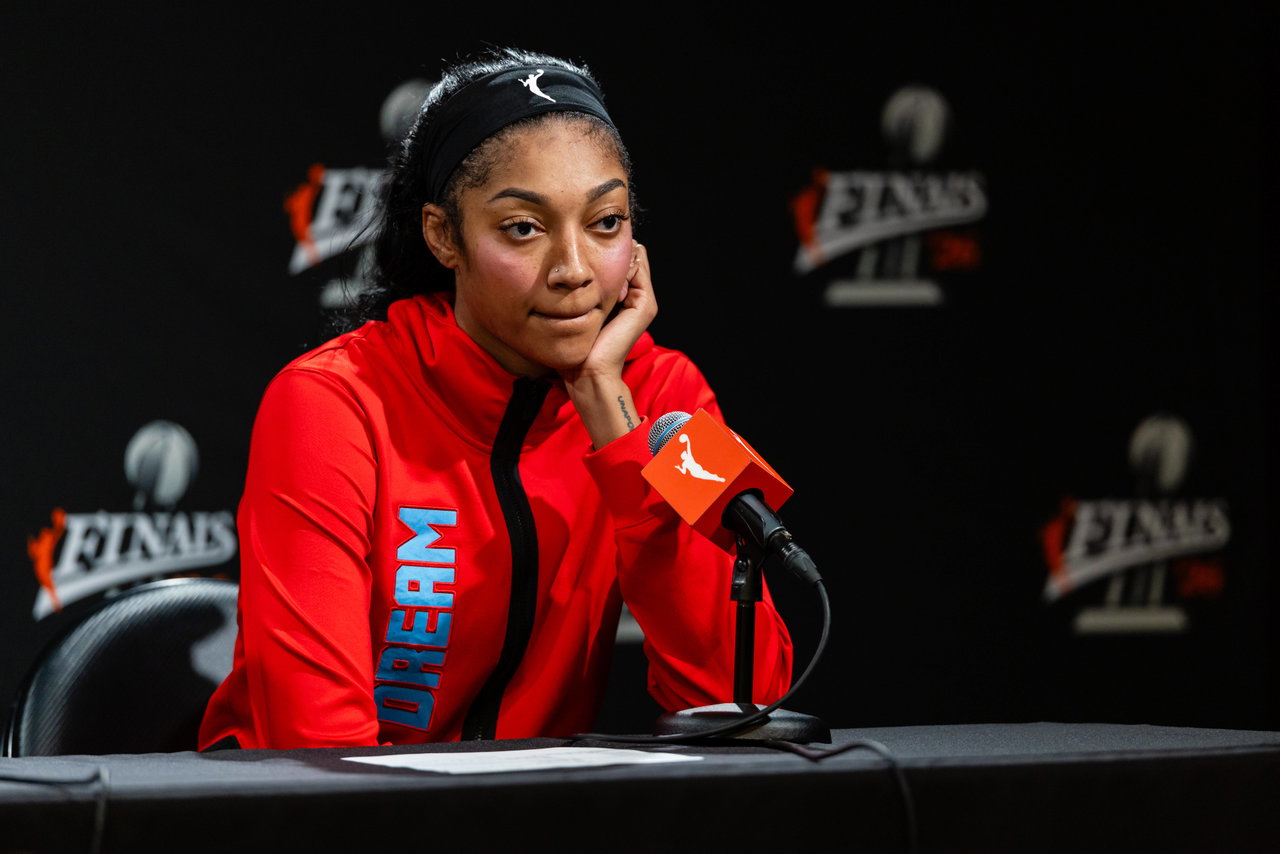
For three games, Angel Reese looked every bit like the superstar Atlanta believed she could become. After responding to a Game 1 loss with a dominant 30-point, 16-rebound performance in Game 2 and following it up with another standout effort in Game 3, the Dream forward appeared to be taking control of the WNBA Finals. Four games later, the conversation looked very different.
Watch What’s Trending Now!
Reese’s offensive downturn over the remainder of the series became one of the defining storylines of Atlanta’s Finals defeat, and it prompted one of her most vocal critics, Dave Portnoy, to deliver a blunt assessment of her performance.
Sharing a clip of his comments on social media, Portnoy wrote: “You don’t have to be an Angel Reese hater to acknowledge it: she was an absolute disaster in the Dream’s Finals losses.”
Portnoy doubled down during his show.
“A total disaster class from Angel Reese. On the other side, Gabby Williams, spectacular. If you watch the game, Gabby Williams from the Valkyries made every play, demanded the ball, but this was a disaster class for Angel Reese. And you don’t have to be an Angel Reese hater to acknowledge it. She was a disaster in their losses, a total no-show.”
Portnoy’s criticism was aimed primarily at Reese’s performance in the losses and the final four games of the series. After excelling in Games 2 and 3, her production dropped sharply from Game 4 onward.
The criticism also carried extra weight because of Portnoy’s well-documented history with Reese.
Following LSU’s victory over Caitlin Clark’s Iowa team in the 2023 NCAA championship game, Portnoy labeled Reese a “classless piece of sh*t.” He has remained critical of the Dream star ever since.
Still, even Reese’s supporters would have difficulty arguing with the numbers from the back half of the Finals.
After taking accountability for Atlanta’s Game 1 defeat, Reese responded with one of the best performances of the series. She scored 30 points, grabbed 16 rebounds, blocked two shots, and shot 62.5% from the field in Game 2.
She followed that effort with 21 points, 12 rebounds, and three steals in Game 3 while converting 58.3% of her field-goal attempts.
After that, however, her offense disappeared.
In the final four games of the series, Reese scored in single digits three times. From Game 4 through Game 7, she averaged 9.5 points while shooting just 26.6% from the floor and committed 19 turnovers.
That stretch fueled Portnoy’s strongest criticism.
“So you can go around, and she made the Finals. Congrats. But she lost them the Finals. There’s absolutely no other way to extrapolate this. And good season, but before we start putting her in Caitlin Clark’s category, to have three games held under 10 and just be a turnover machine, terrible at the line, there’s no other way to look at it.”
Portnoy also criticized Reese for taunting Valkyries players with “too small” and “can’t f**k with me” gestures before struggling through the remainder of the series.
He is hardly the only one who questioned Reese’s play.
Former NFL player Emmanuel Acho also criticized her offensive performance and suggested she failed to deliver in some of the series’ biggest moments.
That said, whether Reese belongs in the same conversation as Caitlin Clark is a separate question altogether.
The Dream star has already enjoyed deeper playoff success, reaching the WNBA Finals while Clark has yet to advance beyond the second round.
The comparison is also imperfect because the two stars play different positions and impact the game in different ways. Reese is the reigning Defensive Player of the Year and an All-WNBA Second Team selection. Clark, meanwhile, is a guard who drives one of the league’s top offenses and earned All-WNBA First Team honors.
Those accomplishments should not be erased because of one difficult stretch.
At the same time, the final four games exposed an offensive weakness Reese will need to address moving forward.
Reese is too competitive to overlook those struggles. If her postseason run proved anything, it is that she can reach a championship stage. The next challenge is finding a way to maintain the same level of production when the stakes are at their highest.
As Reese herself has promised, both she and the Dream expect to be back.