
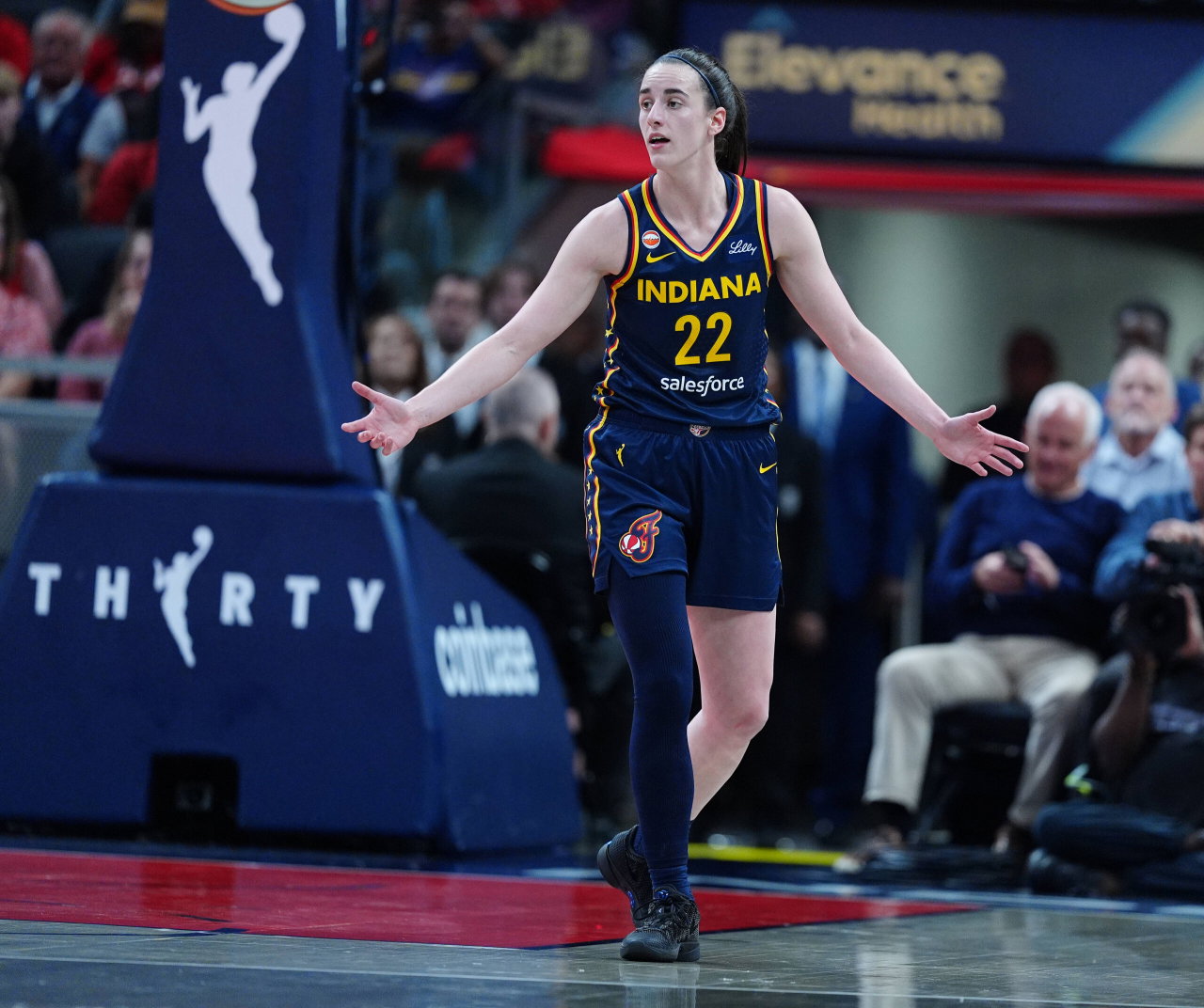
Looking back at Thursday night’s Fever-Aces game, the numbers clearly show that the Indiana Fever fell behind in shooting. Former ESPN host Linda Cohn also believes poor shooting did, to a large extent, impact the Fever’s game. However, beyond the general impact on the Fever’s performance, she also zeroed in on how it specifically affected Caitlin Clark.
Reacting to the game in a video she shared on her YouTube channel, Cohn claimed that while Caitlin Clark started strong, by the time the fourth quarter came, her teammates just couldn’t catch the Aces.
“She didn’t have a single assist after that for the rest of the game. Why? Because most of the time her Fever teammates couldn’t finish. Where was Kelsey Mitchell? Yes, Kelsey Mitchell showed signs of life in that fourth quarter. Eight of those 23 in the fourth quarter.”
In her YouTube video, Cohn argued those numbers were not enough to beat the defending champions. She also pointed out that while Clark got 18 points, not getting a single assist in the second half also hindered the Fever.
“That’s not going to cut it. The best backcourt duo in the WNBA, setting all kinds of records during the regular season, is the reason why Indiana had such an exciting season for the most part. But they were ice cold. Settling for perimeter shots. Not gonna cut it.”
However, while the Fever did not find their sharpest offensive form against the Aces’ defence, they still put themselves in a position where it was an 82-80 game with three minutes left in the contest, but once again the Fever fell behind.
The Aces closed out the final minutes with 12 points, scoring 10 free throws during that stretch to win 94-83, while the Fever could only score 3.
As Cohn said, Clark and Mitchell did create history as a duo in the WNBA. Clark and Mitchell averaged an unprecedented 47 points per game over the course of the season, which was the most in WNBA history. They even had standout individual scoring performances while working as a duo.
Clark and Mitchell became the first duo in WNBA history to have both players score 30 or more points in the same game three separate times in a single season. However, the Aces shut down the prolific scorers in the playoffs.
In Game 3, they shot just 38.5% from the field and a cold 28.1% from three-point range, going 9-of-32 from beyond the arc.
By comparison, the Las Vegas Aces were highly efficient, finishing at 45.3% from the field and 40% from beyond the arc, going 8-of-20, powered by a dominant 36-point night from A’ja Wilson.
Those free throws were another key defining factor in the game. The Aces finished the night shooting 35 free throws compared to the Fever’s 20. In fact, head coach Stephanie White made comments on the disparity in the postgame press conference, expressing her frustration with what she considered an inconsistent approach to the foul calls.
“It’s a game of the margins, and they had 35 free throws. We had 20,” White said.
“I’m not trying to say we don’t foul, because we do. I’m saying that other teams do, too. It’s a hard pill to swallow when you’re not getting the foul calls, when there’s not a lot of consistency.”
While questions about the free-throw disparity and officiating could be made, the fact remained that after momentarily solving the Aces puzzle in Game 2, the Fever struggled against the adjustments the Aces themselves made in Game 3. And although the Fever’s season may be over, they’ll have plenty of time to reflect and find everything they need to improve.