Imago
Benjamin Hager/Las Vegas Review-Journal) @benjaminhphoto
Imago
Benjamin Hager/Las Vegas Review-Journal) @benjaminhphoto
As the WNBA enters a tense stretch of CBA uncertainty, even its strongest teams can feel the pressure. With negotiations looming, Las Vegas Aces’ Chelsea Gray, despite their title win, clarifies where players truly stand on the league’s proposed salary structure because championships don’t silence the bigger fight.
In an exclusive interview with EssentiallySports, Las Vegas Aces player representative Chelsea Gray explained the priorities of the players. When asked what a “good starting point” would be for veteran minimum salaries in the next CBA, Gray, however, resisted naming a number.
Watch What’s Trending Now!
“It’s hard for me to give exact numbers. We just want a salary system based on the revenue that we generate. Like, it’s based on that, the working conditions for everyone,” Gray said.
“Obviously, we have a great facility here in Las Vegas, but I feel like everybody should have access to that. And then protecting our legacy, like the retirement benefits, should be at an elite level. As far as your question, a salary that reflects the revenue share, that’s the most important,” the 33-year-old star said.
According to multiple reports, the WNBA’s latest proposal increases the salary cap from around $1.5 million to $5 million a season per team. Additionally, the increase in the cap over the length of the CBA is tied to revenue growth.
Then, the minimum player salary would rise to $225,000, the average salary to $500,000, and the maximum would be $1 million. That is more than a three-times increase in the current minimum salary and a fourfold rise in the maximum. However, it still doesn’t signal any interest from the league regarding the facility requirements that Gray mentions.
The players want private practice facility access and various locker room and training spaces. When pressed on whether a $220,000 minimum sounds “good” to her and other veterans, Chelsea Gray didn’t hesitate.
“Probably not. I don’t know. I think it’s depending upon the revenue share and the percentages that we’re able to do. I don’t think just throwing a number out there is interesting when I haven’t seen that. It’ll be interesting to like see if that actually stays, and that’s actually the number. I don’t believe anything until it’s signed.” Gray said.
Imago
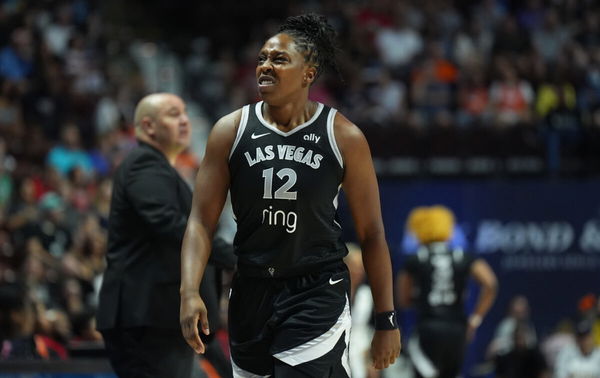
Jul 6, 2025; Uncasville, Connecticut, USA; Las Vegas Aces guard Chelsea Gray (12) returns up court against the Connecticut Sun in the first half at Mohegan Sun Arena. Mandatory Credit: David Butler II-Imagn Images
It’s all about the ‘revenue share’ and the ‘working conditions’, something that is severely lacking in the current proposal. The Athletic reported that the WNBA’s latest offer includes players getting 15% of league and team revenue. According to the Sports Business Journal, the players’ association countered that with a 30%.
Realistically, no side is expecting a 50-50 split like the NBA, as the business realities are just different. WNBA is a much younger league with significantly higher operating costs and a complicated ownership structure. Beyond just the share, the league is looking to cut costs in other areas.
According to Front Office Sports, the league has removed team housing and advanced the start date for training camp to as early as mid-March, coinciding with the March Madness and the NCAA tournament.
“This makes no sense for the younger players, for the players that get cut and are stuck in leases instead of the teams that bring in replacement players, nor for players in bigger markets. Let alone talking about player safety in safe areas.” Natasha Cloud wrote.
The rookies would have to join later in the season, which hampers their growth and, by extension, damages the WNBA. Beyond just these problems that jump out of the page, there are multiple smaller problems that have the potential to further extend the wait for a new CBA.
Too much rift in the CBA negotiations threatens the 2026 season
The players held out for better pay, and the league has conceded. Revenue sharing is now included in the proposed agreement, which was the No.1 priority. However, there is still some distance (30% vs 15%) in the percentages both sides want it to be. Nonetheless, a number that can be agreed upon could be achieved in another month of work. Now that this is partly solved, there are still multiple proposals from the WNBPA that the league has refused to address so far.
The WNBPA wants the core designation completely off the table for the future CBA. The core designation is a method that a franchise can retain a player’s rights while automatically offering a one-year supermax qualifying offer. They can still negotiate a longer deal and even facilitate as a sign-and-trade. Currently, the league has rejected that concept completely and wants to continue with the same system of team building.
The players, on a broader level, want more control over them instead of the franchise or the league. For example, they want the rookie contract shortened from 4 years to 3 years. According to the union, assuming a player enters the league at 22, she will theoretically not be in free agency until she is 29. That includes 4 years of the rookie contract, 1 year of restricted free agency, and a year of being cored.
The two sides are also stranded on various other issues like leave for non-birthing parents, retirement benefits, and mental health services. Neither side can get the result they want. Reflecting on Chelsea Gray’s priorities, those are still very important. Giving players the salaries and revenue they want means cutting down on other things, and the league needs to find the right things to compromise on.
Considering the current situation, the players aren’t in the mood to concede much. The precedent has been set that the league can bend to its will. The question is, how much further will they go? If players insist on getting everything exactly the way they want, then the 2026 season will be at real risk, especially with competitor leagues looming.
Related Newsletters