
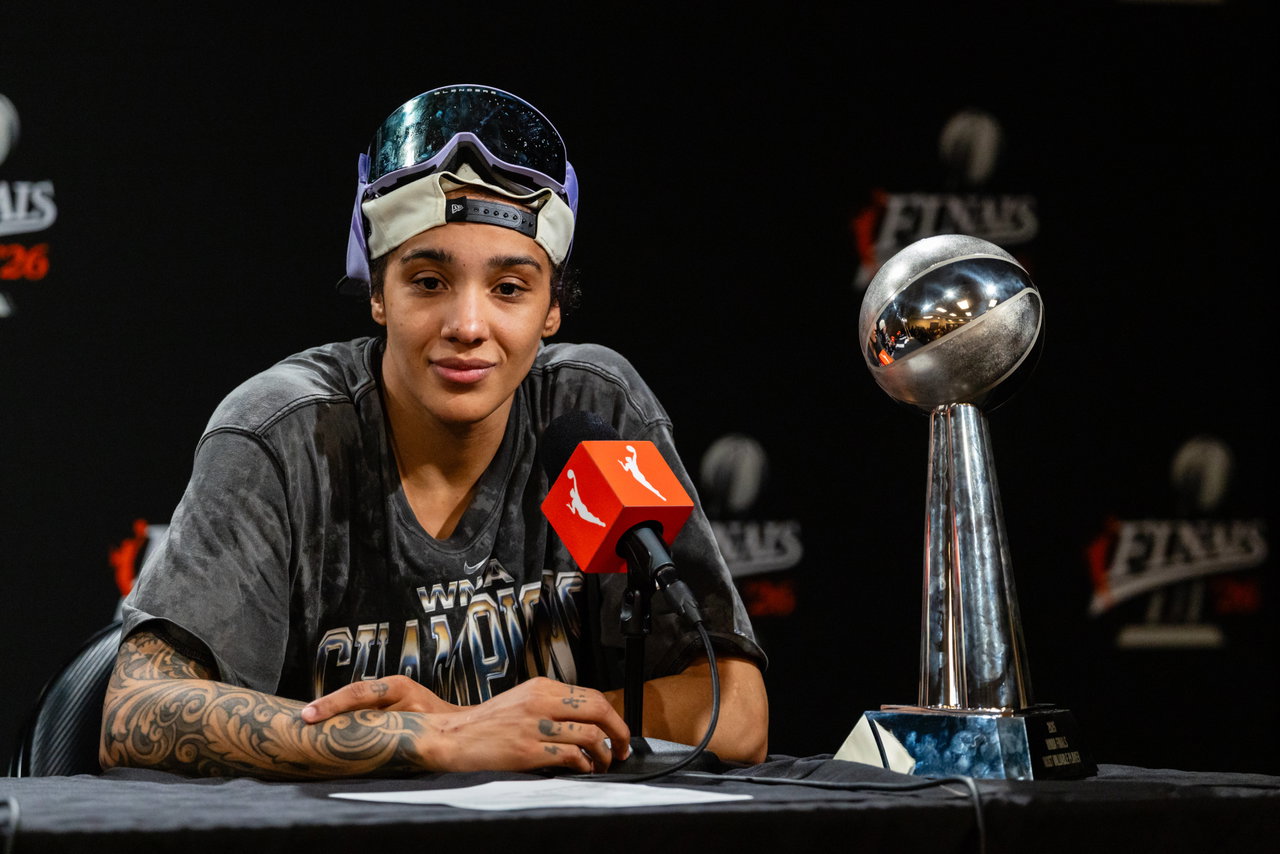
Before 2026, few saw Gabby Williams as a star. A team player and, as Sophie Cunningham put it, a humble leader who doesn’t hesitate to feed whoever is having an outstanding night, but not a traditional star. Yet, when the final whistle of the WNBA Finals’ first Game 7 sounded, Williams had made the difference, scoring 28 points in the second half, more than any WNBA player ever had.
With the Atlanta Dream forcing the series in Game 7, the Valkyries returned to their beloved Ballhalla in a do-or-die game for the championship. When the first half ended, the Dream actually led the Valkyries 30-24. After the second half started, Williams took over.
However, her career trajectory looked quite different before joining Golden State. She had spent three seasons with the Chicago Sky since 2018 and had barely seen the postseason. Then, in 2021, the Sky suspended her for the full season because of her obligations with the French national team.
She was technically shown the door as her unprotected $70,040 salary didn’t count toward the Sky’s salary cap, giving them more cap space. They then traded her to the Los Angeles Sparks during that period, who used her as another piece to build their roster, trading her to the Seattle Storm in 2022 without using her once.
In her following four seasons with the Storm, Williams played just nine postseason games. So when the Valkyries’ owner, Joe Lacob, confidently announced that they would win a WNBA championship within the first five years, Williams, for the first time in her career, made the conscious choice to join the team she wanted as a free agent.
Going from choosing a team, gearing up for their second season, to becoming a WNBA Finals MVP within two years was something not even Williams could have imagined.
Interestingly, for Williams, it wasn’t even the desire to win a title that convinced her to sign with the Bay Area team. It was head coach Natalie Nakase and how the organization functioned.
How Gabby Williams fit into the Valkyries
Before the Bay Area team won a title in their second season, it was actually Williams’ former team, the Seattle Storm, who were the fastest expansion franchise to win a WNBA championship in their fourth season.
Since owner Joe Lacob wanted to prove the notion that an expansion team needs years before tasting true success wrong, everything the Valkyries did was intentional. From General Manager Ohemaa Nyanin to coach Natalie Nakase, the goal was to create a team that would get results rather than pouring money into chasing big names.
So, in the 2025 expansion draft and the WNBA Draft, Valkyries picked up names that teams weren’t exactly lining up to sign. Iliana Rupert, Veronica Burton, Kayla Thornton, and Cecilia Zandalasini were among their most successful picks as they helped the Valkyries reach the playoffs in their first season.
That’s the culture Williams signed up for, and she wasn’t disappointed. Besides Williams, the Valkyries also signed Kiah Stokes and Jannelle Salaun from free agency, and all three quickly became integral pieces of the squad.
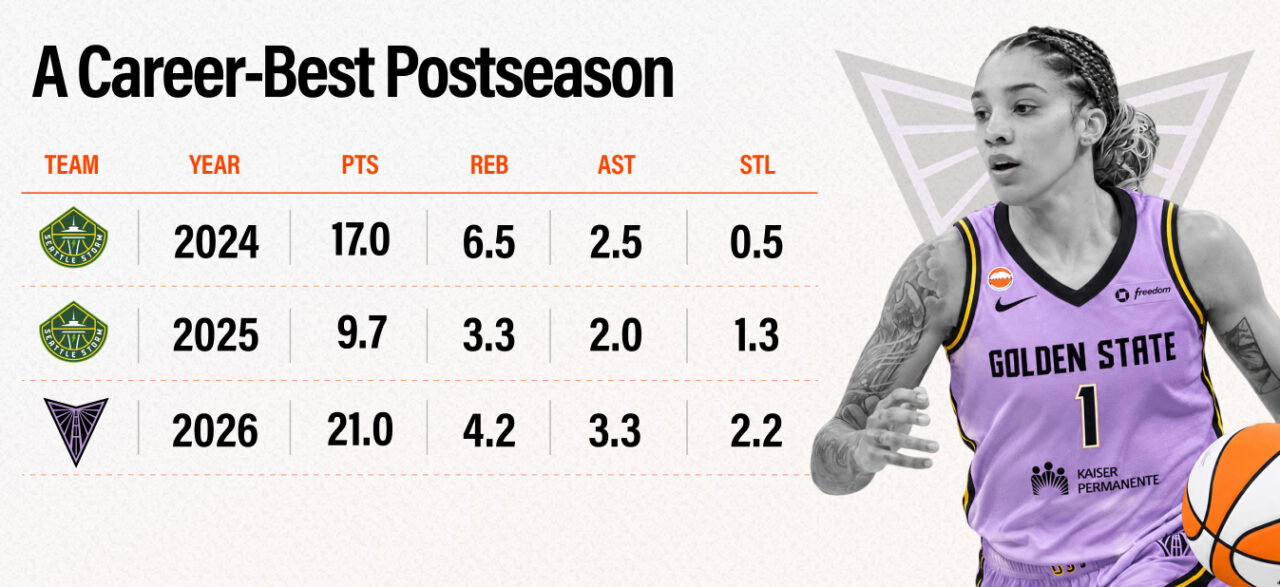
Williams had struggled for minutes in her previous teams. She never became a regular starter for Chicago, and while she did start all those games in her first and final season with the Storm, Williams missed 58 games due to injuries in those four seasons.
Things were different with the Valkyries. The forward started all 39 games she played with the Valkyries, acting as an anchor for the team throughout the season.
Meanwhile, Coach Nakase focused on knowing her players off the court. According to the Athletics’ Chantel Jennings, Nakase arranged dinners and games where she asked questions that had nothing to do with the WNBA or basketball.
It’s how she bonded with her players, including Williams. Instead of asking about her experience with her previous teams, Nakase got to know that Williams grew up playing more than just basketball in the Bay Area.
In fact, Williams was a serious track and field (high jump) athlete alongside playing basketball. Her father, Matt, who was a 6-10 high jumper at the University of Nevada-Reno, inspired her to pursue the sport. At 15, the Valkyries forward cleared the 6 feet, 1.50 inches mark and even competed in the 2012 U.S. Olympic Trials.
At the same time, Williams was playing basketball for Bay Area clubs like Mission Rec and the BullDawgs. In the end, she chose basketball, but through their conversations, the Valkyries’ head coach also learned that the forward loved anime, and even had a tattoo machine.
“She wanted to build trust and rapport through vulnerability. She was a coach who talked about love and connection more than any other WNBA coach,” wrote Jennings.
When the time came, that connection Coach Nakase built became crucial for the Valkyries’ success and in helping Williams win the Finals MVP.
Williams became a star in a team built to function as a unit
Since the Valkyries didn’t have big names like A’ja Wilson, Angel Reese, Paige Bueckers, or Caitlin Clark to build a team around, they focused on developing a culture where every player had the other’s back. The teamwork showed in their first season as Golden State earned a reputation as a solid defensive team with a defensive rating hovering around the 100-point mark.
That defense only improved in 2026. The Valkyries became the highest-rated defense in the WNBA, averaging just 99.3 points allowed per 100 possessions.
This approach also created the perception that the Valkyries didn’t rely too much on individual heroics. It wasn’t just the fans who saw it that way.
A national panel of 56 sportswriters and broadcasters didn’t include a single Valkyries player when they named the 2026 All-WNBA team. Even Williams acknowledged it after winning their WNBA championship.
“Man, all it took was good people. That’s it. All we heard last year, ‘We don’t have no stars. We don’t have no talent.’ We got good people. We got winners,” Williams said in her sideline interview.
“We got people who are ready to put their bodies on the floor to win a game. They don’t care about scoring. They just want to play defense and rebound and just do whatever it takes. And we just built a beautiful culture here.”
Yet, more than once during the playoffs, Williams stepped up during their historic seven-game WNBA Finals against the Dream. In fact, she established the blueprint of her historic Game 7 performance in Game 1.
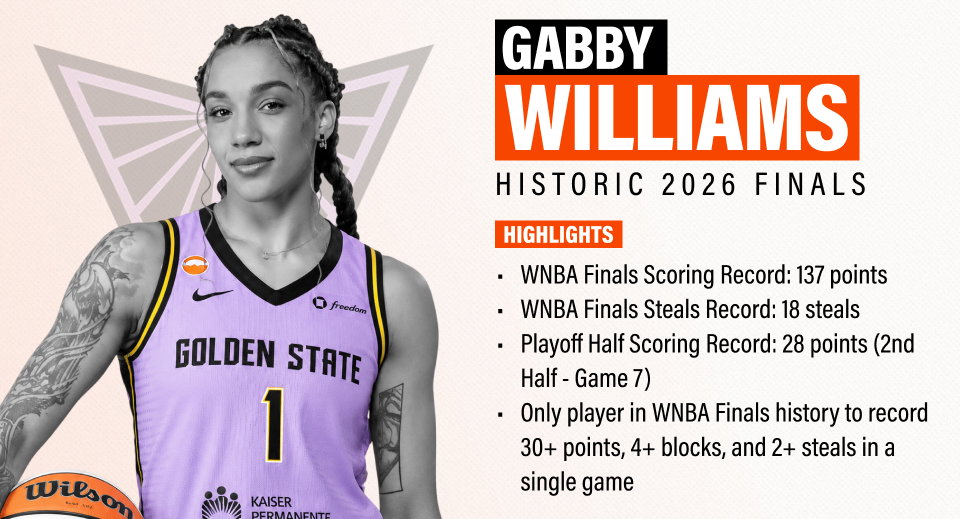
After going scoreless in the first quarter, the Valkyries forward exploded for 16 points in the second quarter and finished the night with a game-high of 26 points. It was her clutch free throws that finally separated the teams that had been neck-and-neck all night.
With 1:18 left, Williams gave the Valkyries a 65-64 lead after 2 successful free throws. Then with another pair of free throws, Williams closed out Game 1 as the Valkyries won 68-64.
Yet when the stakes were even higher in Game 7, and Williams had been mostly for the entire first half, she looked to Nakase for advice. That’s when the head coach told her to be patient, and the game would open up for her.
“It’s easy (to be patient) when you trust the people around you. It’s harder when you don’t. I don’t doubt her because I know she has no ulterior motive. I know she just wants to win,” Williams said after the win.
That trust paid off as she found her groove and dropped the record-breaking second half. Williams had struggled to land 36.4% of her field goals throughout the series, but in Game 7, she scored 43.5% from the field and 50.0% of her three-pointers.
It wasn’t just how many field goals Gabby Williams scored but when she scored and the game-changing impact she had.
“Gabby Williams hit a 31-foot three-pointer to put the Valkyries up 3 with 2:18 left. It increased their title chances from 54% to 75%. It was the 10th biggest shot in WNBA history, as measured by impact to championship probability (+21%),” wrote Inpredict founder Mike Beuoy.
So when the dust settled, the young kid who grew up playing basketball in the Bay Area and just a year ago had an uncertain future as a free agent with journeyman numbers, earned herself the WNBA Finals MVP moniker.