
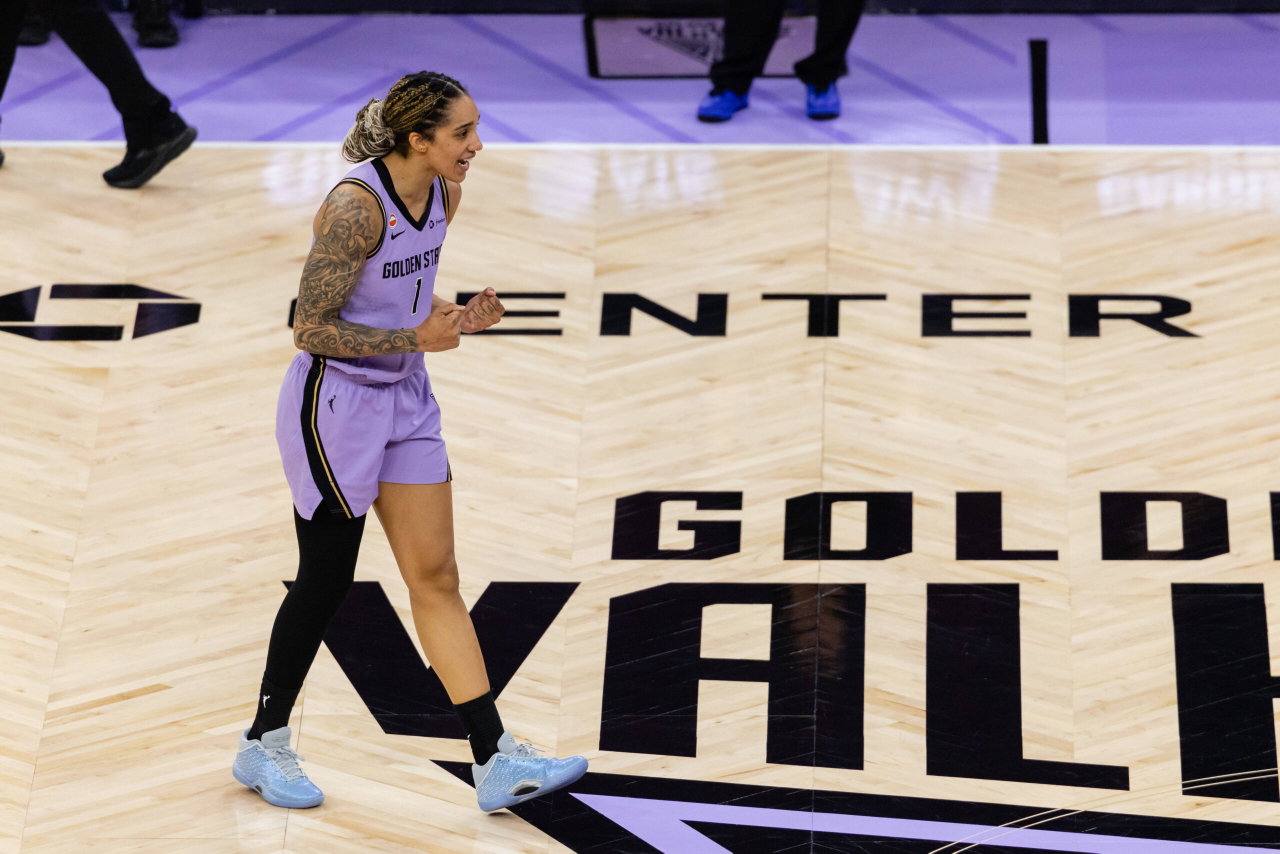
The Golden State Valkyries have built their identity around their suffocating defense all season. That defensive prowess helped them secure a second-place finish in the regular season, sweep the defending champions Las Vegas Aces 3-0 in the semifinals, and even take Game 1 of the WNBA Finals by limiting the Atlanta Dream to just 64 points in a 68-64 victory.
Watch What’s Trending Now!
However, it appears that the Atlanta Dream have now figured out a way around that defense, winning Games 2 and 3 to take a 2-1 lead in the WNBA Finals. Game 3 was particularly concerning for Golden State, as Atlanta dismantled its defensive structure to secure a commanding 97-71 victory; a result so emphatic that Gabby Williams certainly got the message that an improvement is needed.
“We don’t want to make it about offense. They scored 97,” Gabby Williams told the reporters during the post-game press conference. “We have no chance. We have to just go back to our defense, and that will get our offense going.”
The reporter who asked Williams was actually asking her what was not working offensively in that game. And, of course, there was plenty wrong with the Valkyries’ attack. They shot a miserable 34.8% from the field. They were held scoreless for the first five minutes of the game, missing their first eight consecutive field goal attempts before Aminata Gueye finally scored their first basket with 4:39 remaining in the first quarter.
However, this poor offensive display was not entirely new. The Valkyries also struggled to shoot efficiently in Game 1, which they won, and in Game 2. The difference, however, was that they were able to execute their defensive game plan more successfully in those contests, particularly in the series opener, when they limited Atlanta to just 64 points. That defensive effort allowed Golden State to overcome its own offensive shortcomings and take an early lead in the Finals.
Simply put, the Valkyries have shown all season that defense is how they know how to win games. So, when they allowed Atlanta to shoot a blistering 49.3% from the field in Game 3, got outscored 44-20 in the paint, and surrendered a devastating 22-8 run to close out the period after fighting back to tie the game at 49-49 in the third quarter, a victory was always going to be difficult to secure. Their inability to contain Atlanta ultimately proved too costly.
Perhaps the most obvious symptom of the Valkyries’ defensive lapses in Games 2 and 3 has been the production Angel Reese has managed to deliver. In Game 1, the Valkyries limited her to 14 points and 12 rebounds.
But whatever worked in that contest clearly stopped working in the following games. Reese exploded for a Finals-record 30 points and 16 rebounds in Game 2, and she maintained that level of dominance in Wednesday’s victory, delivering 21 points and 12 rebounds to become the youngest player in WNBA Finals history to record at least 20 points and 10 rebounds in back-to-back games.
Apart from these defensive struggles, Golden State also committed 17 turnovers in Game 3, which Atlanta converted into 22 points. This mirrored their turnover issues in Game 2, when they gave up a season-high 19 turnovers that the Dream ruthlessly converted into 24 points.
Game 4 of the WNBA Finals will take place on Saturday, October 24, with the Atlanta Dream hosting the Valkyries again at State Farm Arena. Golden State will undoubtedly be looking to rediscover its defensive intensity and find a way to hold Atlanta to a much lower score, as it did in Game 1.
As coach Natalie Nakase has emphasized, this team hangs its hat on defense. And after demonstrating throughout the season how effective that approach can be, the Valkyries now need to rediscover the formula that brought them this far. They have struggled to match Atlanta offensively, and it does not appear that winning a high-scoring shootout is their most reliable route to victory. If they hope to even the series, the defense that delivered in Game 1 will have to work again.