
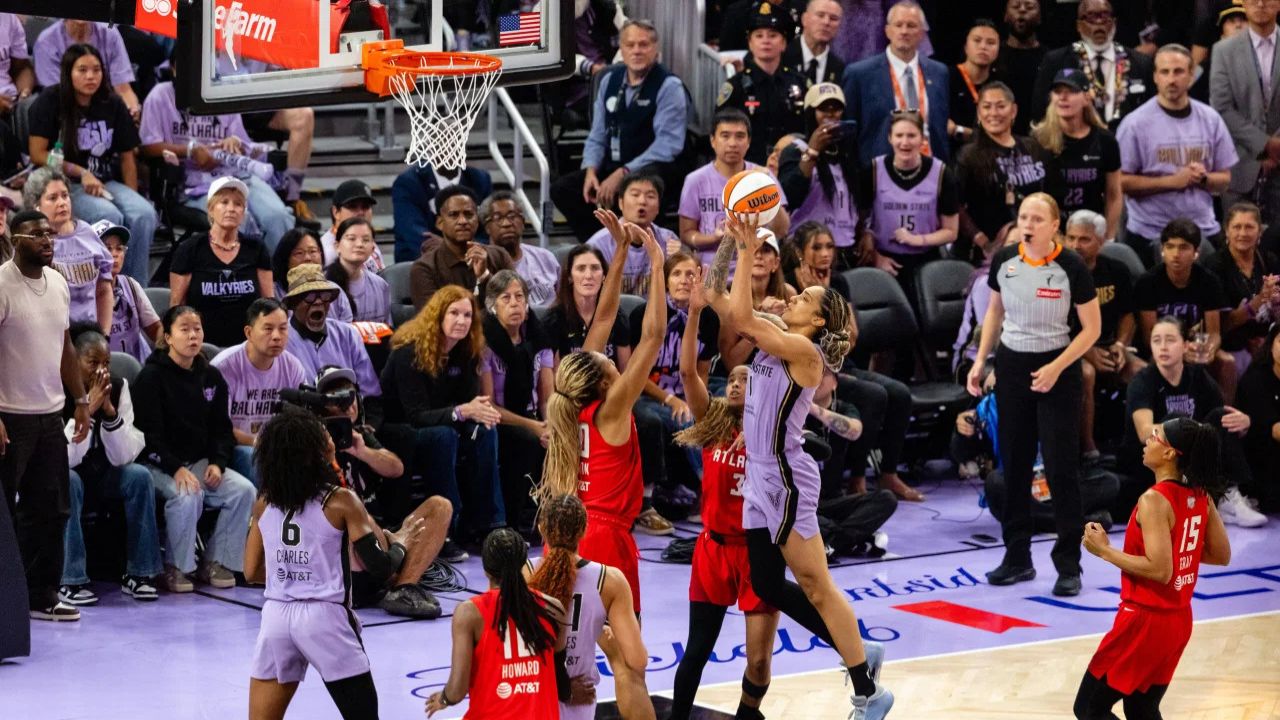
The WNBA Finals delivered a historic Game 7, but Terrell Owens was not among the thousands of fans who witnessed it in person. The former NFL star had extended his stay in San Francisco, hoping to watch the Golden State Valkyries face the Atlanta Dream. Even with his connections, he could not secure a seat and had to settle for watching on television.
Watch What’s Trending Now!
Speaking on Wednesday’s episode of the Get To The Point podcast, Owens described how the whole saga unfolded in a city where he spent eight years of his career with the San Francisco 49ers.
“I could not get a ticket to the WNBA Finals in San Francisco,” Owens said. “I had an appointment up in the Bay Area, so I extended my stay. And I found out that Game 7 of the Finals was going to be in San Francisco. I’m in San Francisco, where I played for eight years. Gave my heart, sweat, tears to that city. Get a ticket. And I tried to call my connections. But yeah, I ended up watching the game on TV.”
Terrell Owens actually began his legendary NFL career with the San Francisco 49ers, playing for the team for eight seasons from 1996 to 2003. The 49ers selected him in the third round of the 1996 NFL Draft. Over the course of his extensive tenure in San Francisco, he developed into one of the league’s most dominant wide receivers, accumulating 592 receptions, 8,572 receiving yards, and 81 touchdowns with the franchise before being traded to the Philadelphia Eagles in 2004.
Since he was already in the city where he had spent a significant part of his professional career, Owens believed getting a ticket would be relatively easy, especially given his connections in the Bay Area. According to him, he had attended basketball games in Los Angeles, Atlanta, and Orlando before, so he expected to find a way into the Finals.
In his effort to secure a ticket, Owens reached out to several people, including someone connected to the Valkyries organization. He also contacted former Golden State Warriors player Festus Ezeli, whom he had run into at a restaurant the night before. However, despite all his efforts, Owens never received a ticket and had to watch the game on television instead.
While it certainly felt like a disappointing experience for Owens, Chris Spencer, who was hosting the podcast alongside him, thought it was also an incredible testament to the immense growth, popularity, and exploding market value of the WNBA. And of course, that is indeed a fact.
In fact, beyond the pull of a title-deciding game, Chase Center was always going to be a packed house. The Valkyries have sold out every single regular-season and playoff home game in their entire franchise history.
And yes, that Finals matchup also ended up setting a number of viewership records, meaning millions of fans like Terrell Owens were also watching the game on television.
Dream-Valkyries WNBA Finals Game 7 Becomes Most-Watched Playoff Game in League History
Game 7 of the WNBA Finals between the Atlanta Dream and Golden State Valkyries ended up becoming the most-watched playoff game in the history of the WNBA. The game drew an average of 3.3 million viewers across USA Network, CNBC, and Peacock. This broke a 27-year-old postseason record previously held by Game 3 of the 1999 WNBA Finals, which averaged 3.25 million viewers.
Across nearly 30 years of league history, the game also ranks second overall since the league’s inaugural opening weekend in 1997, trailing only a highly anticipated regular-season game between the Indiana Fever and Chicago Sky earlier in August, which averaged 3.31 million viewers. It also turned out to be the most-watched WNBA game in cable television history.
Compared to the 2025 title-clinching game, viewership for this year’s Finals grew by 128%. It also beat out all competing college football programming on that Saturday to become the day’s top cable program.
For a league that spent years fighting for this kind of attention, a Game 7 that millions watched, and that even a celebrated former 49er could not get into, is the clearest sign yet of how far the WNBA has come.