
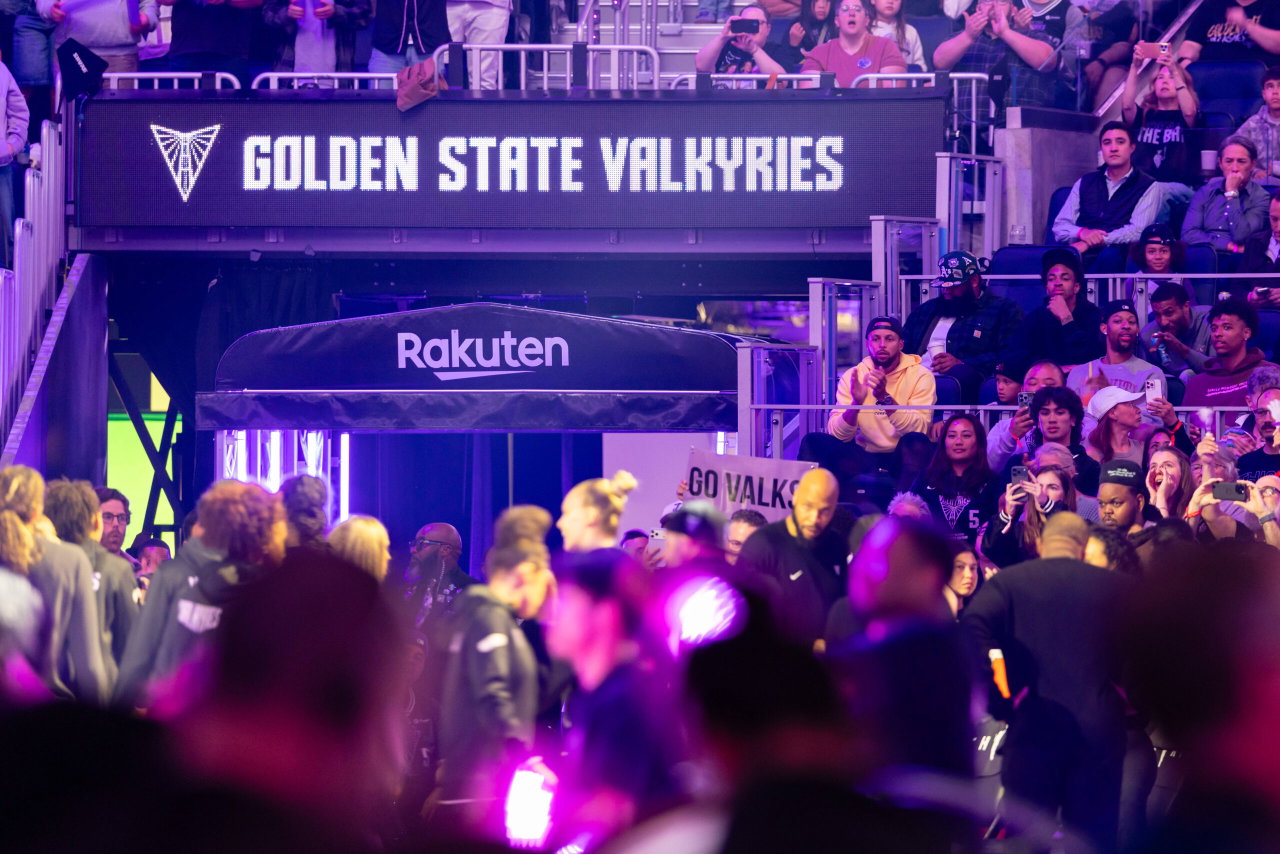
In October 2023, Joe Lacob made a bold promise about a basketball team that had yet to play a single game. The Golden State Warriors owner said his new WNBA franchise would win a championship within its first five years. At the time, the Golden State Valkyries were still months away from assembling their inaugural roster, and nobody knew how quickly the team would find its footing in the league.
Watch What’s Trending Now!
The early signs were encouraging. More than 2,000 season-ticket deposits reportedly came in within hours of the expansion announcement, even before the franchise had settled on its name, logo, and colors. Nearly three years later, the Valkyries have given fans plenty of reasons to believe in the project, both on the court and in the front office.
In just their second season, the Valkyries have reportedly generated $100 million in regular-season revenue, becoming the first WNBA franchise to reach that mark and, according to Boardroom, the first women’s sports team to generate that much annual revenue. They have also taken a 2–0 lead over the defending champion Las Vegas Aces in the semifinals, putting them one win away from their first WNBA Finals appearance. As team president Jess Smith explained to Sportico, “Last year wasn’t a movie premiere. It was really step one.”
The achievement is striking, but the story goes beyond a single financial milestone. Golden State generated $78 million in revenue during its inaugural 2025 season. Its reported $100 million in 2026 regular-season revenue represents an increase of roughly 28%, before any additional postseason revenue is counted. And the organization has reached that point while building a team that has improved from a first-year playoff qualifier into one of the league’s strongest contenders.
How the Valkyries Built a $100 Million Business
The Valkyries’ financial growth has been backed by a mix of ticket demand, corporate partnerships, and the resources available through their connection to the Warriors organization.
The franchise has secured more than 40 corporate partners, including JPMorgan Chase, Rakuten, Sephora, United Airlines, Kaiser Permanente, and CarMax. Those agreements span financial services, retail, travel, healthcare, and other industries, giving the organization a broad commercial base rather than relying on a single category of sponsor.
The team’s ticketing numbers tell a similar story. Golden State sold out all 22 regular-season home games in both 2025 and 2026, while its season-ticket allocation reportedly grew from 10,000 to 12,000 before sales were capped. That decision also allowed the organization to preserve inventory for individual games, groups, and corporate partners.
The demand extends beyond the most expensive seats. Reported courtside prices for the 2026 regular season ranged from $300 to $1,500, depending on the game and seat location, while some upper-level seats were available for considerably less. The distinction matters: the premium prices show that certain customers are willing to pay for the experience, but they do not mean every fan is paying hundreds of dollars to attend.
Across their first two regular seasons, the Valkyries recorded 44 home-game sellouts and cumulative attendance of 794,816. Their sellout streak has since extended to 47 consecutive home games when postseason contests are included.
That level of demand gives the franchise a strong base to build on. But filling an arena is only one part of the business. The next question is how the organization has turned that interest into a commercial operation capable of generating revenue at this scale.
The Strategy Behind the Growth
Smith has made it clear that the organization did not intend to treat its inaugural season as a one-time burst of excitement.
“We kept our foot on the gas as if we were continuing to build in year one, and put a strategy forth to make sure that we were living up to the potential that the market was showing us,” Smith said, per Sportico.
The franchise’s commercial approach includes a dedicated sales and partnership team, alongside access to the Warriors’ established business infrastructure. Its home at Chase Center also puts the Valkyries in a major corporate market, giving the organization opportunities to pursue partnerships and premium hospitality sales that may be harder to secure in smaller markets.
Those advantages are important context when considering the revenue figure. The Valkyries are not operating in isolation from an established NBA organization, and their results should not automatically be treated as a template for every WNBA team. Their access to a major arena, corporate relationships, and dedicated commercial staff gives them a particular set of resources.
Still, the numbers suggest that the organization has found an audience willing to support it. Smith has also spoken about the difference between the team’s first and second seasons, particularly the way fans have embraced the franchise.
“When we launched our brand and introduced this team to the world last year, the reception was amazing. But seeing how our fans have shown up in year two has been special,” Smith said. “We didn’t think it was possible, but they brought even more passion, energy, and sense of community this season. We can truly feel that this culture is built for the long haul.”
The challenge now is to sustain that interest. Sellouts and sponsorships provide a strong foundation, but the franchise’s longer-term success will depend on maintaining demand, managing costs, and continuing to give fans reasons to return.
And that brings the story back to the basketball court, where the Valkyries have given the organization another reason to believe its second season can be even bigger than its first.
From First-Year Playoff Team to Finals Contender
Golden State’s rise has not been limited to its business operations. The Valkyries finished their inaugural 2025 regular season with a 23–21 record and became the first expansion team in WNBA history to reach the playoffs in its debut season. They were eliminated by the Minnesota Lynx in the first round, but the experience gave the team a foundation to build on.
Under head coach Natalie Nakase, the Valkyries improved to 32–12 in 2026, earning the No. 2 seed in the playoffs. They advanced past the Dallas Wings before opening their semifinal series against Las Vegas with a 71–60 victory.
Game 2 offered a far tougher test. Golden State built a 17-point lead, only for the Aces to fight their way back into the contest. Las Vegas eventually took a 76–74 lead with 1:36 remaining, putting the defending champions in position to steal a game on the road.
Instead, the Valkyries responded when the pressure was highest.
Gabby Williams tied the game at 76, setting up Veronica Burton’s decisive three-pointer. With 41.5 seconds remaining, Burton knocked down a shot from beyond the arc to put Golden State ahead 79–76. Las Vegas continued to threaten, but the Valkyries held on for an 83–81 win.
Tiffany Hayes led Golden State with 21 points off the bench, while Williams added 20 points and five rebounds. Kayla Thornton contributed 16 points. For Las Vegas, A’ja Wilson finished with 24 points, but the Aces could not complete their comeback.
The final possession captured just how narrow the margin was. Jackie Young made one free throw with 5.9 seconds left, then deliberately missed the second in an attempt to create another scoring opportunity. Chelsea Gray collected the rebound and tried to tie the game at the basket, but Kiah Stokes blocked her shot with 1.3 seconds remaining.
Burton, whose three-pointer had given Golden State the lead, helped secure the ball as time expired.
Reflecting on the shot that changed the game, Burton said, “I was just saying I had to do something out there. I appreciated Gabby trusting me in that moment, obviously a big moment… the second one I knew that had to go up.”
The sequence showed how quickly a seemingly comfortable lead can disappear in the playoffs. It also showed that Golden State could find a response when its advantage was gone and the defending champions appeared ready to take control.
The $130 Million Question
The Valkyries’ postseason run could add another dimension to an already remarkable financial year.
Sportico has projected that the franchise’s gross revenue could exceed $130 million if it reaches the WNBA Finals. That is a projection, not a guaranteed total, and postseason gate receipts are subject to league revenue-sharing arrangements. The figure should therefore not be confused with the amount the franchise would ultimately retain.
It is also important to separate revenue from profit. The Valkyries’ reported $100 million represents money generated by the business, not $100 million in earnings for its owners. The franchise’s operating expenses and profit margins have not been publicly established in the reporting cited here.
Even with those qualifications, the scale of the reported revenue is notable. The organization has moved from a $78 million inaugural season to a $100 million regular season while its basketball team has improved from a first-round playoff exit to a semifinal series lead over the defending champions.
Golden State now heads to Las Vegas with a chance to finish the series on Friday. The Aces will have home-court advantage and will be fighting to keep their title defense alive, so the Valkyries cannot afford to assume the job is done.
Lacob’s five-year championship target remains ahead of them, but the franchise has already made significant progress toward it. The business has reached a historic revenue mark, the fanbase has continued to show up, and the team is one win from the Finals in its second season.
Whether Golden State closes out the series or has to return to San Francisco for another game, its next step will be watched closely. A Finals appearance would give the Valkyries another major achievement to add to their rapid rise, while potentially pushing their reported annual revenue even higher.
For a franchise that did not exist three years ago, that is a remarkable position to be in.