
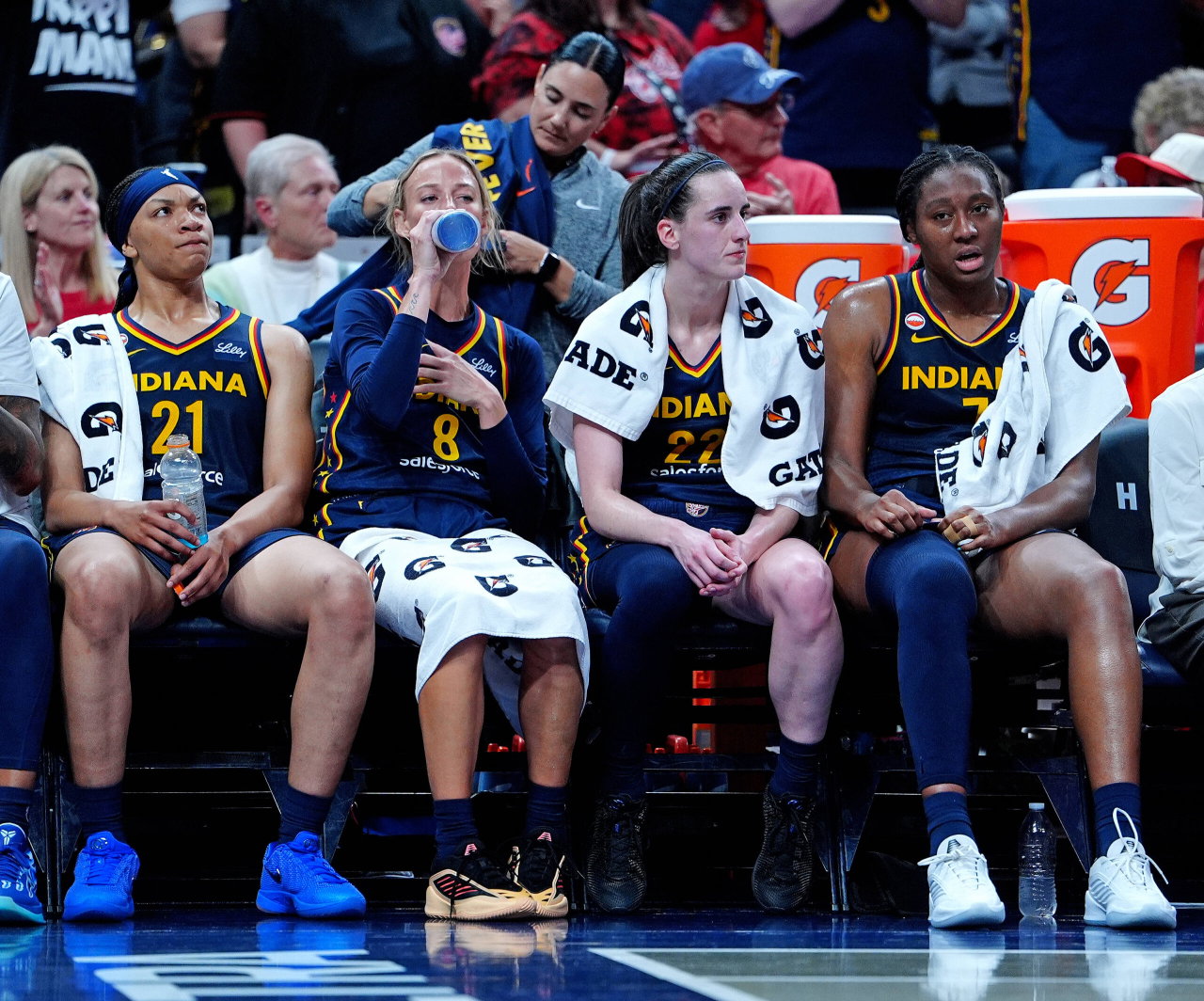
The WNBA’s biggest challenge might not be finding new stars, but keeping viewers invested when the most recognizable figures are no longer competing. With Caitlin Clark, Sophie Cunningham, and the Indiana Fever eliminated from the WNBA playoffs, a New York State Broadcasters Association’s Hall of Fame broadcaster is questioning whether the league can maintain its growing audience, with the seven-game Finals set to begin on Oct. 17, where Angel Reese will be the face of the league.
Watch What’s Trending Now!
“Isn’t that everything that Cathy Engelbert, the outgoing commissioner of the WNBA, has always wanted, proving to the world that the league does not need Caitlin Clark or Sophie Cunningham to prove its popularity,” Craig Carton said during a segment on his Craig Carton Show, which was later clipped and posted to X.
“Last week, only about half a million people watched the Atlanta Dream play in their series against the New York Liberty. Why is it that nobody cares? Because the most popular players aren’t in it… Wouldn’t it be better for the league if the more popular players were actually in the league? But this is the manifestation of Angel Reese, and this is the manifestation of the WNBA. This is exactly what they wanted. Now they got to sleep in it.”
Carton noted that he did not want the league to rig the results and that he believed that “the best team should win.” However, his argument does have some ground to stand on.
Indiana saw some of the league’s top TV viewership during their only playoff series. Their Round 1 matchup against the Las Vegas Aces recorded over a million viewers in each of their three games. During the decisive Game 3, the broadcast averaged 2.25 million viewers, the most-watched game of the round. It peaked at about 2.7 million viewers around 11:15 pm ET, almost 93% more than the Fever’s first-round deciding Game 3 last season against the Atlanta Dream.
Game 3 marked the highest average viewership for a WNBA playoff game since 2024, a record that also involved the Fever. Moreover, the three games of the series were the most-watched of the four matchups in Round 1.
Games 1 and 2 saw averages of 2.1 million and 1.42 million viewers. What makes this accomplishment even more impressive is the fact that each game was broadcast on a different network, showing audience interest despite the setting.
This pattern was something already established in the regular season. The July 12 game between the Fever and Aces drew 2.64 million viewers, peaking at 2.8 million viewers from 10:30-10:45 p.m. ET.
The Semifinals viewership, however, was notably lower. According to data from Sports Media Watch, Game 1 of the series opener between the Atlanta Dream and New York Liberty drew an average of 1.2 million viewers, while the other side of the bracket between the Golden State Valkyries and Las Vegas Aces logged about 1.12 million average viewers.
However, unlike Carton noted, there was significant success to be seen during the semifinals broadcast. The double-header on October 4 featured Game 1 of each series and became the second- and third-most-watched semifinal openers in league history, behind last year’s Fever-Aces matchup,
On top of that, it must be noted that Carton’s claim that only half a million people were watching the series between Atlanta and New York is wrong, since that game drew 1.17 million viewers. Regardless, what matters now is whether the Valkyries and the Dream can sustain good viewership numbers. The series will be broadcast on three networks: NBC, USA Network, and Peacock.
To be fair, the league has already proven that it can draw viewership to the Finals without Clark or the Fever. Last season, the WNBA Finals between the Aces and the Phoenix Mercury, which was broadcast on ABC and ESPN, drew about 1.5 million viewers on average.
Carton seems to believe that the league’s future visibility is bleak, suggesting that the WNBA might stop becoming part of the broader sports conversation if the headlines continue to be about the surrounding off-court chatter rather than the basketball they play.
However, judging by the existing viewership numbers, that hasn’t become an issue yet, and the WNBA Finals could end up being the benchmark for how much attention the league can draw without two of its most recognizable players.